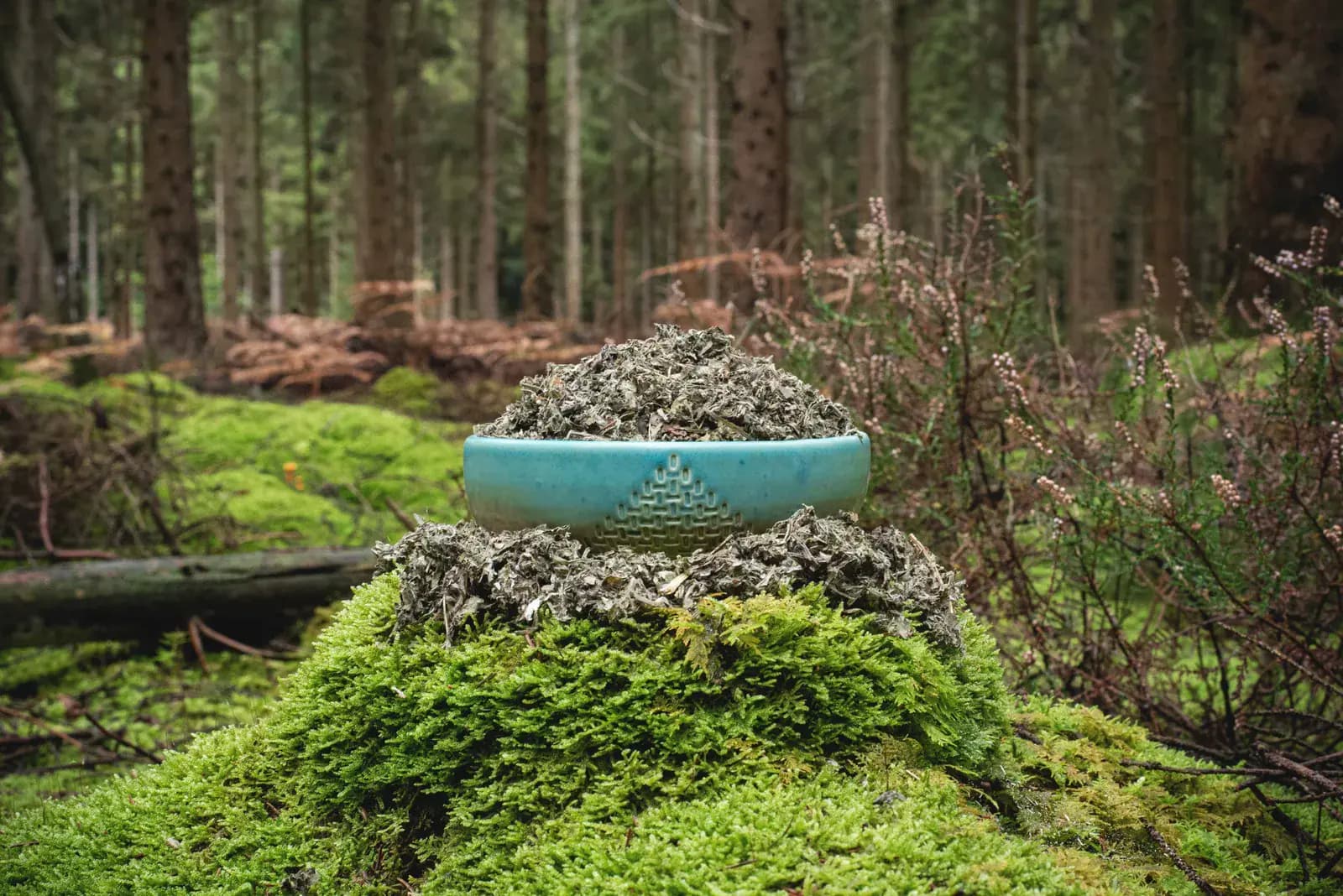
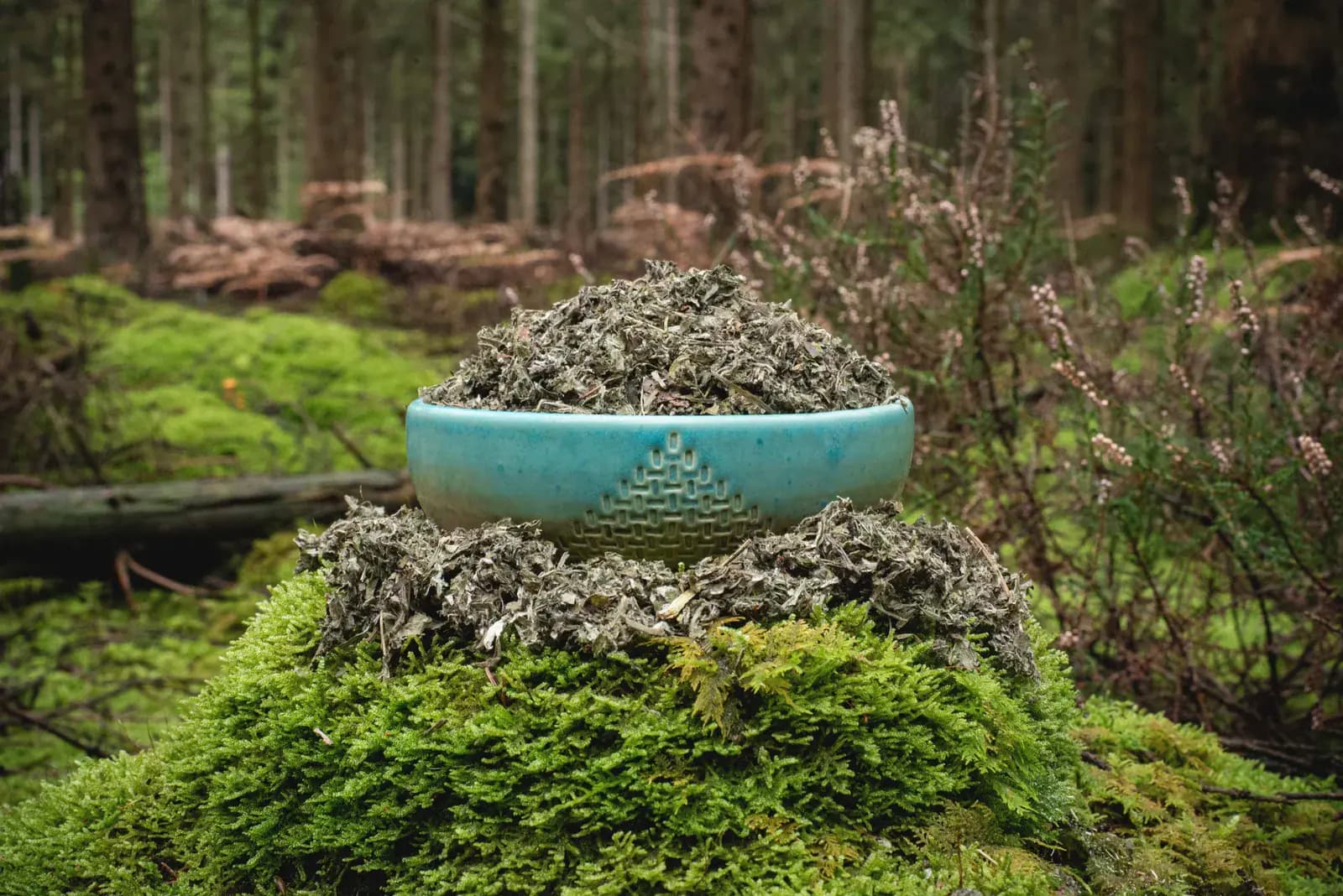
Mugwort
Herb of the Sacred Feminine
from €7.00
Wreaths set on the river, couples leaping the fire hand in hand, a fern flower sought in the night: the Slavic midsummer night, from the Vistula to the Dnipro.
A wreath of field flowers goes down the river.
If the beloved fishes it out, a great love and a happy wedding are on the way; if it catches in the weeds, the girl will not marry this year, so the Polish tradition went.
Herb of the Sacred Feminine
from €7.00
« Very satisfied with my order. The herbs are of high quality, and the shipping was fast and careful. I recommend this shop for its professionalism and the purity of its products. Thank you! »
« Quick delivery. Serious seller. Already has its effect just by being in the hand... »
Around the solstice, on Monday 21 June in 2027; St John's Eve, from Wednesday 23 to Thursday 24 June, as in Poland and Czechia; or the night of 6 to 7 July, where Ivana Kupala follows the Julian calendar.
Field flowers and the day's herbs, gathered before sunrise as in Ukraine, with a few sprays of mugwort woven in.
On a river, a lake or a pond, with a lit candle as in Ukraine. There, a wreath that drifted towards the beloved's house meant a wedding.
At home, a few loose dried leaves on a glowing charcoal, in a dish that holds the heat, window ajar. The ember goes right out before you leave the room.
The Czech way: nine kinds of flowers picked on St John's Eve, woven into a little wreath and slipped under the pillow, to dream of the one who is coming.
Kupala Night has three dates, and each tradition keeps its own. The first is the summer solstice: in 2027 it falls on Monday 21 June, at 3.10pm BST in the UK (Timeanddate). In Poland, the cultural anthropologist Ewelina Kostrzewska (University of Łódź) distinguishes a pre-Christian Kupala Night, held around the solstice, from St John's Eve, a few days later, on the night of 23 to 24 June, in memory of John the Baptist. Today the two run together.
In Ukraine, the Nativity of John the Baptist falls on 24 June in the Julian calendar, which in the 20th and 21st centuries is 7 July in the Gregorian calendar, and the Kupala rites begin the evening before: hence the night of 6 to 7 July. Since the calendar reform of 2023, the Orthodox Church of Ukraine and the Ukrainian Greek Catholic Church keep the Nativity of John on 24 June (Encyclopedia of Modern Ukraine).
| Where | The night | In 2027 |
|---|---|---|
| Poland | Noc Kupały, also sobótka, around the solstice; noc świętojańska, St John's Eve, 23 to 24 June | solstice on Monday 21 June; St John's Eve from Wednesday 23 to Thursday 24 June |
| Ukraine | Ivana Kupala, the night of 6 to 7 July in the Julian tradition; the Nativity of John on 24 June for the two Churches on the new calendar | Tuesday 6 to Wednesday 7 July; 24 June is a Thursday |
| Czechia | Svatojánská noc, St John's Eve, 23 to 24 June (Ptejte se knihovny) | Wednesday 23 to Thursday 24 June |
In the UK, 24 June is also Midsummer's Day, one of the four Quarter Days (Royal Museums Greenwich).
The name is older than the saint's day. The Encyclopedia of Modern Ukraine most often links it to Kupala, a pagan god of the fruits of the earth. Scholars first derived it from that god, then from the ritual bath, kąpiel, that was obligatory that night (Musiał, 2018, p. 19).
In Ukraine, Kupala is also a figure. In parts of the Chernihiv, Sumy and Poltava regions, girls made a Kupalo of straw, sometimes of clay, and burned or drowned it when the feast was over. The tree decked with ribbons, wreaths and flowers, most often a willow, sometimes a cherry, went by the names kupailo and kupailytsia (Encyclopedia of Modern Ukraine).
One of the oldest written traces is in the Galician-Volhynian Chronicle, under the year 1262: “канунъ Ивана дни, на самые Купалья”, the eve of John's day, on Kupala itself (National Historical Library of Ukraine).
In Poland, women wove their wreaths from field flowers and herbs. If the beloved fished one out, it foretold a great love and a happy wedding; if it caught in the waterweed, the girl would not marry within the year (University of Łódź). Towns made a festival of it. A poster kept by the National Archives in Kraków announces wianki on Na Groblach Square, near Wawel Castle. In Przemyśl, on 29 June 1927, a procession of decorated boats came before the wreaths, and the evening ended with dancing on a floating platform (State Archives in Przemyśl). Wreaths still go down the Vistula in Warsaw today.
In Ukraine, the girls took the wreaths off the Kupala tree and set them on the water with lit candles. A wreath that drifted towards the beloved's home meant a wedding; one that stood still or turned on the spot, a lad only teasing; one that sank was a bad sign, and everyone ran home in fright (Encyclopedia of Modern Ukraine). The flowers were picked before sunrise: thyme, lovage, marigolds, larkspur, cornflowers, with nettle and wormwood woven in against the evil spirits and witches said to rage that night. The National Historical Library of Ukraine counts twelve flowers in the Ukrainian wreath, each one a charm.
The fires were lit near the water, and in Poland they were themselves called sobótki. Couples leapt over them holding hands, and a good leap promised a happy match (University of Łódź). In Ukraine, the lads made a living fire by rubbing one dry branch against another. A couple who kept hold of each other's hands above the flames would marry happily; singed clothes boded ill for married life (Encyclopedia of Modern Ukraine). Near Rzeszów, Oskar Kolberg noted in the 19th century that tarred barrels were set alight and sent down the river (Ethnographic Museum in Rzeszów).
Herbs went into the fire and into the water that night: St John's wort, chamomile, lady's mantle, thyme and mugwort, lists Kamila Musiał in her study of the plants of old Slavic belief (Rozprawy Społeczne, 2018, p. 19). Mugwort, bylica pospolita in Polish, Artemisia vulgaris, was held to be a magic herb. Marcin of Urzędów wrote that it was used at the Sobótki fires as an offering to the devil, and people danced around those fires girded with nothing but sprays of mugwort. Gustawicz, in 1882, called it a precious herb, since it did not grow by every house, kept against evil spirits and spells, and against the spirits that raise storms. Lady's mantle went into the little wreaths set on the water; dried, those wreaths were laid on the coals to smoke the whole farmstead and call the rain.
Jan Kochanowski put mugwort into poetry. In his St John's Eve Song about Sobótka, printed in 1586, the fire is lit at Czarnolas and twelve girls rise to dance, “jednako ubranych / I belicą przepasanych”, dressed alike and girded with mugwort (Wolne Lektury).
The girdle has a medieval name as well. Maud Grieve writes that the plant was known as Cingulum Sancti Johannis, St John's girdle, from the belief that John the Baptist wore a girdle of it in the wilderness, and that a crown of its sprays was worn on St John's Eve against evil (A Modern Herbal, 1931).
St John's wort, Hypericum perforatum, the chief herb of that night for Musiał and still called ziele świętojańskie, St John's herb, in Polish, is one we do not sell; nor thyme, nor lady's mantle.
The flower nobody finds. In Polish lore it blooms for a brief moment, with a blaze so strong it is hard not to look away, and brings luck and plenty (University of Łódź). In Ukraine, evil spirits guard it; whoever wins the fiery flower will know everything, grow rich and happy, and understand the speech of birds and beasts (Encyclopedia of Modern Ukraine). In Czech lore, the earth gave up its treasures that night, and a magic fern glowing gold was needed to find them (Ptejte se knihovny).
Ferns bear no flowers. Musiał offers a botanical clue: moonworts (Botrychium) and adder's-tongues (Ophioglossum), sometimes called flowering ferns, carry their spores in dense clusters on long stalks that look like bunches of flowers. In the dark and on wet ground, the search was hard, but not hopeless.
In Czechia, the same night bears St John's name: svatojánská noc. The lads leapt the St John's fires; that evening the girls picked nine kinds of flowers, wove them into a wreath and put it under the pillow, hoping to dream of their future husband (Ptejte se knihovny, the answer service of the Czech libraries).
Other nights for dreaming the future, from St Agnes' Eve to Hallowe'en: prophetic dreams. The herbs and flower water of 23 June across Europe: St John's Eve herbs.
Mugwort: avoid during pregnancy and breastfeeding; take care with an allergy to the daisy family. On charcoal, keep the window ajar and the dish away from curtains, out of reach of children and pets; if you have asthma, avoid the smoke. St John's wort is not sold by INFUSE. It weakens the effect of many medicines, including the contraceptive pill and implants (MHRA) and some antidepressants, and in large doses or on the skin it can make the skin react to sunlight (NCCIH); talk to your doctor or pharmacist before taking it. Our plants are freely sold in France and the European Union; the law varies from country to country, so check your local laws before ordering.
It is the Slavic feast of the summer solstice, which in Poland and Ukraine became one with the eve of St John the Baptist. Fires are lit by the water and leapt over, girls set wreaths of field flowers on the river and read their fortune in them, and the bravest look for the fern flower that night. Mugwort runs through the whole night.
Three dates, depending on the tradition. The solstice falls on Monday 21 June 2027. St John's Eve, kept in Poland and Czechia, runs from Wednesday 23 to Thursday 24 June. In the Ukrainian Julian tradition, Ivana Kupala is the night of Tuesday 6 to Wednesday 7 July.
The name of the feast, and in Ukraine also a figure: a Kupalo of straw, sometimes of clay, that girls burned or drowned after the feast. The name is most often traced to Kupala, a pagan god of the fruits of the earth; scholars have also linked it to the ritual bath, kąpiel, taken that night.
Its rites come from the pre-Christian solstice feast: fire, water, wreaths, herbs. The Church joined them to the Nativity of John the Baptist, and for centuries it condemned them; they held on, and the feast took the name Ivana Kupala (Encyclopedia of Modern Ukraine). Today the two names live side by side.
In Ukraine, they weave wreaths and set them on the water, couples leap the fire hand in hand, a Kupala tree is decked with ribbons and flowers, songs are sung in round dances and festive dishes are cooked (Encyclopedia of Modern Ukraine). In Poland, wreaths still go down the Vistula in Warsaw. In Czechia, girls once slipped a wreath of nine flowers under the pillow to dream of their future husband.
Mugwort, worn as a girdle and thrown into the fire, and St John's wort, in flower at that time. In Poland also thyme, lady's mantle and chamomile; in Ukraine the flowers of the wreath, such as lovage and cornflowers, with nettle and wormwood against the witches. Of these, we sell mugwort.
They began as two feasts: Kupala Night around the solstice, St John's Eve on the night of 23 to 24 June, in memory of John the Baptist. In Poland the two names are now used interchangeably (University of Łódź). In Czechia the night is simply svatojánská noc, St John's Night.
OTHER INTENTIONS · Ritual