
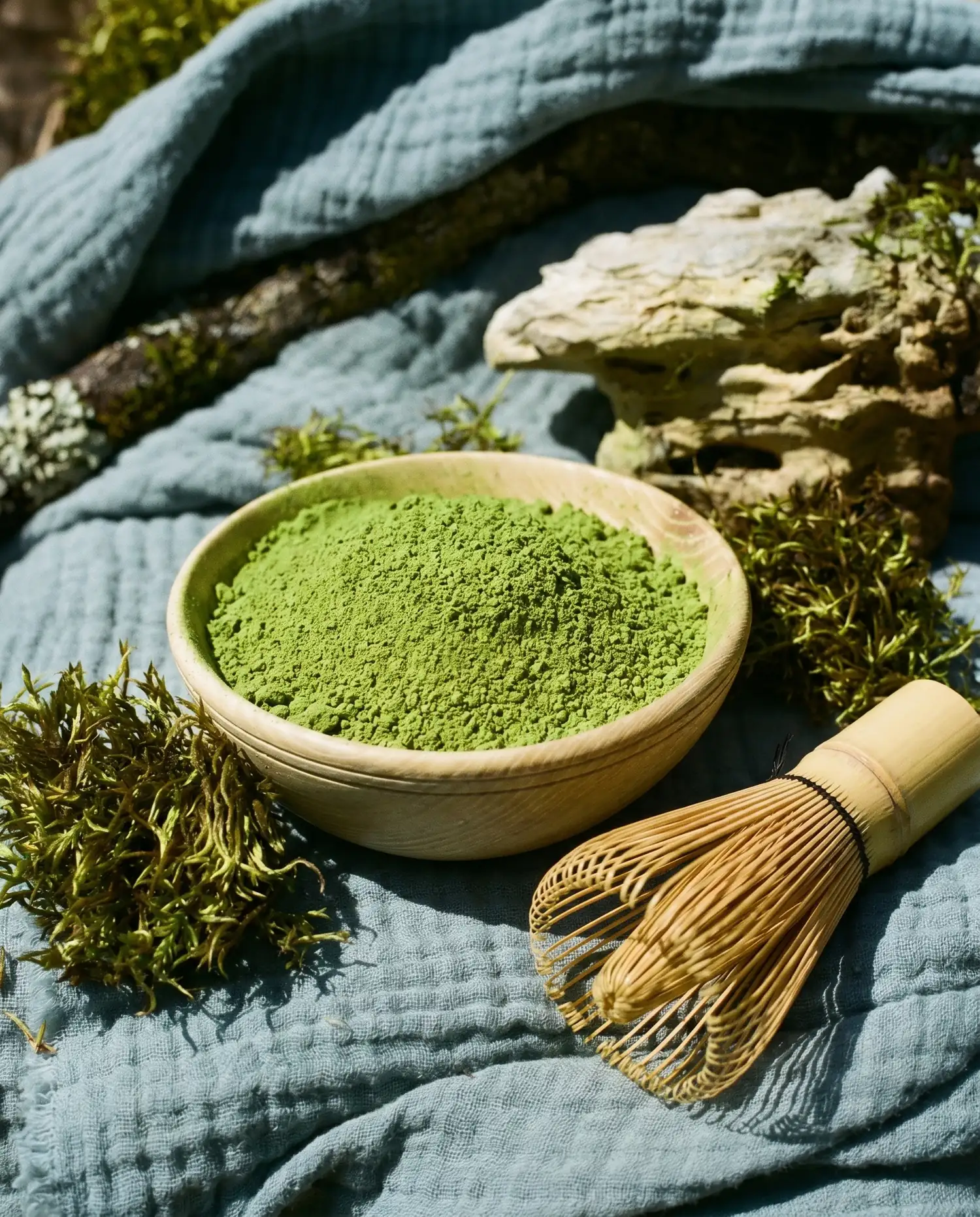
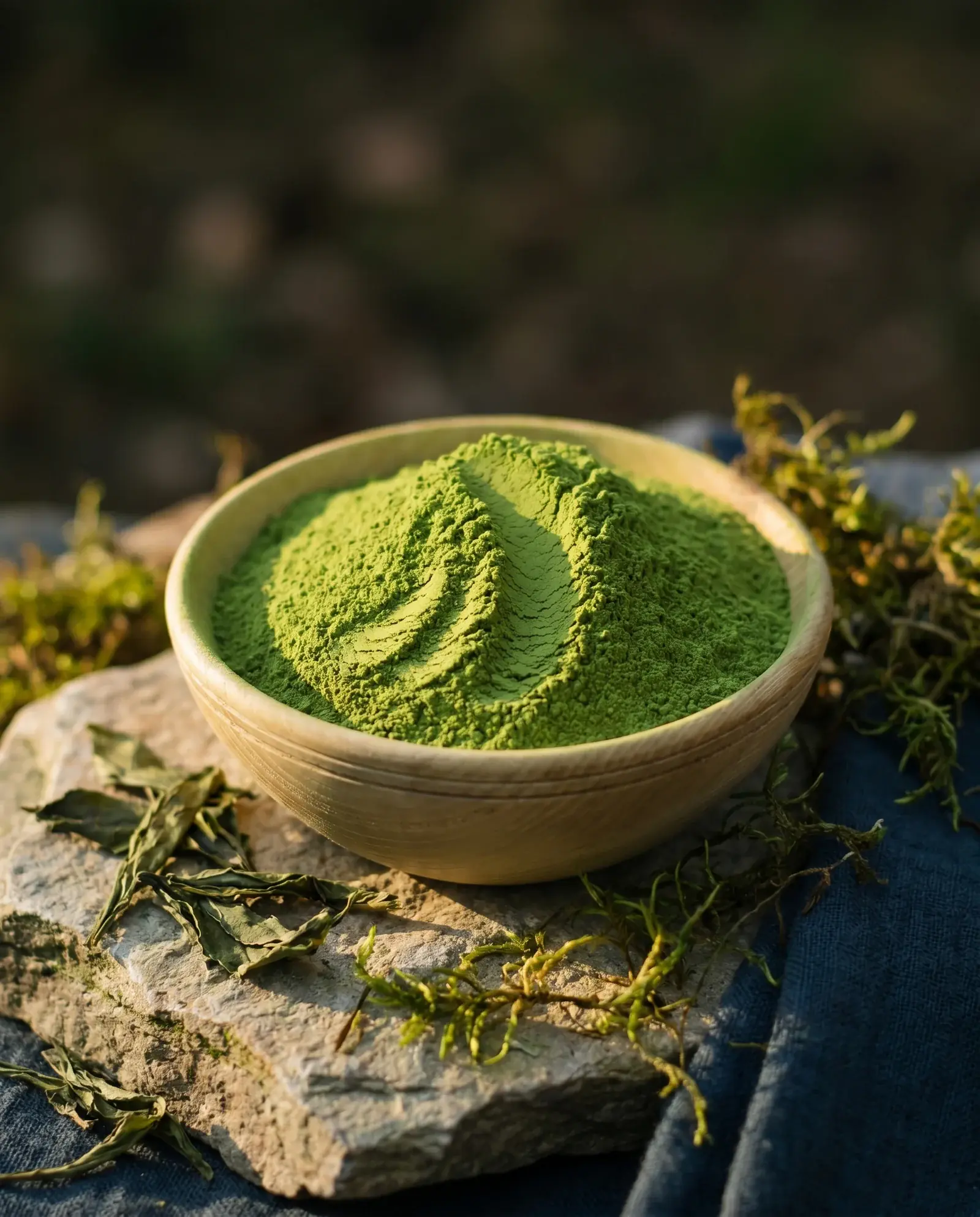
Out of stock
Matcha
The Clear Waking
€12.00
In Japan, a host whisks a bowl of matcha for a few guests: the garden path, the low door, the bowl passed from hand to hand, and what the tradition asks of each person.
In Japan, the tea ceremony is called chanoyu, hot water for tea.
A little hot water in the bowl, swirled and poured away. The tea goes into a bowl that is already warm.
Half a teaspoon to a teaspoon of matcha, 1 to 2 g, sifted into the bowl, so the powder stays fine and free of lumps.
A little water at 70-80 °C, never boiling, then the bamboo whisk in a zigzag until a fine foam forms, with no large bubbles. Drink it straight away, before the powder settles.
For a guest, the host turns the front of the bowl, its finest side, towards them. In Japan the guest turns it in turn, out of modesty, so as not to drink from the front.
The Japanese tea ceremony is the art of preparing and offering a bowl of matcha, powdered green tea, to guests. In Japanese it is chanoyu, hot water for tea, or chado, the way of tea. The Urasenke school puts it simply: host and guest spend time together over a bowl of matcha; the host aims to serve an unforgettable bowl, the guest responds with thankfulness, and both know the time they share can never be repeated.
The two words are not quite the same. The historian Asao Kōzu calls chanoyu the gathering itself, and chado the training and practice that grew out of it. The tradition names four principles, harmony, respect, purity and tranquillity: wa, kei, sei, jaku.
The simplest form is a bowl of thin tea and a sweet. The fullest is the chaji: a few guests, a meal, thick tea and then thin tea (Omotesenke). The Japanese Tearoom at Washington and Lee University describes the order:
A complete chaji can last three to four hours, according to the same tearoom.
Sen no Rikyū, the sixteenth-century tea master, was once asked what the way of tea entails. He answered with seven rules, still passed down today (Urasenke):
The questioner found these rules rather simple. Rikyū replied that he would become the disciple of anyone who could carry them out without fail.
A tea bowl has a front, often its finest decoration. The host sets it down with the front facing the guest; the guest, out of modesty, turns it so as not to drink from the front (Japan Tourism Agency). It is a utensil the guest always handles at a gathering, notes Urasenke. When the hearts of host and guests meet, the tradition speaks of ichiza konryū: a gathering built together.
| Utensil | What it does | A detail |
|---|---|---|
| Chawan, the tea bowl | Holds the tea and passes into the guest's hands | Winter bowls are often thick and deep to keep the tea warm, summer bowls often broad and shallow so it cools more quickly |
| Chasen, the whisk | Mixes the powder and the hot water | Carved from bamboo; its shape varies from one school to another |
| Chashaku, the scoop | Lifts the powder from its container | Often carved by the tea master, and given a name |
| Natsume and chaire | Hold the powder | A lacquered caddy for thin tea; for thick tea, a ceramic jar kept in a cloth pouch |
| Kama, the kettle | Heats the water over the fire | To host a tea gathering is to "hang the kettle", kama o kakeru |
Sources: Urasenke, tea utensils; Japan Tourism Agency.
| Usucha, thin tea | Koicha, thick tea | |
|---|---|---|
| Powder | About 1.8 g per bowl | About 3.75 g per person |
| With the whisk | Whisked to a fine foam, no large bubbles | Kneaded to a thick, smooth tea |
| The bowl | One bowl for each guest | One bowl shared by four or five guests |
| Its place | Usually served with a sweet | The heart of the chaji |
Both powders are made the same way and ground on a stone mill (Urasenke). Thick tea uses only the tips of the newest leaves from mature tea plants; thin tea comes from younger plants (Washington and Lee). What changes most is the preparation (Omotesenke).
Before the sixteenth century, tea masters drank mostly from refined bowls imported from China. By the early sixteenth century they had come to prefer the more rustic bowls from Korea, particularly the ido: some of today's most priceless tea bowls began as inexpensive dishes for daily use, notes the Japan Tourism Agency.
The critic Yanagi Sōetsu wrote famous pages on the most celebrated of them, the Kizaemon, in The Unknown Craftsman: a Korean rice bowl of coarse clay in which the tea masters saw the highest beauty. For Yanagi, their genius lay in their eyes more than in their hands. Rikyū was after the same thing: he found beauty among common utensils and had every guest crawl through the same low door, whatever their rank (Urasenke).
Under the Tang, tea in China was pressed into bricks, then boiled with ginger or salt. Under the Song, the leaves were steamed, dried and ground, and this powdered tea was used mainly in temples. The monk Eisai brought it to Japan in the twelfth century, on his return from study in China (Urasenke).
Three men made a way of it. Murata Shukō looked for beauty in simple things: he would rather see, he said, a moon partly hidden by clouds than a full moon on a clear night. Takeno Jōō simplified the tearoom. Sen no Rikyū (1522-1591) completed wabi tea, the beauty of restraint. His descendants founded the three Sen houses, Omotesenke, Urasenke and Mushakōjisenke, which still teach today.
The Japan Society in London keeps a list of practitioners who give tea ceremony demonstrations and workshops for schools, groups and events. Some work around London, others will travel anywhere in the UK; several practise in the Urasenke tradition.
Our matcha is a green tea grown in China and stone-ground, soft, vegetal and lightly umami. For a light bowl in the manner of usucha: 1 to 2 g of sifted powder, a little water at 70-80 °C, then the bamboo whisk in a zigzag until a fine foam forms.
Another tradition gathers around a shared cup: the cacao ceremony.
Matcha contains a substantial amount of caffeine, since you drink the whole leaf: take care if you are sensitive to caffeine or have high blood pressure or a heart rhythm disorder, and in the evening if your sleep is fragile. Pregnancy and breastfeeding: keep overall caffeine low and ask for advice. On an empty stomach and at high doses, tea may upset digestion or iron absorption, so drink it away from iron-rich meals. Our matcha is freely sold in France and the European Union.
The guests walk through the garden, rinse their hands at a stone basin and enter through a low door. In the full form, the chaji, the host lays the fire, serves a meal, then thick tea in a single shared bowl, and finally thin tea in a bowl for each guest. The short form is a bowl of thin tea and a sweet.
Matcha, for thin tea and thick tea alike. The tea bushes are grown shaded from direct sun, the young shoots are picked, steamed and dried without rolling, the stems and veins removed, and the leaves ground on a stone mill (Urasenke). For thick tea, only the tips of the newest leaves from mature plants are used (Washington and Lee).
To offer a few guests a bowl of tea that is good to drink, in a moment that will not come again. The host thinks of everything for them, the season, the flowers, the fire; the guests receive with gratitude. Urasenke calls it an art of living, guided by harmony, respect, purity and tranquillity.
A complete chaji, with the meal and both teas, can last three to four hours, according to the Japanese Tearoom at Washington and Lee University. In Paris, the Omotesenke demonstrations at the Maison de la culture du Japon last an hour.
White socks: the Maison de la culture du Japon in Paris asks its guests to bring a pair. At an Urasenke gathering, guests also bring a folded paper, kaishi, for the sweets, and a small cloth, fukusa.
Warm the bowl, sift 1 to 2 g of matcha into it, add a little water at 70-80 °C and whisk in a zigzag until a fine foam forms. To serve someone, turn the front of the bowl towards them.
OTHER INTENTIONS · Ritual