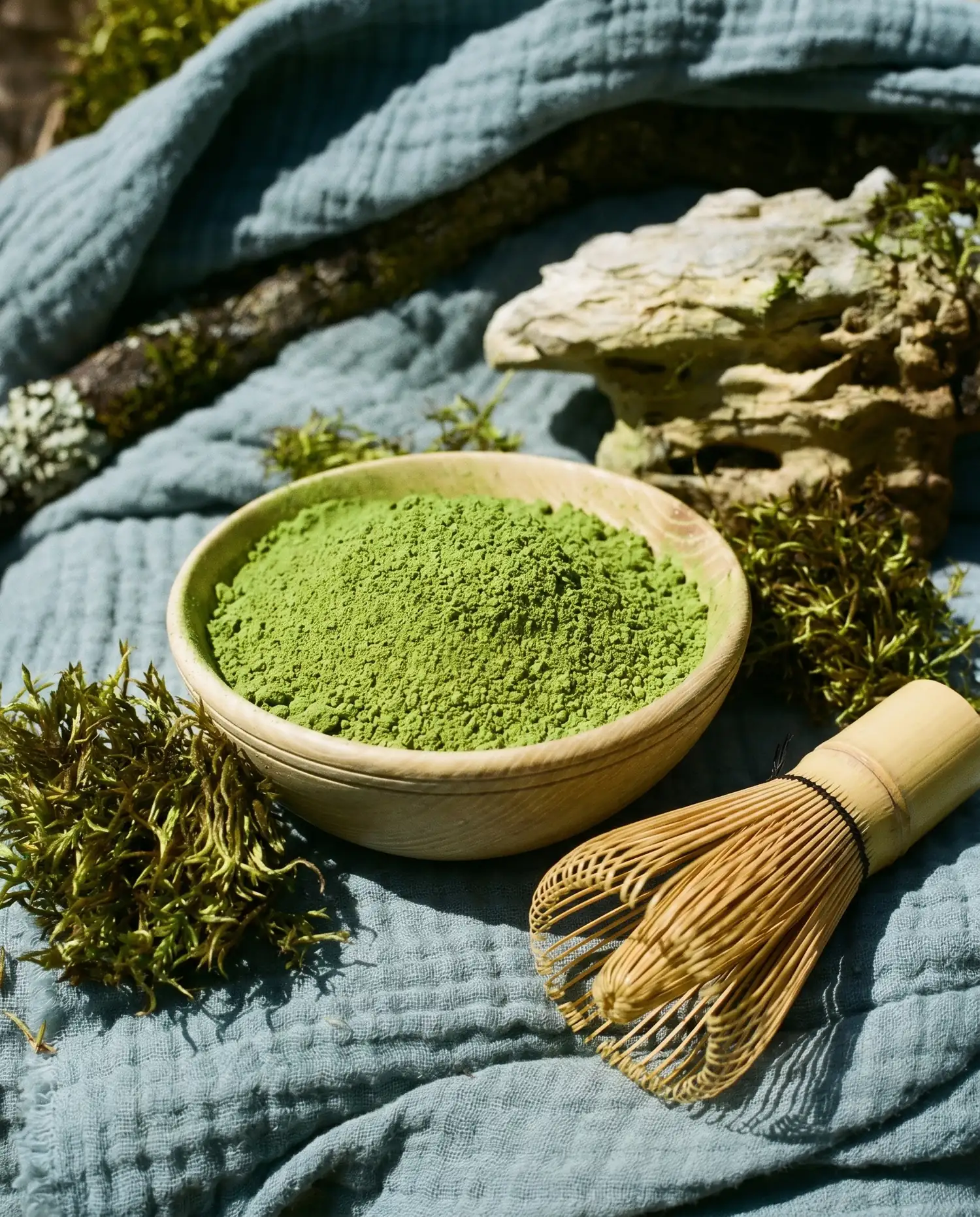
✦ Matcha · in one breath ✦
The whole shaded leaf — a calm vigilance the L-theanine holds without a peak.
⊹ The path of the plant
⊹ Community voices
What the community murmurs.
No testimony yet for this plant — nothing invented, nothing fabricated. If you have met it, your account can open the way for those who come after.
Ask the Forest about Matcha
408 books digested, 97,512 indexed passages. She answers on lineages, synergies, cautions, ritual variations.
⊹ FREQUENT QUESTIONS ⊹
We answer.
What is matcha?
Matcha is a green tea (Camellia sinensis) ground into a very fine powder. Unlike leaf tea, which you infuse then remove, matcha is mixed into the water and drunk whole — you consume the whole leaf, whisked into suspension. The tea bushes are traditionally shaded before harvest, which concentrates the chlorophyll and amino acids and gives matcha its vivid colour and softness.
Where does INFUSE's matcha come from?
Our matcha is grown organically in China. The culture of ground tea was born in China under the Tang dynasty before being brought to its ceremonial refinement in Japan; an organic Chinese matcha presents itself as it is, without imitating Japan. It is a matter of honesty: we state the real origin rather than borrow an imaginary that is not our own.
What is the difference between matcha and coffee?
Both contain caffeine, but the experience differs. In matcha, the caffeine is accompanied by L-theanine, an amino acid that modulates its absorption — many describe a calmer, longer alertness, without the abrupt peak or crash of coffee. It is clear awakening rather than a jolt. Matcha also brings antioxidant catechins.
How do I prepare matcha?
The traditional method: sift half to one teaspoon (1 to 2 g) of matcha into a bowl, pour a little hot water at 70-80 °C (never boiling, which makes it bitter), then whisk in a zigzag with a bamboo whisk (chasen) until a fine foam forms. You can also make it as a latte with warm plant milk. Without a whisk, a small electric frother or a shaker work.
When should I drink matcha in the day?
In the morning or early afternoon. Matcha contains caffeine; taken late, it can disturb falling asleep in sensitive people. The alertness it carries is diurnal and sustained. Many adopt it as an alternative to morning coffee, for its more regular awakening.
Does matcha have use precautions?
Matcha contains caffeine: caution in case of sensitivity, high blood pressure, heart rhythm disorders, and in the evening. During pregnancy and breastfeeding, caffeine intake should stay moderate — ask for advice. Consuming the whole leaf also concentrates the tea's compounds; at very high dose and on an empty stomach, it may disturb digestion or iron absorption. Do your own research (DYOR).
⊹ Chapter · Questions ⊹
Ask, answer, share.
One question, one answer — sometimes several voices. The community answers first; INFUSE steps in when it should.
Nobody has opened a thread yet about this plant. You can be the one — a real question, a use, a doubt, a detail.
Anonymous if you prefer.
In depthbotany · phytochemistry · history
### Botany and cultivation
Matcha comes from Camellia sinensis, the shrub from which all teas are made (green, black, oolong, white). What makes matcha is a precise route of cultivation and processing. A few weeks before harvest, the tea bushes are shaded (traditionally under racks or cloths): deprived of direct light, the plant increases its production of chlorophyll and amino acids, notably L-theanine, while reducing the bitterness of the catechins exposed to the sun. The youngest leaves are harvested, briefly steamed to stop oxidation (which keeps the green), dried, then stripped of veins and stems (the resulting matter is then called tencha), and this matter is slowly ground — traditionally between two stone wheels, turning gently so as not to heat or oxidise the powder.
### Descriptive pharmacology
Because the whole leaf is consumed, matcha concentrates the compounds of green tea. It contains caffeine, L-theanine (an amino acid associated with a state of alert relaxation, which modulates the perception of caffeine), catechins — above all EGCG (epigallocatechin gallate), an antioxidant polyphenol abundant in green tea —, chlorophyll (colour and, for some, a gentle detox interest), carotenoids and various vitamins and minerals. The co-presence of caffeine + L-theanine is often invoked to explain the particular quality of matcha's awakening: a sustained alertness without the nervousness of coffee alone. These elements describe the tea's composition; they do not constitute a therapeutic promise.
### Lineage and long history
Tea reduced to powder and whisked appears in China under the Tang dynasty (7th-10th century), where tea compressed into cakes was roasted, ground and beaten in hot water; the practice refines under the Song, with its whisking contests and its sought-after foam. The monk Eisai brings this culture to Japan in the 12th century, with Zen Buddhism; there it becomes the heart of the tea ceremony (chanoyu), later codified by masters such as Sen no Rikyū around the principles of harmony, respect, purity and tranquillity. In China itself, the fashion for whisked tea then declines in favour of infused tea, but the culture of ground green tea never entirely disappeared — and it is on this land of origin that our organic matcha grows.
« Every plant is a door. Matcha opens onto a long companionship — listen to it more than you measure it. »