Tobacco alternatives: the best herbs to smoke, and how to blend them
The House's smoking herbs sorted into four families (neutral bases, flavour bases, complements, resins), their sourced traditions, our measured recipes, and the truth about smoke.
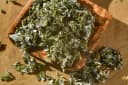 The plant of this articleRaspberry · Rubus idaeusfrom €4.88View →
Smoke as prayer, smoke as prison, smoke as return. What we bring to our lungs deserves a real choice.
tagline · path
In short. A tobacco-free smoking blend is built from four families: a neutral base that replaces tobacco (mullein, raspberry leaf, Herbal Mix), 40 to 60%; complements rich in tradition (blue lotus, damiana, wild dagga, Calea), 20 to 40%; a flavour plant (lavender, rose), 10 to 20%; and, if you like, a touch of worked resin. All smoke, even from plants, irritates and damages the lungs.
For adults only (18+). Freely sold in France. Check the law in your country.
What can you smoke instead of tobacco?
To replace tobacco, start from a neutral base, add one or two complements, then a flavour plant. These families and proportions come from Tim, the House's founder, who also publishes his blends on his site smokableherbs.earth. Some complements can also hold the base: blue lotus, which is even smoked on its own, damiana, mugwort, and Yauhtli up to half the blend. None of the plants in this guide contains tobacco or nicotine.
| Family | What it brings | House plants | Share of the blend |
|---|---|---|---|
| Neutral base | carries the smoke, replaces tobacco | mullein, raspberry leaf, Herbal Mix (with its marshmallow) | 40 to 60% |
| Flavour base | gives the taste | lavender, rose petals, noble chamomile, peppermint, white lotus | 10 to 20% |
| Complement | character, tradition, light effects | blue lotus, damiana, mugwort, wild dagga, Yauhtli, Calea, imphepho, kanna, Entada rheedii, lotus stamens | 20 to 40%; Calea 10 to 20%; Yauhtli up to 50%; blue lotus, damiana and mugwort can hold the base |
| Resin | a dense note, worked into a powder | blue lotus, white lotus, wild lettuce and Entada resins | a small share, around 5 to 10% |
Neutral bases, to replace tobacco
A neutral base burns evenly, carries the smoke and leaves the taste to the other plants. It is the part of the blend that replaces tobacco.
Herbal Mix, the ready-to-roll blend
Herbal Mix is our soft, floral, ready-to-roll blend: marshmallow, raspberry leaf, red clover, sweet clover, peppermint and calendula flowers, finely cut. Our partner prepares it in the Netherlands, with herbs sourced in Europe; marshmallow, one of Tim's bases, is already in it. It rolls on its own or serves as the base for every plant in this guide. Some people also roll it with their usual tobacco, half and half or 30/70, to get used to the taste; the smoke then carries the tobacco's nicotine. Sweet clover contains coumarin: moderate use, and medical advice for anyone on anticoagulants.
Raspberry leaf (Rubus idaeus)
Raspberry leaf has been known since antiquity as a women's herb, drunk as a tea; the raspberry leaf monograph tells that story. In smoke, it gives a cottony texture and a barely fruity taste: a classic neutral base. This is a present-day use.
Mullein (Verbascum thapsus)
Mullein came from Europe to North America, where several peoples adopted it: Moerman's Native American Ethnobotany database records 18 smoked uses among nine peoples, including the Iroquois, Mohegan, Penobscot, Potawatomi, Menominee and Hopi. The Menominee smoked it as a tobacco (Smith 1923). Its smoke has a fine, almost neutral taste. The fine hairs on the leaves are best sieved out. The mullein monograph covers the plant in full.
Coltsfoot (Tussilago farfara)
Coltsfoot is Europe's historic smoking base: Dioscorides and Pliny already described the smoke of its dried leaves. INFUSE no longer sells it. It contains pyrrolizidine alkaloids, including senkirkine, which are toxic to the liver; the European Medicines Agency lists it among the plants concerned (EMA, 2021), and the effect of these alkaloids through smoke is barely studied. We mention it for its history and give its place in our blends to mullein and raspberry leaf.
Hops, corn silk, hazel, mulberry
Other neutral plants can be rolled, though we do not sell them. Hops (Humulus lupulus), known for beer since the Middle Ages, give a bitter, herbaceous smoke: smoking them is a present-day use. Corn silk (Zea mays), dried until brown, was rolled in rural North America when tobacco ran short (Cape Gazette); the Navajo, Tewa and Kiowa rolled their tobacco in the dried husks of the ear (Moerman's database). Hazel leaves (Corylus avellana) and mulberry leaves (Morus alba) make soft bases; Korean and Chinese patents describe tobacco-free cigarettes made from mulberry leaves.
Flavour bases, for the taste
A flavour plant makes up 10 to 20% and gives the blend its scent.
White lotus (Nelumbo nucifera)
Smoked white lotus is "soft and floral", in Tim's words. It goes in as a flavour base or as a complement: petals and stamens crushed in the hand, mixed into the blend or sprinkled on top.
Our white lotus is Nelumbo nucifera, the sacred lotus of India, in its white form. It is a true lotus, of the Nelumbonaceae family, and a different plant from the blue lotus, which is a water lily. In Sanskrit the white lotus is the pundarika: the Lotus Sutra, a major Buddhist text, bears its name. Our flowers come from the lakes of Sri Lanka. Smoking it is a present-day use.
What people report. At the House, we smoke white lotus for its softness: a floral calm, a light presence, a heart that opens. It is subtle, and some feel nothing.
Rose, lavender, noble chamomile, peppermint
Rose petals (Rosa damascena) crushed in the hand give the blend a floral, sweet note; the rose monograph tells the plant's story. Lavender (Lavandula angustifolia) has a strong scent: a small share is enough, and the lavender monograph says where it comes from. Noble chamomile (Chamaemelum nobile) gives a round, fruity smoke; see the noble chamomile monograph. Peppermint, already in Herbal Mix, brings its freshness. These are present-day uses, chosen for their taste.
Complements: taste and tradition
A complement makes up 20 to 40% and brings the blend its character; some can also hold the base. We choose them from the shamanic traditions INFUSE holds dear, from Mexico to southern Africa. These plants are wonderful to smoke for their effects, light and deep at once. We describe them as they are reported: by tradition, with its source; by our customers' accounts; by our own use at the House. The effects are subtle, they vary from one person to the next, and some people feel nothing.
Our figures come from our dreamers' accounts: 174 customer reviews describing a night with a plant, read one by one, all preparations together, most often as a tea. They are testimonies, with no protocol and no control group.
Blue lotus (Nymphaea nouchali)
Blue lotus is smoked three ways at the House: on its own, flowers crumbled alone; as the base, with other plants around it; or as a complement, 20 to 40% of the blend. Its taste mixes floral, earthy and slightly nutty notes, with a subtle sweetness and a touch of bitterness.
The most widely sold blue lotus is commonly called Nymphaea caerulea; it is in fact Nymphaea nouchali, a South Asian water lily with larger, more fragrant flowers. Our flowers come from the lakes of Sri Lanka, from a small family business. We also offer the rarer authentic blue lotus.
Ancient Egypt drank it and offered it: a Ptolemaic-era vase held it, mixed with other plants (Tanasi et al. 2024). Smoking it is a present-day use, and we say so plainly.
What people report. At the House, we smoke blue lotus for its gentle relaxation, a light reverie and a quiet sensuality: a subtle effect, deep without being strong. Of 25 night accounts from our customers, 16 describe changed dreams, 7 of them more vivid dreams; one noticed nothing, and 6 short reviews say the same (dreamers' accounts). One customer reported dizziness after two flowers: a little is enough. Pregnancy, breastfeeding, sedative or antidepressant medication: we abstain. Blue lotus is freely sold in France; check the law in your country.
Calea (Calea ternifolia)
Calea (long known as Calea zacatechichi) makes up 10 to 20% of the blend, crumbled very fine. Its bitterness is frank; in a small share, it brings a herbaceous note.
The Chontal of Oaxaca, in Mexico, call it thle-pela-kano, the leaf of God. They drink it as a tea, smoke the dried leaves and slip them under the pillow before sleep (Díaz 1979); its Nahuatl name, zacatechichi, means "bitter grass". Our guide to the dream herbs tells the story of Calea in full.
What people report. Chontal tradition sees it as a plant that carries dreams full of messages (Díaz 1979). It is the plant our customers write about most: of 40 accounts, 31 describe changed dreams, 11 more vivid dreams, 11 better recall on waking and 6 a lucid dream; 5 noticed nothing, and 5 short reviews say the same (dreamers' accounts). At the House, we smoke it in a small share for a slower mind and a light reverie that sometimes carries on into the night: subtle, deep without being strong. One customer described a numb mouth: a little is enough. Pregnancy, breastfeeding: we abstain; on sedative or psychotropic medication, medical advice first. It is freely sold in France; check the law in your country.
Wild dagga (Leonotis)
According to South Africa's National Biodiversity Institute (SANBI), the Khoikhoi smoked the dried leaves and flowers of Leonotis leonurus. Depending on the form, INFUSE sells Leonotis leonurus (extract and resin) or Leonotis nepetifolia (orange petals): the wild dagga page says which. Its petals give a soft, slightly herbaceous smoke, 20 to 40% of the blend.
What people report. Khoikhoi tradition smoked it (SANBI). At the House, we smoke it for a gentle relaxation, a light warmth in the body and a calmer mind that stays clear. Many find it subtle; some feel nothing. At large doses, an aqueous extract caused adverse effects in rats (Maphosa et al. 2008). Pregnancy and breastfeeding: we abstain; care with blood-pressure medication, sedatives, and unstable diabetes. Check the law in your country.
Damiana (Turnera diffusa)
Damiana, a plant of Mexican traditional medicine, is mostly drunk as a tea; its leaves are smoked as well (UTEP, Herbal Safety). Warm, slightly sweet taste, 20 to 40% of the blend, or as the base of Tim's blend for two. The damiana monograph tells the plant's story.
What people report. Mexican tradition gives it a reputation as a plant of sensuality (UTEP, Herbal Safety). At the House, we smoke it for its warmth, a gentle relaxation and a quiet sensuality, light, that leaves the mind present. The effect stays subtle and varies from person to person. Pregnancy, trying to conceive, breastfeeding: we abstain; care with antidepressants and with diabetes.
Mugwort (Artemisia vulgaris)
Mugwort gives a herbaceous, bitter taste. Tim uses it as a complement, or as the base of his dream blend. Moerman's database records no old smoked use for it; it goes into blends today for its taste, and stays out of pregnancy. See the mugwort monograph.
What people report. Of 8 night accounts from our customers, 5 describe changed dreams, 4 of them more vivid dreams; two people sought a lucid dream without reaching it (dreamers' accounts). At the House, we smoke it for its bitterness and a light reverie.
Yauhtli, Mexican tarragon (Tagetes lucida)
Yauhtli goes in as a complement, or up to half the blend, with any base. Its sweet anise taste, close to liquorice, gets along with almost every smoking herb.
That generous share has a history. Among the Huichol (Wixárika) of Mexico, the ethnobotanists Siegel, Collings and Díaz described in 1977 a mixture of Tagetes lucida smoked on its own or in equal parts with a wild tobacco, Nicotiana rustica. Further back, researchers found residues of Tagetes lucida mixed with tobacco in small Maya flasks buried in Yucatán more than a thousand years ago (Zimmermann et al. 2021). The Aztecs called it yauhtli. We source it from the Puebla region of Mexico, wild-harvested, as whole leaves to crumble finely. The Yauhtli monograph goes further.
What people report. At the House, we smoke it for its softness and warmth, a clearer mind, a presence shared among friends. Of 12 night accounts, 8 describe changed dreams (dreamers' accounts); one customer had a stomach ache. Light, and variable from one person to the next.
Imphepho (Helichrysum odoratissimum)
Imphepho is the incense of southern Africa. In a blend, a small share of its silvery leaves brings its scent. Rolling it is a present-day use, born from a long tradition of smoke. The imphepho monograph tells the plant's story.
What people report. The Zulu burn its leaves and stems to call on the goodwill of the ancestors (Hutchings et al. 1996), and Zulu diviners breathe its smoke in their rituals (Sobiecki 2008). At the House, we love it for the calm and presence it brings to the blend and to the room. Of 12 night accounts, 7 describe changed dreams and 3 noticed nothing; one person felt tired (dreamers' accounts). With asthma, keep the smoke light; with an allergy to the daisy family, abstain.
Kanna (Sceletium tortuosum)
Kanna is a succulent from the Karoo, in South Africa. The Khoikhoi and San prepared it fermented, as kougoed, "stuff to chew" in Afrikaans; it was mostly chewed, also drunk as a tea, taken as snuff, and smoked. In the eighteenth century, the botanist Thunberg already noted that the San chewed it and then smoked it (Gericke and Viljoen 2008; Smith et al. 1996). Our fermented leaves crumble finely, in a small share, over a base. The kanna monograph goes further.
What people report. In 1914, two pharmacists who studied it concluded that the peoples of the Karoo took it for enjoyment more than as a remedy (Hartwich and Zwicky 1914, cited by Gericke and Viljoen 2008). At the House, we smoke it in a small share for a gentle warmth, an opening of the heart, a quiet presence: light, deep without being strong. Kanna acts on serotonin: never with an antidepressant or any serotonergic medication, and medical advice before any use while on treatment. Pregnancy, breastfeeding: we abstain. Check the law in your country.
Entada rheedii, the powdered seed
Entada rheedii is the large seed of a tropical vine. We crack the shell, grind the inner flesh finely and sprinkle a little over the blend: too much makes it hard to smoke, and the powder lasts a long time.
What people report. In South Africa, diviners use the seed to remember dreams, and tobacco smoked in a pipe carved from the seed is reported there (Sobiecki 2008, after Van Wyk and Gericke 2000). Of 11 night accounts from our customers, 6 describe changed dreams and 4 noticed nothing in their dreams (dreamers' accounts). At the House, we sprinkle it for the reverie it accompanies, subtle. The plant remains little studied: moderation, and we abstain during pregnancy, breastfeeding, and on sedative or antidepressant medication without medical advice.
Lotus stamens
Pure pink lotus stamens (Nelumbo nucifera, the same species as white lotus) are sprinkled by the pinch, last, for a floral note. Blue and white lotus flowers also serve as complements, in a small share, over another base. See the pink lotus monograph.
Resins: a paste to crumble
Our resins are concentrated extracts prepared with water: the plant soaks, boils, is filtered, then the water evaporates down to a paste. For smoking, we offer four: blue lotus resin, white lotus resin, wild lettuce resin and Entada resin.
On its own, a resin is greasy and sticky. You can roll thin snakes of it to lay in the blend, but it spreads badly. Tim works it differently: a small amount of resin kneaded with a powder, or with a very finely cut plant, until it reaches a sandy texture that crumbles easily. This crumbly resin paste then goes into the blend, in a small share.
The white latex of wild lettuce (Lactuca virosa) dries into a brown resin, lactucarium, which appeared in nineteenth-century European pharmacopoeias. Eaten fresh in large amounts, it has caused poisonings (Besharat et al. 2009): a small share, and moderation. Check the law in your country for each of these resins.
The House recipes
The first four recipes are Tim's, published on his site smokableherbs.earth, in parts: a part can be a spoon, a pinch or a gram, as long as the measure stays the same. The last two are House suggestions, built on his rules. One plant on its own a few times first: that is how you learn its flavour before pairing it. Blue lotus is also smoked on its own.
The evening blend
Mullein 2 parts, damiana 1 part, lavender ½ part (about 57%, 29% and 14%). To begin with. Mullein carries the smoke, damiana brings its warmth, lavender its scent. At the House, we roll it in the evening for a gentle relaxation: it is light, and some feel nothing.
The dream blend
Mugwort 2 parts, blue lotus 1 part, raspberry leaf 1 part (50%, 25% and 25%). For those who already know the plants. Mugwort and blue lotus are two plants our customers associate with more vivid dreams: 4 accounts out of 8 for mugwort, 7 out of 25 for blue lotus, all preparations together (dreamers' accounts). At the House, we smoke it late in the evening, for a light reverie, and keep it out of pregnancy.
The blend for two
Damiana 3 parts, rose petals 1 part, blue lotus 1 part (60%, 20% and 20%). For those who already know the plants. Mexican tradition gives damiana a reputation as a plant of sensuality (UTEP, Herbal Safety); rose and lotus add their flowers. At the House, we share it for its warmth and a quiet, subtle sensuality.
The ceremony blend
Blue lotus 2 parts, wild dagga 1 part, mullein 1 part (50%, 25% and 25%). For those who know the plants well. Blue lotus holds the base, wild dagga brings its warmth, mullein carries the smoke. At the House, we keep it for a circle, a ritual, a moment of presence: deep without being strong.
House suggestion: anise and bitter
Herbal Mix 50%, Yauhtli 35%, Calea 15%. Built on Tim's rules: a neutral base, Yauhtli under half the blend, Calea between 10 and 20%. The sweet anise of Yauhtli softens Calea's bitterness; at the House, we roll it at any time of day, for a slower mind.
House suggestion: worked resin
Raspberry leaf 50%, blue lotus 30%, rose petals 10%, blue lotus resin paste worked into a powder 10%. Crumbled like fine sand, the resin gives the blend a dense lotus note.
How do you prepare, roll and store a blend?
The plants go in dry and finely crumbled: lotus flowers and Calea leaves crush in the hand, and Yauhtli is rubbed between the fingers to release its anise scent. Hard stems come out, since they prick and burn badly. Everything is mixed in a bowl, then rolled in a thin paper, with a card filter if you like. A pipe works too.
A plant that is too dry burns fast and hot; too damp, it goes out. The blend keeps in a closed jar, away from light and heat. Aromatic plants such as Yauhtli lose their scent over time: small quantities are best.
What other herbs can you smoke?
Other plants can be smoked, on their own or in a blend. In North America, two of them have a very long history.
Bearberry and dogwood: kinnikinnick
In North America, kinnikinnick names the smoking mixtures of Indigenous peoples. Bearberry (Arctostaphylos uva-ursi) is its most cited plant: Moerman's database records 29 smoked uses, among the Blackfoot, Cheyenne, Chippewa and others, its dried leaves smoked alone or with tobacco. The bark of red osier dogwood (Cornus sericea) went in too, with 18 smoked uses recorded. We do not sell them.
Sagan Dalya has left this list: the sources describe it drunk as a tea by the Buryats, never smoked.
What is in herbal smoke?
Herbal smoke contains tar, carbon monoxide and fine particles, like tobacco smoke; it contains no nicotine. All smoke, even from plants, irritates and damages the lungs.
A 2022 review compared herbal cigarettes with tobacco and judged them at least as dangerous (Abdel Rahman et al., ACS Omega). In 2026, a study measured more concentrated fine particles in herbal cigarette smoke than in tobacco smoke (Thakur et al., Journal of Hazardous Materials). The Dutch public-health institute Trimbos reports more tar and carbon monoxide inhaled with herbal cigarettes. We smoke these plants for their taste and their history, in small amounts, now and then.
Tobacco questions are answered by public services such as NHS Smokefree in the UK and smokefree.gov in the US.
Are these herbs legal?
Every plant INFUSE sells in this guide is freely sold in France. Their status changes from one country to another, especially for blue lotus, Calea, kanna, wild lettuce, Entada and wild dagga: check the law in your country before ordering. These plants are for adults only (18+).
A neutral base, a flavour base, a complement: ready-to-roll Herbal Mix, blue lotus, Yauhtli, Calea, everything for the House blend. For adults only (18+).
Discover Herbal Mix →Is smoking herbs safer than tobacco?
No. Herbal smoke has no nicotine, but it contains tar, carbon monoxide and fine particles. The studies that measured herbal cigarettes found them at least as harmful as tobacco (Abdel Rahman et al., ACS Omega, 2022; Thakur et al., Journal of Hazardous Materials, 2026).
What can I smoke instead of tobacco?
A neutral base: mullein, raspberry leaf or ready-to-roll Herbal Mix. Then add a complement, such as blue lotus, damiana or Yauhtli, and a flavour plant, such as lavender or rose.
What is the best herbal blend to smoke?
The one whose taste you like. To begin with, Tim's evening blend: mullein 2 parts, damiana 1 part, lavender ½ part.
What is a herbal smoking blend?
A mix of dried, finely cut plants, rolled or smoked in a pipe, with no tobacco and no nicotine. Ours is Herbal Mix: marshmallow, raspberry leaf, red clover, sweet clover, peppermint and calendula.
Can you smoke coltsfoot?
Coltsfoot is Europe's historic smoking base, but it contains pyrrolizidine alkaloids that are toxic to the liver (EMA, 2021). INFUSE no longer sells it and prefers mullein and raspberry leaf.
How do you smoke a plant resin?
On its own it is too greasy. A small amount of resin kneaded with a powder or a very finely cut plant gives a sandy texture that crumbles easily into the blend.
What effects do smoking herbs have?
Light, subtle effects that vary from person to person: people report gentle relaxation, reverie, warmth, more vivid dreams. Of 40 accounts from our customers with Calea, 31 describe changed dreams and 5 noticed nothing. Some feel nothing at all.
Do these herbs contain nicotine or THC?
No. None of the plants in this guide contains nicotine or THC.
Can you mix Herbal Mix with tobacco?
Some people do, half and half or 30/70, to get used to the taste. The smoke then carries the tobacco's nicotine.
Sources
- Abdel Rahman R.T., Kamal N., Mediani A., Farag M.A. (2022). How Do Herbal Cigarettes Compare To Tobacco? ACS Omega 7:45797-45809. doi:10.1021/acsomega.2c04708
- Thakur A.K. et al. (2026). Journal of Hazardous Materials. doi:10.1016/j.jhazmat.2026.142424
- Trimbos-instituut, Kruidensigaret. trimbos.nl
- Tabac Info Service, Remplacer le tabac par des plantes. tabac-info-service.fr
- European Medicines Agency, HMPC (2021). Public statement on the use of herbal medicinal products containing toxic, unsaturated pyrrolizidine alkaloids (EMA/HMPC/893108/2011 Rev. 1). ema.europa.eu
- Zimmermann M. et al. (2021). Metabolomics-based analysis of miniature flask contents identifies tobacco mixture use among the ancient Maya. Scientific Reports 11:1590. doi:10.1038/s41598-021-81158-y
- Siegel R.K., Collings P.R., Díaz J.L. (1977). On the use of Tagetes lucida and Nicotiana rustica as a Huichol smoking mixture. Economic Botany 31:16-23. doi:10.1007/BF02860647
- Díaz J.L. (1979). Journal of Psychedelic Drugs 11:71-101.
- Tanasi D. et al. (2024). Scientific Reports 14:27891.
- Gericke N., Viljoen A.M. (2008). Sceletium — A review update. Journal of Ethnopharmacology 119:653-663. doi:10.1016/j.jep.2008.07.043
- Smith M.T., Crouch N.R., Gericke N., Hirst M. (1996). Journal of Ethnopharmacology 50:119-130. doi:10.1016/0378-8741(95)01342-3
- Sobiecki J.F. (2008). Southern African Humanities 20:333-351.
- Van Wyk B.-E., Gericke N. (2000). People's Plants: A Guide to Useful Plants of Southern Africa. Briza.
- Hutchings A., Scott A.H., Lewis G., Cunningham A.B. (1996). Zulu Medicinal Plants: An Inventory. University of Natal Press.
- Besharat S., Besharat M., Jabbari A. (2009). Wild lettuce (Lactuca virosa) toxicity. BMJ Case Reports. doi:10.1136/bcr.06.2008.0134
- Moerman D.E. Native American Ethnobotany Database, Botanical Research Institute of Texas: mullein smoked, bearberry smoked, dogwood smoked, corn and smoke.
- Smith H.H. (1923). Ethnobotany of the Menomini Indians. Bulletin of the Public Museum of the City of Milwaukee 4:1-174.
- SANBI, PlantZAfrica: Leonotis leonurus. pza.sanbi.org
- Maphosa V., Masika P.J., Adedapo A.A. (2008). Human & Experimental Toxicology 27:837-843.
- University of Texas at El Paso, Herbal Safety: Damiana. utep.edu
- Cape Gazette, Corn silk can actually be put to good use as a tea. capegazette.com
- Mulberry-leaf cigarette patents: KR100851254B1, CN100391376C. patents.google.com
 from €4.88View →
You have a story to drop into the Forest too?
Share a story →0 min déjà parcourues · 19 min jusqu'au seuil de retour
What this reading opened
Be the first voice. Each word is read before joining.
Sign in to share what this reading opened in you.
Sign in →