⊹ To weave around
To accompany Blue Lotus
Click a card to see why it pairs — and choose your form.
Read it through your world
The whole page is read through this lens.
✦ Blue Lotus · in one breath ✦
As she rises from the mud to the sky, she opens the path of awakening.
⊹ The path of the plant
⊹ Community voices
What the community murmurs.
Average · 543 reviews
including 531 left on our Etsy shop
Breakdown
I deeply recommend this little shop, the owners are very kind and act from the heart. The products are of high quality and handled with incredible care. I'm so happy that my herbal collection is growing and I can't wait to order more. At the moment I'm enjoying the tea made of blue water lilly and I feel calm, joyful and at peace. Love! M
Masa
Dream · left on our Etsy shop · 9 March 2022
A shop of great purity. The herbs have an exceptional vibration, ideal for sacred work. A huge thank you for the gift of the Pink Lotus, a thoughtful gesture that touched me deeply and came at the perfect time. Quality, speed, and beautiful energy. May the Light guide you!
La pièce
Dream · left on our Etsy shop · 2 February 2026
This plant has become a staple to my mental health care routine. If you have paranoia or anxiety or just stress out easily, take this and it shuts all that negativity off. And this store is wonderful. I will continue to be a loyal customer as long as they exist.
Tara
Dream · left on our Etsy shop · 10 November 2021
The blue lotus flower petals were of a high quality, potent blue in colour with an almost sweet, magical smell. I could tell how well the herbs have been cared for, dried and stored. I drank the tea before going to sleep and I can attest it brings a sense of heightened awareness, calmness, peace and introspection. Also dream recall increased significantly ! I deeply recommend Tim and Alice and this shop, their passion and energy feels inspiring and uplifting! Denisa, Romania.
Denisa
Dream · left on our Etsy shop · 2 June 2021
I wanted to give it some time until I could write a review but I have to say that the quality of the flowers is superb. This has become my favorite tea before sleeping. I can feel how relaxed I am after some minutes and then I sleep like a baby and have very symbolic dreams.
Emilio
Dream · left on our Etsy shop · 10 May 2025
The powder is very easy to use and using half a teaspoon helped me contain raging emotions.I put the powder under my tongue and let it work as I meditated.I have observed more dream recall but have yet to settle into understanding their meanings .Customer service is very helpful and informative so I decided to order whole flowers to continue my journey.I recommend delving into their website to understand better the approach and attitude to working with the plants.
Itemeka
Dream · left on our Etsy shop · 25 February 2025
Fast shipping to Aus. Excellent seller / store, great customer experience. Beautifully packaged. Would highly recommend this seller. Lotus flower is lovely as a cup of tea at night, like camomile on steroids. Love it. Thankyou
Ally
Dream · left on our Etsy shop · 6 October 2024
I’m new to the lotus family so this is my first experience with it. I made a cup of tea with two flowers and felt very lightheaded in about 40-50 minutes, it’s quite potent. If you are sensitive like me I would recommend one flower or less. Very relaxing and helped me fall asleep and stay asleep through the whole night. Haven’t experienced any lucid dreams yet.
Michelle
Dream · left on our Etsy shop · 4 September 2024
excellent quality and very nice spectrum of on how it affects the body (slightly euphoric but also calming and relaxing )
Kiruna
Dream · left on our Etsy shop · 8 July 2024
An absolutely fantastic flower, I have this daily in the evening for a much more satisfying and theraputic sleep, it's nice.
James
Dream · left on our Etsy shop · 25 January 2024
I love this plant and I am going to order again, it is very pleasant to consume personally I smoke it even if it is difficult to burn and it has a good smell a good taste a little sweet and it creates a very pleasant effect of relaxation and well-being. This plant allows you to remain lucid while having effects of relaxation and fatigue similar to cannabis. I would like to thank the seller for the gifts received with each order placed, it’s very kind of that 🙏🏻
Lucas
Dream · left on our Etsy shop · 17 November 2023
🗣 AMAZING 🤩 the flowers are top notch Omgosh after I drink it maybe about 10 minutes eyes were heavy and they were like so hard to keep open and the sleep that I had so restful peaceful when I woke up in the morning there wasn’t that I want to run back to bed I was up and let’s go. Packaged lovely and shipping was fast 🥳🥳🥳🥳 keep up the great work and thank you for the samples ♥️
AfroYoYo
Dream · left on our Etsy shop · 19 September 2023
Ask the Forest about Blue Lotus
408 books digested, 97,512 indexed passages. She answers on lineages, synergies, cautions, ritual variations.
⊹ FREQUENT QUESTIONS ⊹
We answer.
What is blue lotus?
Blue lotus — commonly called Nymphaea caerulea, in fact Nymphaea nouchali — is an aquatic water lily of the Nymphaeaceae family, revered in ancient Egypt. Botanically, she is distinct from the sacred Asian lotus (Nelumbo nucifera), which belongs to a different genus and family.
What are the traditional uses of blue lotus?
She is mainly prepared as an evening infusion, as macerated wine (the classic Egyptian preparation), in a sensual bath, or sprinkled on a smoking base. Tradition associates her with opening toward dreams, meditation and sensuality.
How do I prepare a blue lotus infusion?
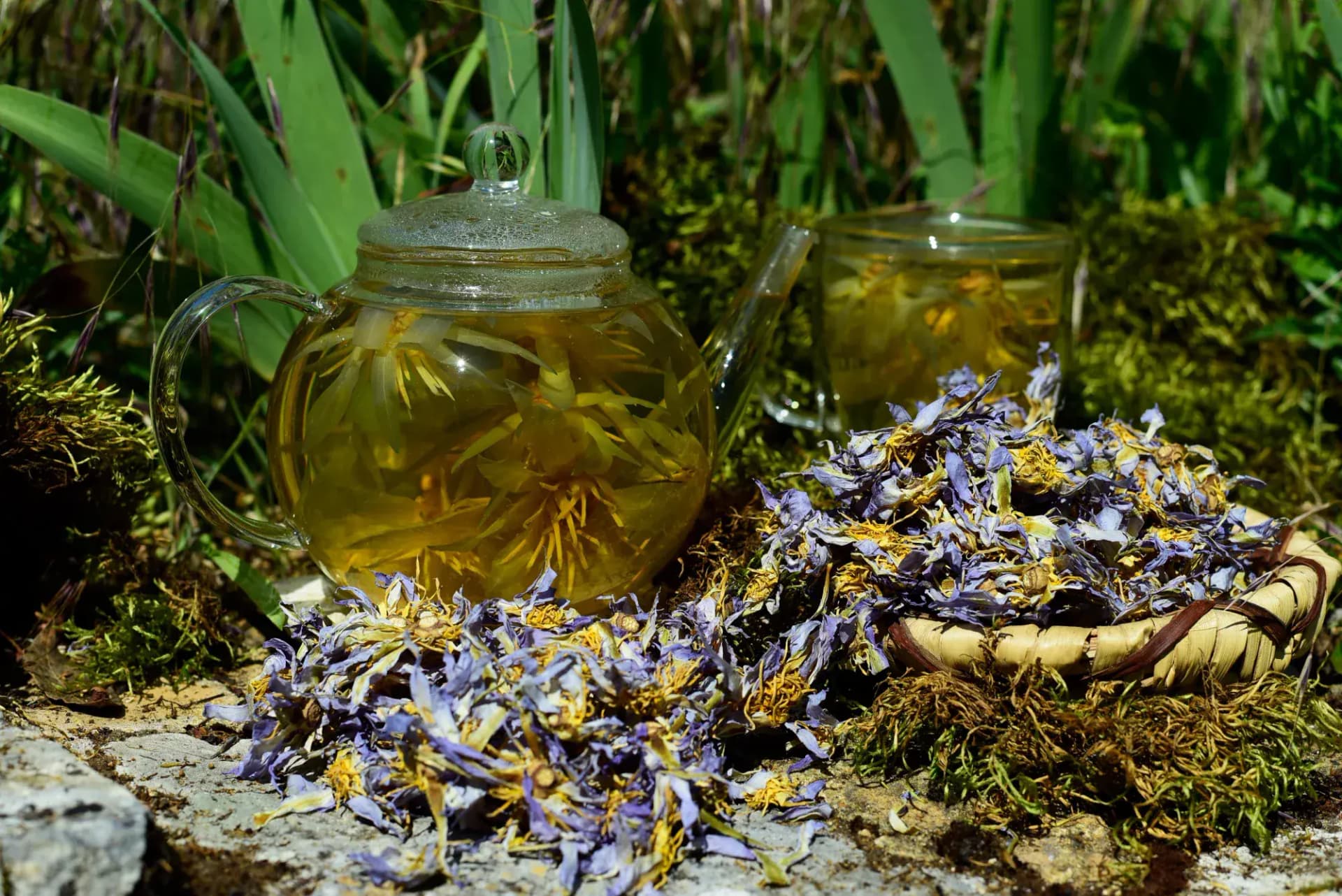
Place a whole flower in a cup, pour simmering water (never violently boiling), let her infuse for 7 to 10 minutes. The same flower can be reused several times. Best savoured in the evening.
Does blue lotus make you dream?
Our dreamers often speak of it, and the question "What do people who tried blue lotus say?" gives the details. On the side of tradition, a Ptolemaic Egyptian vase mixed blue lotus with other plants in a drink that one of the researchers links to dreams and visions (Tanasi et al. 2024). No study has measured the effect on dreaming.
Blue lotus vs pink lotus — what's the difference?
Blue lotus is a Nymphaea (aquatic water lily); the pink lotus INFUSE offers is a Nelumbo nucifera, the sacred Asian lotus. Two different botanical genera, with distinct scents and qualities — sisters of the water rather than twins.
How do I recognise a real blue lotus?
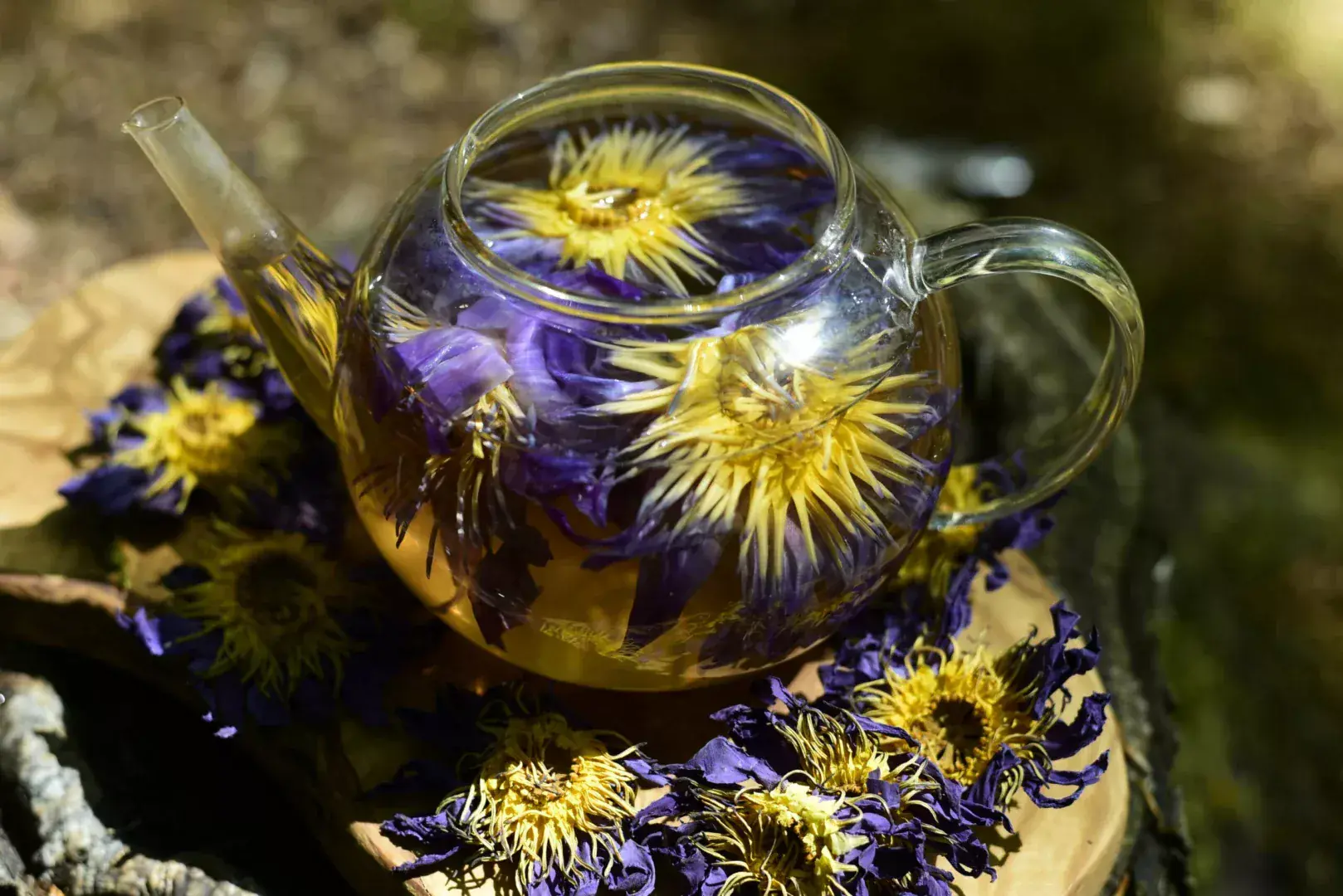
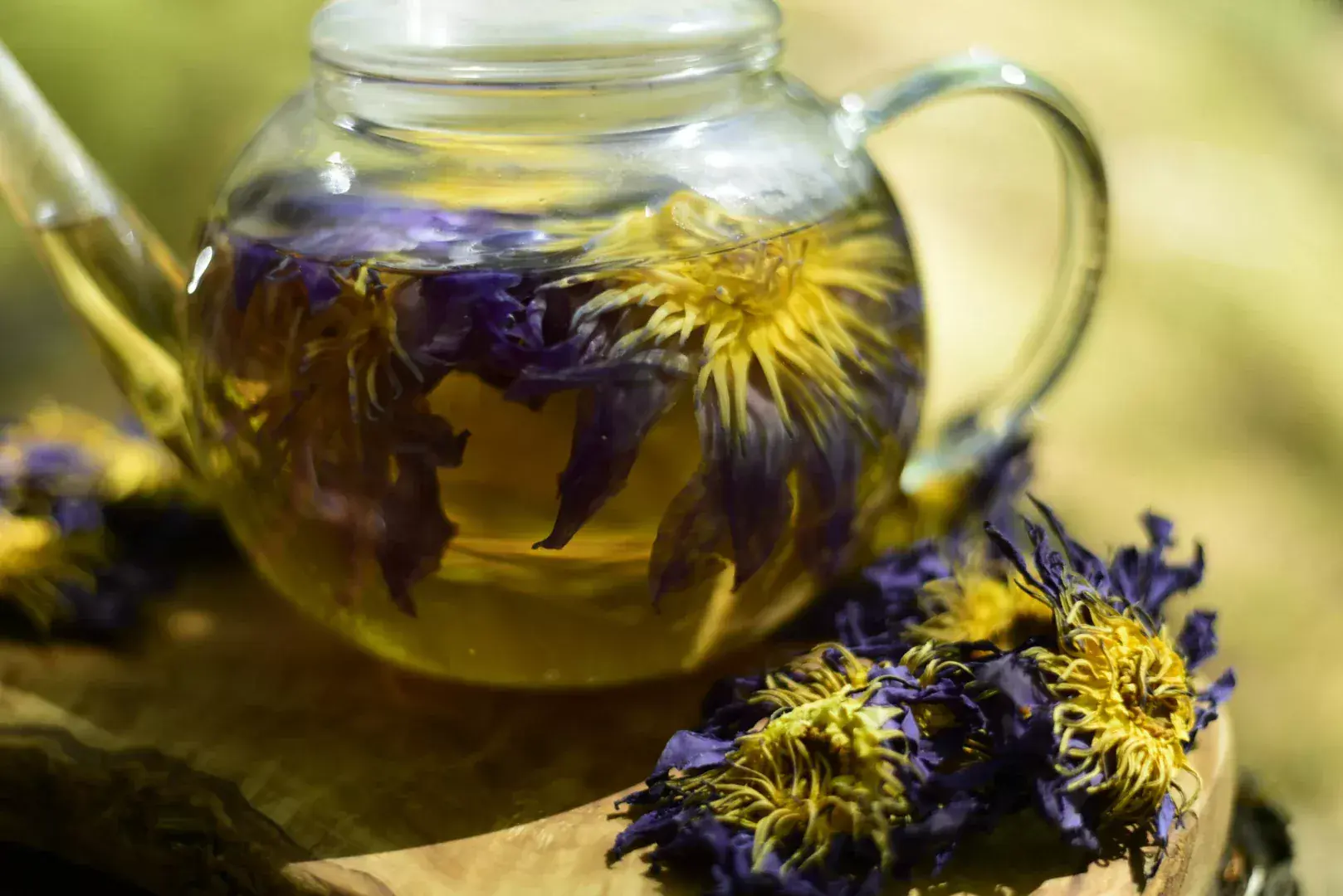
True Nymphaea caerulea has fine pointed petals, a clear blue, a marked sweet fragrance and a heart of golden-yellow stamens. Many products sold under this name are in fact white water lilies (N. alba or odorata), with a very different profile.
Where does INFUSE's blue lotus come from?
Our flowers are wild-harvested in the lakes of Sri Lanka, in connection with a small family business.
Does blue lotus have side effects? Precautions
Start with a small quantity. Avoid during pregnancy and breastfeeding, and when taking sedative, dopaminergic or antidepressant medications (theoretical interactions reported). Our plants are sold as dried flowers.
What are the effects of blue lotus?
What our dreamers describe: gentle relaxation, falling asleep easily, dreams more vivid and better remembered. What research has measured: its nuciferine acts on serotonin and dopamine receptors (Farrell et al. 2016). It relaxes and can make you drowsy: leave driving for another time.
Is blue lotus a drug? Is it hallucinogenic?
What research has measured: its nuciferine blocks several serotonin receptors, including 5-HT2A, and acts on dopamine receptors (Farrell et al. 2016). What our dreamers describe: relaxation, gentler sleep, more vivid dreams. A case series reports sedation and perceptual disturbances after vaping concentrated extracts (Schimpf et al. 2023). It relaxes and can make you drowsy: no driving afterwards. Its status varies from country to country. Freely sold in France. Check the law in your country.
Can you smoke blue lotus?
It is a reported use: Schultes, Hofmann and Rätsch mention Nymphaea flowers smoked alone or with tobacco to bring on divinatory dreams (Plants of the Gods, p. 50). Some crumble petals and stamens over a smoking herb base, or dust a pinch of powdered extract on it. We share this as information, for adults aged 18 and over. Smoke irritates the lungs, and concentrated extracts have caused sedation (Schimpf et al. 2023).
Nymphaea caerulea or Nymphaea nouchali?
The most widely sold blue lotus, the one on this page, is commonly called Nymphaea caerulea; it is in fact Nymphaea nouchali, a South Asian water lily with bigger, more fragrant flowers. The Egyptian lotus is N. nouchali var. caerulea. We offer both, each on its own page.
How much blue lotus for a tea?
One or two flowers per cup, in hot water that is not boiling, for 7 to 10 minutes. Start with one flower to find your sensitivity; the same flower can be steeped again.
Is blue lotus legal?
Freely sold in France. Check the law in your country.
What do people who tried blue lotus say?
Of 543 reviews published on INFUSE, 25 tell of a night: 16 an effect on their dreams (7 more vivid dreams, 4 better recall, 3 meaningful dreams, 1 a lucid dream), 12 gentler sleep, 1 nothing in their dreams; 6 short reviews say 'no effect'. Denisa: 'dream recall increased significantly'. Silvia: 'I noticed no effect on my dreams'.
⊹ Chapter · Questions ⊹
Ask, answer, share.
One question, one answer — sometimes several voices. The community answers first; INFUSE steps in when it should.
- Anonymous voiceSep 15
Le matin ou le soir ?
- flordelparaisoestelarINFUSE teamSep 17
Le Lotus Bleu est plutôt un compagnon du soir, il favorise la détente et l'entrée dans le sommeil 🙏
In depthbotany · phytochemistry · history
For those who want to go below the page: botany, chemistry, then four voices, each one named. ◆ what the tradition left in writing, ◇ what research has measured, ● what our dreamers tell us, ☾ what the House says.
Is blue lotus a lotus or a water lily?
Commonly called Nymphaea caerulea, the blue lotus on this page is in fact *Nymphaea nouchali*: an aquatic water lily of the Nymphaeaceae. The name caerulea belongs, strictly, to the Egyptian variety, Nymphaea nouchali var. caerulea, native to the eastern half of Africa and southern Arabia, which we offer separately as our Authentic Blue Lotus. Nymphaea nouchali itself is the water lily of South and East Asia; in Sri Lanka, where our flowers are gathered, it is the national flower, the nil mānel.
Both are distinct from the sacred Asian lotus (Nelumbo nucifera), a different genus in a different family — a frequent confusion that the ethnobotanical sources take care to dispel (Schultes, Hofmann & Rätsch, Plants of the Gods, pp. 49-50).
Nymphaea caerulea or nouchali: what is the difference?
INFUSE offers two blue lotuses, both true Nymphaea. In our own words: "By experience, both are amazing mystical flowers. The Nymphaea x Nouchali offers bigger and more fragrant flowers; the authentic Nymphaea Caerulea offers smaller flowers and is a lot more rare and difficult to harvest", with effects we find more refined and deeper. Two treasures, one wider and more fragrant, the other smaller and denser.
This is also why naming the species matters. A 2023 analysis compared eleven "blue lotus" products sold for perfumery with authentic extracts: none of them matched; they held synthetic fragrance and oils of citrus, lavender or geranium (Dosoky et al., Molecules). Other products sold under the name are white water lilies or Nelumbo — plants with their own history (Matthew Wood recalls the white water lily in European herbalism, The Book of Herbal Wisdom, pp. 74-76), with another chemistry.
The caerulea form, with smaller flowers, has its own page: Authentic Blue Lotus.
Phytochemistry (descriptive)
The chemistry of the blue water lilies is that of the aporphine alkaloids, nuciferine first among them. In receptor tests nuciferine blocks the serotonin receptors 5-HT2A, 2B and 2C and partly activates the dopamine receptors D2 and D5 (Farrell et al. 2016, PLoS One). Apomorphine, often cited, is disputed: a 2023 analysis found none in authentic extracts of the Egyptian variety (Dosoky et al.). The flower also holds flavonoids, anthocyanins (which give the blue), tannins and mucilage.
◆ The documented tradition
The lotus of the Egyptian tombs is Nymphaea nouchali var. caerulea. The flower on this page, commonly called Nymphaea caerulea, is in fact Nymphaea nouchali, its close cousin from South Asia. Garlands of blue lotus petals accompanied Tutankhamun, laid on his coffins (identified by Percy Newberry). In 2024, the analysis of a Ptolemaic vase in the image of Bes revealed blue lotus mixed with fermented fruit, honey and Syrian rue (Tanasi et al. 2024); one of the authors sees in it a ritual drink "inducing dreams and visions". In South Africa, Zulu diviners buy the flowers of Nymphaea nouchali, izibu, in Johannesburg's markets for visions of the ancestors (Sobiecki 2008, p. 345), and the Xhosa count the root of the blue water lily, uzuba, among the ubulawu used for washing (Hirst 2005).
◇ Blue lotus effects: what the studies say
Its nuciferine acts on several serotonin and dopamine receptors (Farrell et al. 2016). The presence of apomorphine is still debated: it was absent from the authentic extracts analysed by Dosoky et al. (2023). A case series describes sedation after concentrated extracts (Schimpf et al. 2023). A direct link to dreaming has not been measured.
Schultes, Hofmann and Rätsch note signs that Nymphaea flowers were used, in both the Old and the New World, to bring dreams for divination, smoked alone or with tobacco (Plants of the Gods, pp. 50, 71). These are reported uses, carried by tradition and by the accounts of today's drinkers; clinical research on the whole flower remains thin. Among our own dreamers, the blue lotus comes up often for deeper sleep and, for some, more vivid dreams.
● Blue lotus reviews: our dreamers' accounts
Of 543 reviews published on INFUSE, 25 tell of a night (re-read one by one for our dreamers' accounts; a review can say several things). 16 report an effect on their dreams: 7 more vivid dreams, 4 better recall, 3 meaningful dreams, one a lucid dream. 12 speak of gentler sleep. One person noticed nothing in their dreams, and 6 short reviews, outside this count, say "no effect".
"I drank the tea before going to sleep and I can attest it brings a sense of heightened awareness, calmness, peace and introspection. Also dream recall increased significantly!" — Denisa
"I noticed no effect on my dreams, but I don't really care much about that aspect, frankly - I was just looking for a natural sleeping aid." — Silvia
☾ The House
This magical flower gives you what you are ready to receive. Indeed, as it grows from mud to sky, her initiation can take you on the complete path of awakening. Her power also reaches beyond the waking state, gifting Conscious & Lucid Dreams; elevated messages from our Soul through introspection, meditation, and sleep.
Egyptian lineage
In Egyptian tradition the blue water lily was consecrated to Osiris (Pendell, Pharmako/Gnosis, p. 338). Her flower opens with the morning sun and closes toward evening; the Nile read in it an image of solar rebirth and a companion of the passage of death. She appears on Egyptian vases from the earliest dynasties and in the frescoes of the tombs, and her petals were woven into the floral collars laid with Tutankhamun (Newberry). A Ptolemaic vase in the shape of the god Bes, analysed in 2024, still held traces of the Egyptian blue lotus mixed with other plants — a preparation its curator links to a ritual of dream and vision (Tanasi et al., Scientific Reports). Across the ocean, the botanist William Emboden has argued that the Maya honoured a close species, N. ampla.
Blue lotus side effects and safety
Start with a small amount to see how your body responds: the flower acts gently, and she acts. Avoid during pregnancy and breastfeeding (insufficient data). Theoretical interactions are reported with dopaminergic medication (L-DOPA, dopamine agonists, antipsychotics), with MAO inhibitors (including Peganum harmala, which strengthens the effects), and with SSRI antidepressants. She is a plant of moments — rituals, chosen evenings — to take now and then. Freely sold in France. Check the law in your country.
The blue lotus has its full monograph in the Forest, and our guide to the best herbs for lucid dreaming places it among the other dream allies.
Sources: Schultes, Hofmann & Rätsch, Plants of the Gods (pp. 49-50, 71) · Pendell D., Pharmako/Gnosis (pp. 337-338) · Wood M., The Book of Herbal Wisdom (pp. 74-76) · Dosoky N.S. et al. 2023, Molecules · Farrell M.S. et al. 2016, PLoS One · Tanasi D. et al. 2024, Scientific Reports 14:27891.
Sources for the four voices: Tanasi D. et al. 2024, Scientific Reports 14:27891 · Sobiecki J.F. 2008, Southern African Humanities 20:333-351 · Hirst M. 2005, Indo-Pacific Journal of Phenomenology 5(2) · Farrell M.S. et al. 2016, PLoS One 11:e0150602 · Dosoky N.S. et al. 2023, Molecules · Schimpf M. et al. 2023, Military Medicine 188:e2689 · our customers' reviews.