Yauhtli (Tagetes lucida): the Aztec cloud herb
Yauhtli (Tagetes lucida), or Mexican tarragon, is an anise-scented member of the Asteraceae from Mexico. The Aztecs burned it for Tlaloc, Francisco Hernández called it "the cloud herb", and Maya flasks over a thousand years old still hold its trace. The Wixárika smoke it to clear their visions; our dreamers drink it at night.
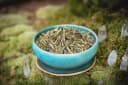 この記事の植物メキシカンタラゴン「Yauhtli」 · Tagetes lucida4.9(88)€7.00〜見る →
The last sovereign territory. You enter through the plants, through silence, through a return to the dreams of the elders.
日本語訳は準備中です — この記事は別の言語で表示されています。
| Item | What we know |
|---|---|
| Accepted name | Tagetes lucida Cav. |
| Family | Asteraceae, the marigold family (Tagetes) |
| Names | yauhtli (Nahuatl) ; iyauhtli ; yahutli ; pericón ; hierba anís ; hierba de nubes ; Mexican tarragon ; Texas tarragon ; Spanish tarragon ; cloud plant ; sweet mace |
| Range | Mexico and Central America |
| Parts used | leaves, thin stems and flowers, dried |
| Peoples | Aztecs (Mexica), Yucatec Maya, Wixárika (Huichol) |
| Taste | sweet anise, close to liquorice and tarragon |
| Research | calming effects in animals (Pérez-Ortega et al., 2016) ; no study of dreaming in humans |
| At INFUSE | wild-harvested dried herb, Puebla region (Mexico) |
What is Yauhtli?
Yauhtli is a small Mesoamerican perennial herb from Mexico and Central America, Tagetes lucida, a member of the Asteraceae with narrow leaves and yellow flowers that smells of anise when you crush it. It is also called Mexican tarragon, pericón or hierba anís. It is a cousin of the orange marigold, Tagetes erecta, Mexico's flower of the dead.
The name yauhtli comes from Nahuatl, the language of the Aztecs. INFUSE offers it as Mexican Tarragon "Yauhtli".
Why is Yauhtli called the cloud herb?
Because Francisco Hernández, the naturalist sent by the King of Spain in the 16th century, named it hierba de nubes, the cloud herb (Ortiz de Montellano, 1990). For the Aztecs, Yauhtli belonged to Tlaloc, god of rain, clouds and lightning: they burned it as incense for him, and its smoke rose like a cloud.
What do Aztec sources say about Yauhtli?
The Franciscan friar Bernardino de Sahagún recorded it in the 16th century in the Florentine Codex as a remedy: whoever shivers with fever drinks it. According to the historian Bernard Ortiz de Montellano, Yauhtli powder was also blown into the faces of certain victims before ritual sacrifice (Ortiz de Montellano, 1990).
To this day in Mexico, on the eve of Saint Michael's Day (San Miguel), 28 September, people weave crosses of pericón and set them on doors, fields and fences to protect the home and call the rain. On the Día de Muertos, the orange marigold guides the souls, and Yauhtli scents the offerings.
Is Yauhtli older than the Aztecs?
Yes. In 2021, researchers analysed small Maya flasks buried in the Yucatán more than a thousand years ago: using metabolomics, they found residues of Tagetes lucida mixed with tobacco, Nicotiana tabacum and Nicotiana rustica (Zimmermann et al., 2021). It was the first time the plant had been detected in an archaeological object; the Maya were already blending it with tobacco.
How do the Wixárika use Yauhtli?
Among the Wixárika (Huichol) of Mexico, Yauhtli is smoked alone or in equal parts with wild tobacco, Nicotiana rustica; the blend is said to make visions clearer (Siegel, Collings and Díaz, 1977). Richard Evans Schultes and Albert Hofmann included it in Plants of the Gods among the plants of Huichol ceremonies.
Does Yauhtli make you dream?
At the House, we drink it in the evening: at night, it unveils its magic through vivid, meaningful dreams. Our dreamers talk about it: 8 accounts out of 12 report an effect on their dreams.
No study has yet measured its effect on dreaming; the old sources tie it to incense, vision and fever.
What is in Yauhtli, and what does science say?
Its leaves hold an essential oil rich in estragole and methyl eugenol, which gives its anise and tarragon taste, along with coumarins such as 6,7,8-trimethoxycoumarin, herniarin and scoparone. In rats, an extract showed an antidepressant-like effect (Guadarrama-Cruz et al., 2008), and a review describes its calming effects in animals (Pérez-Ortega et al., 2016). None of this has been measured in humans.
How do you prepare Yauhtli?
At the House, Yauhtli is drunk, smoked and burned: a true delight to smoke or drink.
- As a tea: one teaspoon of dried herb in a cup of hot water, five to ten minutes. The taste is anise-like, soft, a little sweet. Enjoy it at any time of the day, and in the evening for dreaming; the same herb can be infused up to 3 times.
- The House dream brew (Dream Brew): one teaspoon of Yauhtli, one of mugwort (mugwort) and half a teaspoon of blue lotus, in 250 ml of hot water, ten minutes, before bed.
- To smoke: alone, or in a blend. The House Xocoatl blend, smoked after cacao: 40% Yauhtli, 30% damiana, 30% mullein. For dreaming: mugwort, Yauhtli, imphepho and mullein.
- As incense: a few dried sprigs on a charcoal, to open a circle or honour an altar.
- With Ceremonial Cacao: a pinch in the preparation.
- In the kitchen: it stands in for French tarragon, on fish, chicken or an omelette.
Well-kept herb stays a clear green with a strong anise scent. Amounts and formats: see the Mexican Tarragon "Yauhtli" page. It also goes into Dream Elixir and Euphoria.
Yauhtli vs Calea: what is the difference?
Both are Mexican plants of the same Asteraceae family, and our dreamers often pair them. Calea is the plant of the Chontal of Oaxaca, very bitter, consulted in the evening to receive messages in dreams, with one human trial (1986). Yauhtli is the herb of incense and visions, with a soft anise taste, and far easier to drink.
| Plant | Peoples | Taste | What is documented |
|---|---|---|---|
| Yauhtli (Tagetes lucida) | Aztecs, Maya, Wixárika | anise, soft | incense, Maya flasks (2021), Huichol smoke (1977) |
| Calea (Calea ternifolia) | Chontal of Oaxaca | very bitter | one human trial on dreaming (1986) |
Is Yauhtli safe?
As a light tea and for chosen moments, Yauhtli has a long history of use; a few precautions matter. It contains estragole and methyl eugenol, two substances the European Union bans from being added as such to food: take it in moderation, without long courses.
- Pregnancy and breastfeeding: avoid it, as there is no data.
- Allergy to Asteraceae (marigold, calendula, chamomile, ragweed): take care.
- With sedatives or alcohol: the effects can add up; do not drive afterwards.
- Sensitive stomach: one of our dreamers had a stomach ache; start with a little.
- The law: Yauhtli is freely sold in France. Check the law in your country.
What is said about Yauhtli?
The Aztecs, the Wixárika and those who drink it today all have their own words for Yauhtli.
- Yauhtli is often translated as "that which is offered"; it is said to be linked to Ayauh, the sacred mist of the threshold, where the soul travels at night.
- The Aztecs believed, so it is said, that it revives the Tonalli, the vital force of the soul, and soothes Susto, deep fright; it went with the limpia, the cleansing, and with the soul's return.
- It is said to help you cross the Waters of the soul, drawn on by visions of the far shore: it is Tlaloc's herb.
- Its essence is seen in Xochipilli, the Prince of Flowers, god of ecstasy, music and dance, also called Temicxoch, "the Flowery Dream"; the story goes that his statue in the National Museum of Anthropology in Mexico City bears the flowers of the sacred plants.
- The Cruz-Badiano Codex (Libellus de Medicinalibus Indorum Herbis, 1552), the oldest Aztec herbal, written by the Indigenous Nahua physician Martín de la Cruz and put into Latin by Juan Badiano at the College of Tlatelolco, is said to list it among many remedies, even against lightning.
- In the royal versions of xocoatl, the Aztec cacao drink, Yauhtli was blended, so the story goes, with cacao, chilli and vanilla.
- Among the Wixárika it is called tamutsáli; mixed with tobacco (yé), it goes with peyote (hikuri), and the jicareros carry it on their pilgrimage to Wirikuta, in the desert of San Luis Potosí.
- It is said to keep its strength when fresh: an aged herb loses its scent.
What do dreamers who tried Yauhtli report?
Of the 174 night reports left by our customers, 12 are about Yauhtli: 8 report an effect on dreams, and one person had a stomach ache (count from September 2026).
"A gentle yet potent guide for navigating the dream time" — Evan
"this herbal tea disagrees with me, upset my stomach, I'm not sure why." — Zoe
Every report, plant by plant: our dreamers' accounts.
Where to find Yauhtli, and how to recognise it?
INFUSE offers Mexican Tarragon "Yauhtli" as a dried herb, wild-harvested in the Puebla region of Mexico, with few stems. Good Yauhtli keeps clear green leaves, yellow flowers and a strong anise smell when crushed; brown or scentless, it has aged.
Is Yauhtli hallucinogenic?
The Wixárika smoke it to make visions clearer (Siegel et al., 1977). Our dreamers describe a gentle effect, mostly at night, on their dreams.
Can you smoke Yauhtli?
Yes: alone, in a blend, or in equal parts with wild tobacco as the Wixárika do.
Can Yauhtli replace tarragon in cooking?
Yes, the taste is close: on fish, chicken, an omelette or a vinaigrette.
Yauhtli, pericón, Mexican tarragon: are they the same plant?
Yes, these are three names for Tagetes lucida. Pericón is the name it goes by in Mexico.
Is Yauhtli legal?
Yes, it is freely sold in France. Elsewhere, check the law in your country.
Sources
- Zimmermann M. et al. (2021). Metabolomics-based analysis of miniature flask contents identifies tobacco mixture use among the ancient Maya. Scientific Reports 11:1590. doi:10.1038/s41598-021-81158-y
- Siegel R.K., Collings P.R., Díaz J.L. (1977). On the use of Tagetes lucida and Nicotiana rustica as a Huichol smoking mixture. Economic Botany 31:16-23. doi:10.1007/BF02860647
- Pérez-Ortega G. et al. (2016). Tagetes lucida Cav.: ethnobotany, phytochemistry and pharmacology of its tranquilizing properties. Journal of Ethnopharmacology 181:221-228. doi:10.1016/j.jep.2016.01.040
- Guadarrama-Cruz G. et al. (2008). Antidepressant-like effects of Tagetes lucida Cav. in the forced swimming test. Journal of Ethnopharmacology 120(2):277-281. doi:10.1016/j.jep.2008.08.013
- Ortiz de Montellano B. (1990). Aztec Medicine, Health, and Nutrition. Rutgers University Press.
- Sahagún B. de. Historia general de las cosas de Nueva España (Florentine Codex), 16th century.
- Schultes R.E., Hofmann A. (2001). Plants of the Gods. Healing Arts Press.
- Rätsch C. (2005). The Encyclopedia of Psychoactive Plants. Park Street Press, entry Tagetes lucida.
- Rätsch C., Müller-Ebeling C. (2013). The Encyclopedia of Aphrodisiacs. Park Street Press.
- Pendell D. (2005). Pharmako/Gnosis. Mercury House.
- Wikipedia, Tagetes lucida. en.wikipedia.org
Further reading
- The best herbs for lucid dreaming, the guide to dream plants
- Dream herbs
- Calea zacatechichi, the leaf of God
- Mugwort, the oldest of herbs
- Blue lotus, the sacred flower of Egypt
- Our dreamers' accounts
 4.9(88)€7.00〜見る →
あなたにも、森に置いていく物語があるだろうか?
物語を分かち合う →