Calea zacatechichi (Calea ternifolia): the Chontal herb of dreams
Calea zacatechichi (Calea ternifolia) is a bitter shrub of the daisy family, native to Mexico and Central America. The Chontal of Oaxaca smoke it, drink it as a tea and slip it under the pillow to receive messages in dreams. In 1986, a double-blind trial recorded more dream reports than with a placebo.
 The plant of this articleCalea Zacatechichi · Calea zacatechichi (Calea ternifolia)4.8(269)from €7.20View →
The last sovereign territory. You enter through the plants, through silence, through a return to the dreams of the elders.
tagline · path
| Key point | What is known |
|---|---|
| Accepted name | Calea ternifolia Kunth; Calea zacatechichi Schltdl. is a synonym |
| Family | Asteraceae, the family of chamomile and daisy |
| Names | zacatechichi (Nahuatl, "bitter grass"); thle-pela-kano (Chontal, "leaf of God"); thlepatli; dream herb; Mexican dream herb; bitter grass; hierba de los sueños |
| Range | Mexico and Central America |
| Parts used | leaves and fine stems, dried |
| People of the dream | the Chontal of Oaxaca, southern Mexico |
| Taste | very bitter, herbaceous |
| Human study | Mayagoitia, Díaz and Contreras, 1986: double-blind, against a placebo and against diazepam |
| At INFUSE | whole wild-harvested leaves, Puebla region (Mexico); elixir |
What is Calea zacatechichi?
Calea zacatechichi is a shrub of the daisy family (Asteraceae), native to Mexico and Central America, whose very bitter leaves are used for dreaming. Its accepted botanical name is Calea ternifolia Kunth; Calea zacatechichi Schltdl. is a synonym that trade and ethnobotany still use. The epithet ternifolia means "with leaves in threes".
In English it is called the dream herb, in the singular. INFUSE offers it on the Calea zacatechichi page.
What does thle-pela-kano, the leaf of God, mean?
Thle-pela-kano is the plant's Chontal name, reported by the Mexican researcher José Luis Díaz in the 1970s: "the leaf of God". Its Nahuatl name, zacatechichi, joins zacatl, grass, and chichic, bitter: bitter grass. One name tells where the message comes from, the other what you pass through to receive it.
Nahuatl, the language of the Nahua and the Mexica, shows the plant was known beyond Chontal country. Trade also calls it the "Aztec dream herb"; its use for dreaming is documented among the Chontal.
Who uses Calea to dream, and how?
The Chontal of Oaxaca use it to receive divinatory messages in dreams: to find the cause of an illness, or someone far away or lost (Díaz, 1979; Mayagoitia et al., 1986). The dried leaves are smoked, drunk as a tea and placed under the pillow before sleep (Díaz, 1979). The proportions are not written down: they stay with those who prepare it.
The Chontal of Oaxaca speak Tequistlatecan languages, a small family of their own, in the Sierra Sur and along the coast. In the 1960s Thomas MacDougall, who walked these mountains for decades, brought this use to the attention of botanists; Richard Evans Schultes, of Harvard, and Albert Hofmann later included Calea in Plants of the Gods. Other Oaxacan peoples, among them the Mixe and the Zoque-Popoluca, are sometimes named: we have not found a written source for them.
Sleeping in order to know is a very old practice. The Greeks spent the night in the sanctuaries of Asclepius, at Epidaurus, to receive their remedy in a dream: this was called incubation. Oracle dreams are also known from Mesopotamia and from Buddhist temples in Japan. In southern Africa, Xhosa diviners drink the foam of Undlela Ziimlophe to strengthen their dreams. Calea belongs to this family of plants questioned at night, and its use is still alive.
What does science say about Calea and dreams?
Only one human study measures dreaming: in 1986, volunteers reported more dreams on Calea than on a placebo or on diazepam. Lilian Mayagoitia, José Luis Díaz and C. M. Contreras first observed drowsiness and light sleep in cats, on the electroencephalogram (EEG), then, at high doses, salivation, loss of balance and vomiting. In healthy volunteers, double-blind, the extract lengthened reaction time and changed the estimation of passing time.
During a monitored nap, light sleep and brief awakenings increased, and dream reports were significantly more frequent. The authors read this as hypnagogic imagery, the images that arise at the edge of sleep (Journal of Ethnopharmacology 18:229-243). The number of volunteers does not appear in the published abstract.
Recent animal work opens leads without proving anything for humans. In rodents, an extract increases hippocampal activity during REM sleep, the sleep of dreams (Martínez-Mota et al., 2021). In mice, it eases pain with no clear effect on anxiety (Sałaga et al., 2016).
How it works remains unknown. The plant contains sesquiterpenes typical of the daisy family, the caleicines, caleochromenes and germacranolides, along with a flavone, acacetin; none of these compounds has been linked to dreaming. The title of the 1986 study itself speaks of an "alleged oneirogenic plant".
Calea, African dream root, African dream bean, mugwort: what is the difference?
Calea is the plant of the evening and of the question asked.
| Plant | People, tradition | Preparation | What is documented |
|---|---|---|---|
| Calea (Calea ternifolia) | Chontal of Oaxaca, Mexico | bitter tea, smoke, leaves under the pillow, in the evening | one human trial (1986) |
| Undlela Ziimlophe (Silene undulata) | Xhosa diviners, South Africa | root whisked into foam, drunk fasting in the morning, three days at full moon | ethnography (Hirst, 2005) |
| Entada (Entada rheedei) | diviners of South Africa | seed carried, pipe carved from the seed | two mentions (Sobiecki, 2008) |
| Mugwort (Artemisia vulgaris) | Europe | light tea, pillow by the bed | dream pillow: a recent tradition |
| Sinicuichi (Heimia salicifolia) | Mexico | leaves fermented in the sun | reputation, effect not demonstrated |
| Yauhtli (Tagetes lucida) | Aztecs, Huichol | smoke, tea | incense and visions (Aztecs, Huichol) |
| Bobinsana (Calliandra angustifolia) | Amazon, dieta | tea | master plant of the dieta (Luna, 1984) |
Undlela Ziimlophe is drunk in the morning and works the following night; Calea is taken in the evening, with a question. Our dreamers often pair Calea with mugwort.
How is Calea prepared?
Traditionally, Calea is smoked, drunk as a tea and slipped under the pillow, in the evening (Díaz, 1979). At the House, the recipe fits in a few words: a small pinch of leaves steeped in the evening and sipped slowly, because it is very bitter and a little goes a long way; as an elixir, a tincture, 3 to 5 drops at bedtime; as a smoke, rolled with a gentle base. Calea tea is very bitter: you may use as much sweetener as needed, and lemon and mint may also help; powder in capsules avoids the taste. Best used on a 3 to 5 day diet, then a break: she is known to offer spectacular, vivid, memorable dreams from the first days. Amounts and formats: see the Calea zacatechichi page.
Around her, at the House:
- A question, the evening before, simple and personal, written or spoken before sleep.
- A notebook by the bed: on waking, before moving, a few words, an image.
- For those seeking lucidity: waking in the middle of the night, a few minutes awake with the intention of recognising the dream, then back to sleep (the method known as wake back to bed, WBTB, often paired with the MILD or WILD techniques).
Is Calea zacatechichi safe?
Human safety data are almost non-existent, and animal and cell studies report toxicity at high doses: Calea is taken in small amounts, in cycles of a few nights. In rats, an aqueous extract lowered platelets and white blood cells and raised liver enzymes (González-Yáñez et al., 2019). In the laboratory, the plant proved toxic to human kidney cells (Mossoba et al., 2016) and to supporting cells of the nervous system (Garcia et al., 2025).
- Pregnancy and breastfeeding: avoid, for lack of data.
- Ongoing treatment (SSRI, MAOI or tricyclic antidepressants, anxiety medication, sleeping pills): medical advice before the plant.
- Allergy to the daisy family (chamomile, echinacea, daisy, ragweed, yarrow): caution.
- Driving: not after taking it, nor in the morning if the night leaves you foggy.
- Psychological fragility: dream plants stay away from such times.
- The law: Calea is sold freely in France. Check the law in your country.
Calea is used for dreaming; it replaces no sleep treatment.
What is said about Calea?
The Chontal, and those who work with her, have their own words for Calea.
- "She shows you what is wrong within you," the Chontal say of Calea. Dreamers describe it too: a plant that answers the question asked, sometimes bluntly.
- The curandero prepares the tea and a cigar of leaves; they are taken in the dark, and the dream is read in the morning.
- Thle-pela-kano is also translated as "the leaf that clears the senses".
- The ancient codices do not name her, and the first written accounts of her date from the twentieth century; her Nahuatl name still bears witness to old knowledge.
What do dreamers say about Calea?
Of the 174 night stories left by our customers, 40 are about Calea: 22 describe more vivid dreams, 10 sharper recall, 6 a lucid dream, and 5 noticed nothing (count from September 2026).
"insightful dreams, lots of colour and symbols, amazing dream recall." — Emily
All the stories, plant by plant: our dreamers' accounts.
Where to find Calea, and how to recognise good leaves?
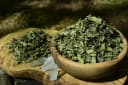
INFUSE offers Calea zacatechichi as whole wild-harvested leaves from the Puebla region of Mexico, and as an elixir. The plant is easily confused with related species: a whole leaf, which you can look at and smell, is easier to check than a powder. Grey-green verging on olive, with a smell of bitter hay and a hint of camphor, it has kept well; brown, pale yellow or odourless, it has aged.
It is also part of the Dream Elixir, alongside Bobinsana, Uvuma, lotus, Yauhtli, kanna and passionflower.
Is Calea zacatechichi legal?
It is sold freely in France. Elsewhere, check the law in your country before ordering.
Can you smoke Calea?
Yes: smoke is one of the Chontal uses described, with the tea and the leaves under the pillow (Díaz, 1979). At the House, it is rolled with a gentle base.
How many nights before you notice anything?
Some dreamers describe an effect from the first night; many describe it over 3 to 5 nights. The notebook on waking shows what changes.
Does Calea make you sleepy?
In the 1986 study, light sleep and brief awakenings increased: it lightens sleep.
Does Calea work during the day?
In awake volunteers, the 1986 study measured longer reaction times and a changed sense of time. At the House, the tea and the elixir are taken in the evening; smoking Calea, a plant of clarity by day as by night, can be rolled at any time of the day.
Why is Calea so bitter?
Its name says so: zacatechichi, bitter grass. A little honey softens it; capsules and the elixir avoid the taste.
Sources
- Mayagoitia L., Díaz J.L., Contreras C.M. (1986). Psychopharmacologic analysis of an alleged oneirogenic plant: Calea zacatechichi. Journal of Ethnopharmacology 18(3):229-243. PubMed 3821139
- Díaz J.L. (1979). Ethnopharmacology and taxonomy of Mexican psychodysleptic plants. Journal of Psychedelic Drugs 11(1-2):71-101. doi:10.1080/02791072.1979.10472094
- Martínez-Mota L. et al. (2021). Calea zacatechichi produces anxiolytic- and antidepressant-like effects, and increases the hippocampal activity during REM sleep in rodents. Journal of Ethnopharmacology 265:113316. doi:10.1016/j.jep.2020.113316
- Sałaga M. et al. (2016). Neuropharmacological characterization of the oneirogenic Mexican plant Calea zacatechichi aqueous extract in mice. Metabolic Brain Disease 31(3):631-641. doi:10.1007/s11011-016-9794-1
- González-Yáñez M.G.E. et al. (2019). Safety of aqueous extract of Calea ternifolia used in Mexican traditional medicine. Evidence-Based Complementary and Alternative Medicine 2019:7478152. doi:10.1155/2019/7478152
- Mossoba M.E. et al. (2016). Evaluation of "Dream Herb", Calea zacatechichi, for nephrotoxicity using human kidney proximal tubule cells. Journal of Toxicology 2016:9794570. doi:10.1155/2016/9794570
- Garcia M.R. et al. (2025). Mexican calea interferes with cholinergic and dopaminergic pathways and causes neuroglial toxicity. Journal of Ethnopharmacology 337:118915. doi:10.1016/j.jep.2024.118915
- Schultes R.E., Hofmann A. (1992). Plants of the Gods. Healing Arts Press.
- Díaz J.L. (1977). Ethnopharmacology of sacred psychoactive plants used by the Indians of Mexico. Annual Review of Pharmacology and Toxicology 17:647-675. doi:10.1146/annurev.pa.17.040177.003243
- Rätsch C. (2005). The Encyclopedia of Psychoactive Plants. Park Street Press.
- Toro G., Thomas B. (2007). Drugs of the Dreaming: Oneirogens, Salvia divinorum and Other Dream-Enhancing Plants. Park Street Press.
- Hirst M. (2005). Dreams and medicines: the perspective of Xhosa diviners and novices in the Eastern Cape, South Africa. Indo-Pacific Journal of Phenomenology 5(2):1-22. doi:10.1080/20797222.2005.11433901
- Sobiecki J.F. (2008). A review of plants used in divination in southern Africa and their psychoactive effects. Southern African Humanities 20:333-351. sahumanities.org
- Wikipedia, Calea ternifolia (accepted name, synonyms, Nahuatl etymology). en.wikipedia.org
Further reading
- The best herbs for lucid dreaming, the guide to dream plants
- Dream herbs
- Undlela Ziimlophe, the root of the white paths
- Entada rheedii, the seed that crossed the seas
- Sinicuichi, the sun herb
- Bobinsana, mistress of the heart
- Yauhtli, the cloud herb
- Mugwort, the oldest of herbs
- Our dreamers' accounts
 4.8(269)from €7.20View →
You have a story to drop into the Forest too?
Share a story →40 min déjà parcourues · 50 min jusqu'au seuil de retour
What this reading opened
Be the first voice. Each word is read before joining.
Sign in to share what this reading opened in you.
Sign in →