Corn poppy, opium poppy, California poppy: how to tell three plants apart
Three flowers called poppy, three different plants. The corn poppy of the fields, the opium poppy and the California poppy differ in their alkaloids, their legal status and their use: how to tell them apart, and what the sources say.
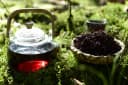 The plant of this articleWild Poppy · Papaver rhoeas4.9(114)from €6.00View →
The last sovereign territory. You enter through the plants, through silence, through a return to the dreams of the elders.
tagline · path
Short answer. Corn poppy (Papaver rhoeas) and opium poppy (Papaver somniferum) are two species of the same genus with different alkaloids: morphine and codeine belong to the opium poppy, while corn poppy carries another family, the rhoeadine alkaloids. The California poppy (Eschscholzia californica) belongs to a different genus altogether. The 1961 UN Single Convention names the opium poppy; it names neither the corn poppy nor the California poppy.
Three plants at a glance
| Corn poppy | Opium poppy | California poppy | |
|---|---|---|---|
| Latin name | Papaver rhoeas | Papaver somniferum | Eschscholzia californica |
| Flower | bright red, often with a black blotch at the centre | white, pink or mauve, large | orange to yellow, four silky petals |
| Leaves | deeply cut, hairy | blue-green, waxy, clasping the stem | fine, feathery, grey-blue |
| Fruit | small capsule | large round capsule | long narrow pod |
| Alkaloids | rhoeadine family | morphine, codeine, thebaine | californidine, eschscholtzine, protopine |
| Status | unrestricted | controlled by the 1961 Convention and national laws | unrestricted |
Corn poppy, the flower of the fields
The Priestess of the Night. Corn poppy grows along wheat fields and footpaths all over Europe; it was said to bloom in the cave of Hypnos, the Greek god of sleep. The petals are what goes into the cup: one or two teaspoons in hot water, ten to fifteen minutes, and the infusion turns purple, soft as velvet. The same petals can be steeped again up to three times.
In 2018, a Korean team compared the alkaloids of corn poppy and opium poppy and identified 55 of them. The rhoeadine-family alkaloids turned up only in corn poppy; morphine and codeine, only in opium poppy (Oh et al., 2018).
Our corn poppy comes as dried flowers for tea. Its story, from Demeter to the fields of Flanders, is told in our monograph.
The opium poppy
The opium poppy has been grown since antiquity, for its seeds and for the latex that runs from the still-green capsule when it is scored. Dried, that latex is opium: it contains morphine and codeine. The 1961 Single Convention on Narcotic Drugs names the plant by its Latin name and also covers poppy straw, every part of the plant except the seeds. Each country then regulates how it is grown.
The poppy seeds on bakery bread come from this plant. The seeds themselves contain no alkaloids, but their surface can be contaminated with latex during harvest. The European Food Safety Authority (EFSA) set an acute reference dose for morphine of 10 micrograms per kilogram of body weight (opinion of 2011, confirmed in 2018).
The California poppy
The California poppy is the state flower of California, a vivid orange that closes in the evening. It belongs to the same family as the poppies, the Papaveraceae, but to another genus. Its main alkaloids are californidine, eschscholtzine and protopine. The European Medicines Agency (EMA) published a traditional-use monograph on it in 2015. INFUSE does not sell it.
What the law says
The 1961 Single Convention names Papaver somniferum; corn poppy and California poppy do not appear in it. In Germany, the Narcotics Act (BtMG, Schedule III) covers the opium poppy, seeds excepted. In Russia, the list in Government Decree No. 934 of 2010 covers the opium poppy and the other Papaver species that contain narcotic substances. In Brazil, ANVISA's List E names Papaver somniferum.
Precautions
- Pregnancy and breastfeeding: no corn poppy, as reliable data are lacking.
- Sedative medicines: corn poppy may add to their effect; ask for medical advice before combining them.
- Eating the plant: in Konya, Turkey, an emergency department described five cases of poisoning in people who had eaten corn poppy (Günaydın et al., 2015). The tea is made from the dried petals.
- In the garden: ornamental poppies are often Papaver somniferum; their capsules are not for picking to make tea.
Is corn poppy a drug?
No. Corn poppy contains neither morphine nor codeine, which belong to the opium poppy; its alkaloids are of the rhoeadine family. No narcotics convention names it, and it is sold freely as a herbal tea.
Is corn poppy poisonous?
As a tea of dried petals, it has been drunk in Europe for centuries. Eaten, the plant caused five cases of poisoning described in Turkey (Günaydın et al., 2015). No corn poppy during pregnancy or breastfeeding, nor with sedatives without medical advice.
What is the difference between Papaver rhoeas and Papaver somniferum?
Papaver rhoeas, the corn poppy, is a red field flower with a small capsule. Papaver somniferum, the opium poppy, has large white, pink or mauve flowers, waxy blue-green leaves and a large capsule whose latex gives opium.
Does California poppy contain opium?
Opium is the latex of the opium poppy, Papaver somniferum. The California poppy belongs to another genus, Eschscholzia; its main alkaloids are californidine, eschscholtzine and protopine.
Do poppy seeds contain morphine?
The seeds do not make it; their surface can be contaminated with latex during harvest, and EFSA has set an acute reference dose for morphine of 10 micrograms per kilogram of body weight.
How do you make corn poppy tea?
One or two teaspoons of dried petals in a cup of hot water, ten to fifteen minutes, then strain. The same petals can be steeped again up to three times, a little longer each time.
Sources
- Single Convention on Narcotic Drugs, 1961, article 1 ("opium poppy", "poppy straw"), United Nations.
- Oh J.H. et al. (2018). Identification and metabolite profiling of alkaloids in aerial parts of Papaver rhoeas by liquid chromatography coupled with quadrupole time-of-flight tandem mass spectrometry. Journal of Separation Science 41(12):2517-2527. PMID 29607619.
- Günaydın Y.K. et al. (2015). Intoxication due to Papaver rhoeas (Corn Poppy): Five Case Reports. Case Reports in Medicine 2015:321360. PMID 26074968.
- EFSA (2011). Scientific opinion on the risks for public health related to the presence of opium alkaloids in poppy seeds; EFSA CONTAM (2018), EFSA Journal 16(5):5243.
- EMA, HMPC (2015). Community herbal monograph, Eschscholziae herba.
- Betäubungsmittelgesetz (BtMG), Schedule III, Germany.
- Decree of the Government of the Russian Federation No. 934 of 27 November 2010.
- ANVISA, List E of controlled plants, Brazil (RDC No. 1011/2026).
 4.9(114)from €6.00View →
You have a story to drop into the Forest too?
Share a story →0 min déjà parcourues · 5 min jusqu'au seuil de retour
What this reading opened
Be the first voice. Each word is read before joining.
Sign in to share what this reading opened in you.
Sign in →