⊹ To weave around
To accompany Adaptogenic Blend
Click a card to see why it pairs — and choose your form.
✦ Adaptogenic Blend · in one breath ✦
It kindles the morning fire and anchors the vital essence; the ground holds over time.
⊹ The path of the plant
⊹ Community voices
What the community murmurs.
No testimony yet for this plant — nothing invented, nothing fabricated. If you have met it, your account can open the way for those who come after.
Ask the Forest about Adaptogenic Blend
408 books digested, 97,512 indexed passages. She answers on lineages, synergies, cautions, ritual variations.
⊹ FREQUENT QUESTIONS ⊹
We answer.
What is an adaptogenic blend?
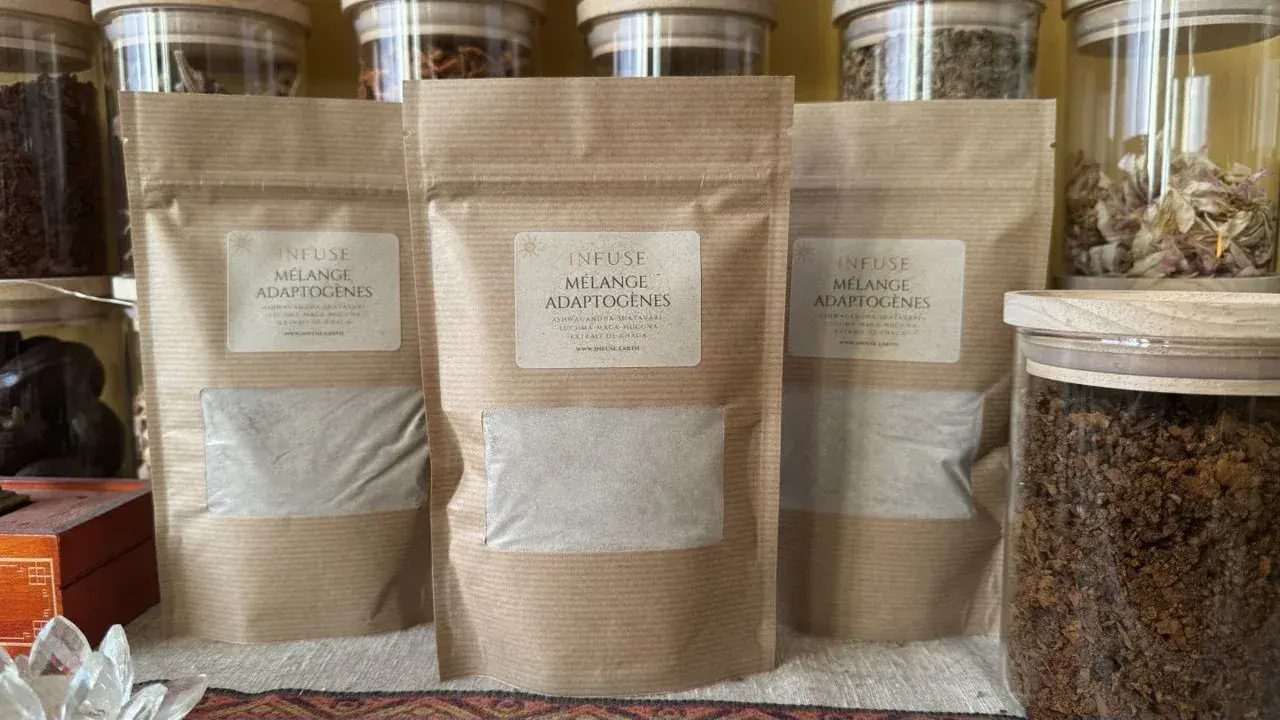
An adaptogenic blend is a mix of plants and mushrooms described as adaptogens — species studied for their capacity to help the body deal with different forms of stress without unbalancing its functions. Our Inner Fire blend gathers six lineages (Chaga, Ashwagandha, Shatavari, Mucuna, Maca, Lucuma) into a powder prepared warm like a latte.
Does the adaptogenic blend contain caffeine?
No. None of the six plants in the blend contains caffeine. It is designed as a coffee alternative, for the warm cup of the morning.
Which plants compose this blend?
Six. Chaga (8:1 extract), Ashwagandha, Shatavari, Mucuna pruriens, Maca and Lucuma — three lineages crossed between Indian Ayurveda (Ashwagandha, Shatavari, Mucuna), Andean high-altitude medicine (Maca, Lucuma) and Siberian boreal mycology (Chaga).
How do I prepare an adaptogenic latte?
Place a heaped teaspoon (about 5 g) in a small saucepan. Add 250 ml of plant milk (oat, almond, coconut). Heat gently until simmering — around 85°C, never boiling — to preserve the beta-glucans of Chaga. Emulsify with a manual or electric frother for 30 seconds to obtain a creamy texture.
When should I drink the adaptogenic blend?
In the morning, as a waking ritual — ideally between 7 and 10 am, after twenty minutes of natural awakening, and before 2 pm. Its nutritional density accompanies the morning.
Can the adaptogenic blend replace coffee?
It is designed as an alternative to coffee — same warmth, same morning gesture, without caffeine. The transition is gentle — two weeks in parallel with coffee.
How long before I feel the effects of an adaptogenic blend?
Adaptogens work over time — not as immediate effects. Count two to four weeks of daily intake for a first integrated sensation. It is a ground that builds.
Is the adaptogenic blend contraindicated during pregnancy?
Yes, as a precaution. The blend contains plants active on hormonal and nervous systems; it is contraindicated during pregnancy, breastfeeding, or in case of dopaminergic treatment (Mucuna naturally brings L-DOPA) without the advice of a healthcare professional.
⊹ Chapter · Questions ⊹
Ask, answer, share.
One question, one answer — sometimes several voices. The community answers first; INFUSE steps in when it should.
- Anonymous voiceSep 1
Le matin ou le soir ?
- flordelparaisoestelarINFUSE teamSep 2
Le matin, comme rituel de réveil — idéalement entre 7 h et 10 h, après vingt minutes d'éveil naturel. Sa densité nutritionnelle accompagne la matinée et tempère la sensation de faim. Pas après 14 h — Mucuna et Maca peuvent légèrement éveiller en fin de journée.
In depthbotany · phytochemistry · history
The word and the thing
The word adaptogen is young. Coined in 1947 by the Soviet toxicologist Nikolai Lazarev and refined by Israel Brekhman in his 1968 work on Eleutherococcus senticosus, it names substances described as helping the body cope with different forms of stress — physical, climatic, mental — without unbalancing its functions. The canonical definition sets three criteria: non-specificity (effective against varied stressors), normalisation (a return toward balance, whichever way the imbalance runs) and innocuousness (no disruptive effects at usual doses).
The thing this word names is far older. At least three lineages had observed and formalised it long before: Vedic Ayurveda (the concept of rasayana), the high-altitude medicine of the Andes (the plants of the Junín plateau as everyday food-medicines) and the circumpolar boreal pharmacopoeia (chaga, eleuthero). Soviet science of the 1950s and 60s categorised it.
Six roots, six roles
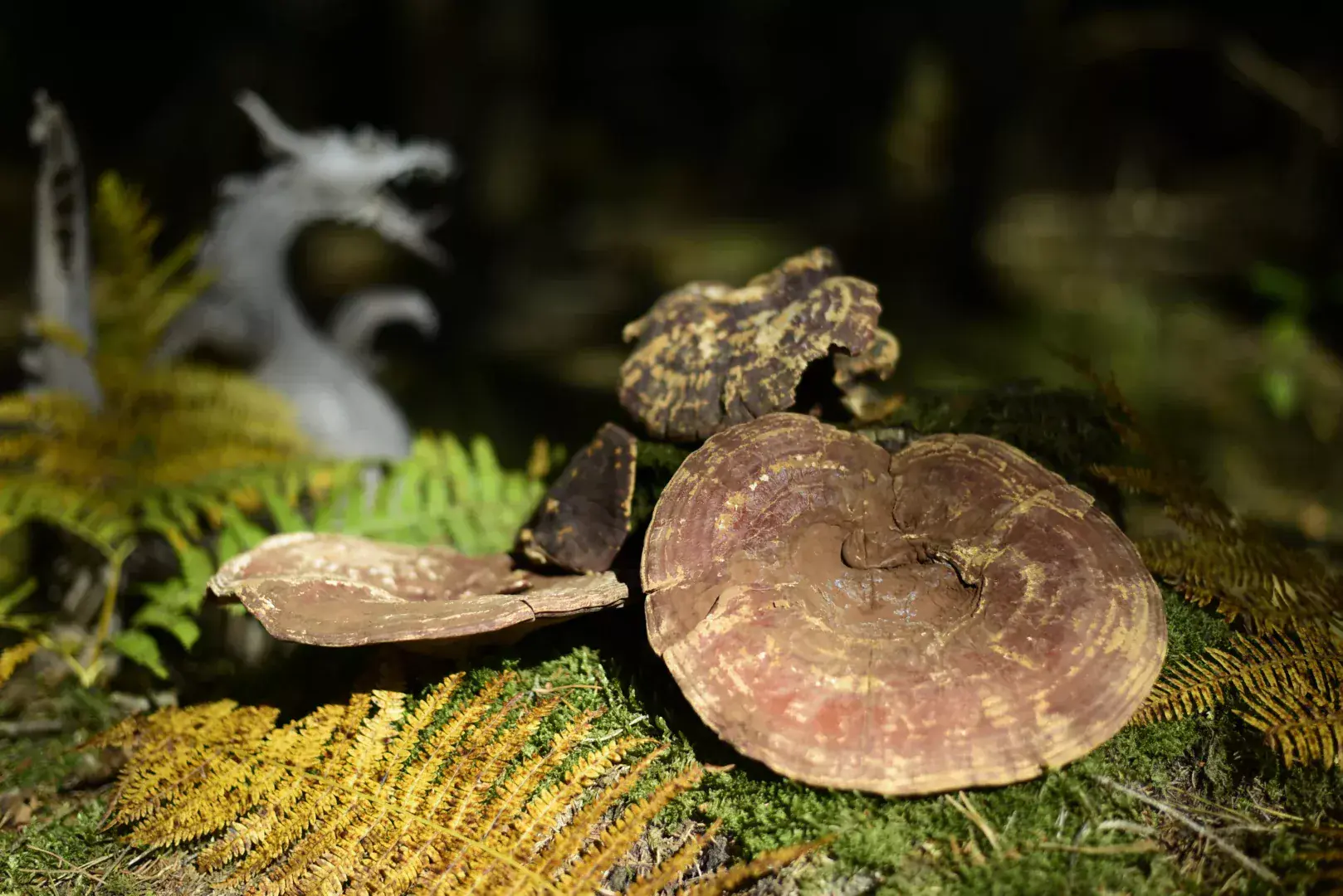
Chaga (*Inonotus obliquus*, 8:1 extract). A parasitic fungus of the birch, growing in cold forests. Its black, cracked conk holds beta-glucan polysaccharides (estimated in the literature at around 8% of dry weight), triterpenes (betulinic acid, inotodiol, lupeol) and melanin pigments. Traditionally gathered by peoples of the boreal forest (the Khanty, the Cree, the Ojibwe), it appears here as a concentrated 8:1 extract, so that the alcohol-soluble triterpenes reach the cup in a useful amount alongside the water-soluble polysaccharides. The extract is made by dual extraction.
Ashwagandha (*Withania somnifera*). A major root of the Ayurvedic pharmacopoeia, counted among the rasayana and, more precisely, the medhya rasayana (the rasayana of the mind). Its phytochemistry is dominated by the withanolides, a family of steroidal lactones. The scientific literature on it remains descriptive and uneven. The blend uses the whole root as a powder, as in the Indian tradition, and no third-party standardised extract.
Shatavari (*Asparagus racemosus*). Another Ayurvedic rasayana, associated in the tradition with nourishing and moistening the tissues, and linked by the texts to the feminine (the Sanskrit name shatavari reads as "she of the hundred roots" or, in a popular reading, "she who has a hundred husbands"). Its tuberous root contains steroidal saponins (shatavarins I to IV) and mucilage. In the blend it brings a soft, receptive polarity that balances the more tonic roots.
Mucuna pruriens (kapikacchu). A tropical legume whose seed contains L-DOPA, the direct precursor of dopamine (typically 3–6% of the seed's dry weight, depending on variety and preparation). It has a long history in Ayurvedic practice, where it is associated with motivation. The seed is prepared the traditional way, with a long soak that reduces its anti-nutrients, and no third-party standardised extract is used. This is a fact of composition, stated as such: bioavailability depends on many factors, and caution is required with any dopaminergic treatment.
Maca (*Lepidium meyenii*). A tuber grown on the Junín plateau in Peru, above 4,000 metres, since pre-Inca times. It contains complex carbohydrates, fibre, amino acids (including the eight essential ones), iron, calcium, zinc and selenium, along with macamides, fatty-acid amides (N-benzylamides) characteristic of maca. Traditionally, it is eaten cooked.
Lucuma (*Pouteria lucuma*). An Andean fruit with dense, dry, yellow-orange flesh that tastes of caramel, maple syrup and vanilla. The Moche of coastal Peru (1st to 8th centuries CE) shaped ceramic bottles after the fruit, and lucuma often appears on the ceramics of coastal burial sites. As a powder, it contains beta-carotene, iron and niacin. In the blend it sweetens naturally, so no sugar needs to be added, and its roundness turns the drink into a pleasure.
Three polycentric pharmacopoeias
The blend deliberately brings together distinct origins — India, Peru, the boreal forests — without claiming a single, millennia-old tradition. The thread that links them is an Ayurvedic reading: the pairing of Ojas (vital essence, the deep reserve) and Tejas (the fire of transformation, clarity). The nourishing ingredients (shatavari, lucuma, maca) sit on the Ojas side, the more tonic ones (chaga, mucuna, ashwagandha) on the Tejas side. This is a storytelling frame, and we offer it as one.
The Sanskrit rasayana (from rasa, essence or fluid, and ayana, path or vehicle) names, in Ayurveda, a category of plant-foods associated with regeneration and with nourishing the deep tissues. Ashwagandha, shatavari and mucuna belong to it by tradition.
At 4,000 metres, on the puna of Junín, the Quechua traditionally prepare maca as mazamorra, a porridge in which the root cooks for several hours in water, sometimes with quinoa and milk. Cooking gelatinises the starches (the local term is gelatinizada) and makes the root easier to digest. Preparing the blend in hot milk follows the same cooked path.
Nuggets & lineage
Aleksandr Solzhenitsyn gave chaga a place in literature: in Cancer Ward (written 1963–1966, published 1968), the patient Oleg Kostoglotov, a former Gulag prisoner, longs to gather the birch fungus and brew it himself.
Israel Brekhman, who worked from 1964 at the Institute of Biologically Active Substances in Vladivostok, set out the theory of the adaptogen in his 1968 monograph on Eleutherococcus, then with Dardymov in 1969. The Soviet trials of eleuthero followed sailors, divers, pilots, athletes, workers and cosmonauts: the adaptogen was born in Soviet scientific and military research.
Safety and good use
The blend brings together plants that act on the hormonal and nervous systems. It is not advised during pregnancy or breastfeeding without the advice of a health professional. Because of its L-DOPA content, mucuna calls for caution with any neurological or psychiatric treatment (notably MAO inhibitors, dopaminergic medication and antiparkinsonian treatment): ask for advice before use. As with any plant-food, starting with small amounts lets you observe how your body responds.
The blend is not a medicine and replaces no treatment. It accompanies a slow building of the ground, over several weeks to several months, with quiet, cumulative effects: that is precisely what sets it apart from a stimulant.