Mycelial synergy
Four intelligences. Check them all for the complete synergy.
✦ Chaga Yaga · in one breath ✦
Resilience, grounding.
⊹ The path of the plant
⊹ Community voices
What the community murmurs.
Average · 27 reviews
including 26 left on our Etsy shop
Breakdown
I have become a fan of this shop and of Chaga, which replaces my morning coffee. I adore. THANKS.
Túyyo
Daily · left on our Etsy shop · 18 January 2024
I am happy to have discovered this serious store on Etsy. The different plants were carefully packaged. These are of very good quality. I loved the Chaga, which replaced my traditional coffee. A very nice discovery. THANKS.
Túyyo
Daily · left on our Etsy shop · 5 January 2024
This is the perfect coffee helper! I brew it with my normal coffee, or I boil it and use the water to make tea. It's lovely tasting
Kathleen
Daily · left on our Etsy shop · 13 October 2023
Super fast shipping. Truly top quality product. I've been using it for a couple of days and it gives me a lot of energy and mental clarity.
Lorenzo Galli
Daily · left on our Etsy shop · 17 December 2023
Works like an extremely good version of chaga, well concentrated. Healing and inspiring, divining!
bas
Daily · left on our Etsy shop · 13 July 2023
Feeling good with this one! Love that I can use a spoonful a few times and still receive its benefits.
Lauren Carrozzi
Daily · verified purchase · 27 October 2024
The mushroom quality is excellent! I use it as base for medicinal tea blends.
lisafrez
Daily · left on our Etsy shop · 20 April 2025
Ask the Forest about Chaga Yaga
408 books digested, 97,512 indexed passages. She answers on lineages, synergies, cautions, ritual variations.
⊹ FREQUENT QUESTIONS ⊹
We answer.
What is Chaga?
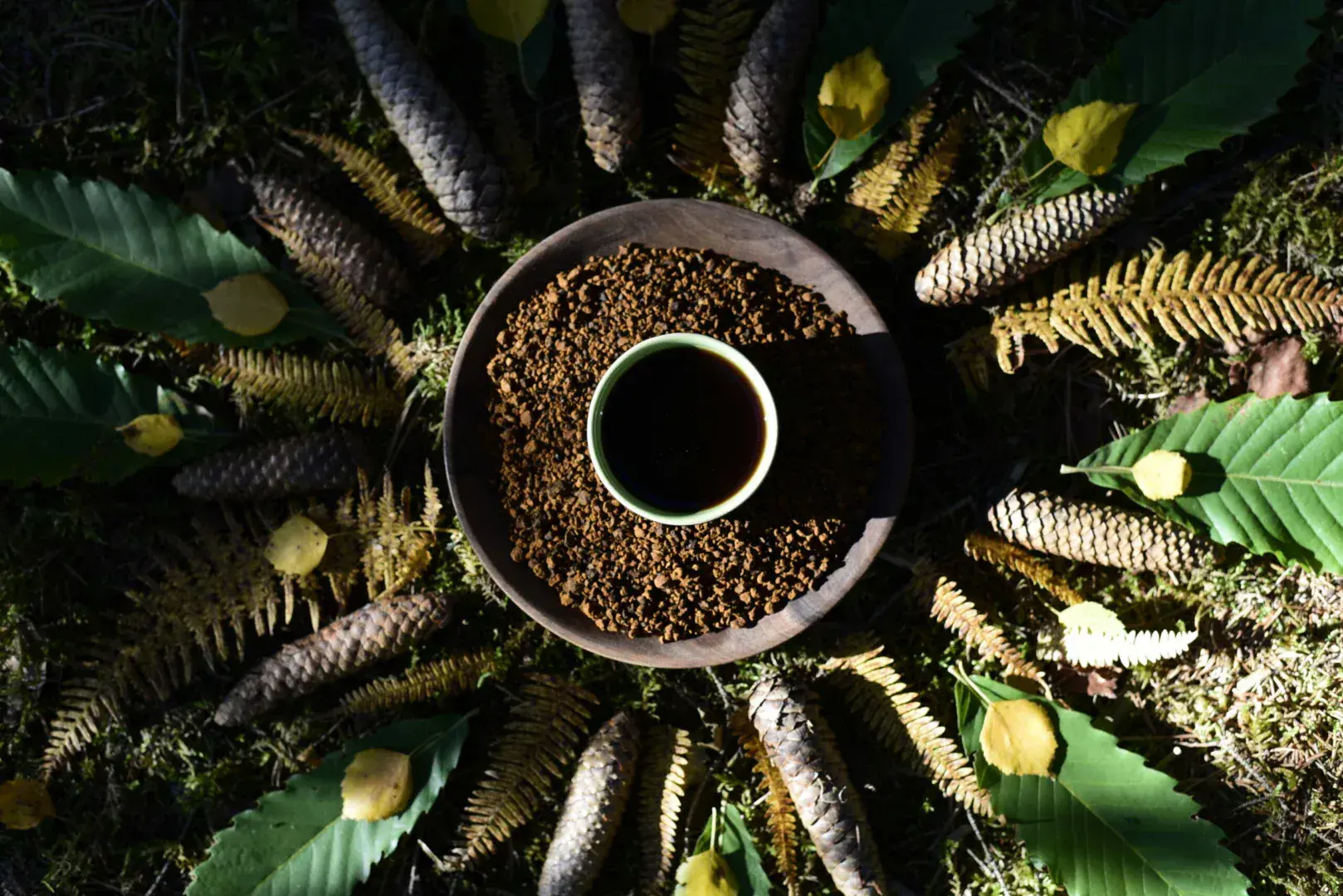
Chaga (Inonotus obliquus) is a parasitic fungus that grows on the bark of birch trees in boreal forests — Siberia, northern Europe, North America. The black, cracked conk that is harvested is not a classic mushroom cap but a dense mycelial mass, brown-orange at heart. An earthy drink with coffee and caramel notes, traditionally drunk as a long decoction.
Why is Chaga called the mushroom of immortality?
It is a traditional nickname, inherited from Siberian and East Asian medicines, where Chaga was held as an elixir of longevity. In China she was also called king of plants. These names speak the esteem of the peoples who used her for centuries — they describe a reputation, not a health promise.
How do I prepare Chaga?
The traditional way is the long decoction, never boiling water. Count 2 to 3 spoons of ground Chaga for 1 litre of water, gentle simmer 20 to 30 minutes, until a deep brown colour. The pieces can be reused several times. The 8:1 powder extract dissolves directly — 0.5 g once or twice a day in a warm drink.
Do I really need a double extraction for Chaga?
Yes, for the complete medicine. Chaga keeps her compounds in two compartments — beta-glucans are water-soluble, triterpenes (including betulin, inherited from the birch) are alcohol-soluble. A simple water infusion pulls only part. Double extraction (water + alcohol) opens both doors; this is the reason for the INFUSE 8:1 extract.
Does Chaga contain caffeine?
No, Chaga does not contain caffeine. This is precisely why many make her a morning coffee replacement — her earthy warmth and coffee-caramel taste give a warm ritual without the jitters or caffeine spike.
What are the precautions and contraindications of Chaga?
Chaga is contraindicated during pregnancy and breastfeeding for lack of data, in case of anticoagulant treatment, active autoimmune disease, history of oxalate kidney stones (she is rich in oxalates) and treated diabetes. Stop her two weeks before any surgery. When in doubt, ask your doctor's advice before using her.
Where does INFUSE's Chaga come from and is she cultivated?
INFUSE's Chaga is wild, never cultivated — harvested on living birch in Estonia, at the heart of winter. Chaga takes a decade or more to mature: her medicine holds to this wild slowness, impossible to reproduce in fast culture.
Can Chaga be drunk every day?
Yes, she is a medicine of duration. Tradition drinks her as a daily cure over weeks — one cup per day is worth more than a large one-off dose. Many do cures of several weeks followed by a pause.
⊹ Chapter · Questions ⊹
Ask, answer, share.
One question, one answer — sometimes several voices. The community answers first; INFUSE steps in when it should.
Nobody has opened a thread yet about this plant. You can be the one — a real question, a use, a doubt, a detail.
Anonymous if you prefer.
In depthbotany · phytochemistry · history
Botany: what is really harvested
Inonotus obliquus (botanical synonym Polyporus obliquus), also called the birch mushroom and known in Russia as chaga (чага), is a fungus of the Hymenochaetaceae family, a parasite of birches (Betula spp.), more rarely of alder or beech. A detail often overlooked: the black, charcoal-like conk that bursts through the bark — the one that is harvested and called “chaga” — is not the sexual fruiting body of the fungus. It is a sterile mycelial mass, a hard aggregate close to compacted charcoal, which can weigh several kilos. The true fruiting body only forms after the death of the host tree, beneath the bark, and is rarely observed. All the material used therefore comes from the parasitic conk — the visible expression of a long settling into the wounded tree.
Descriptive phytochemistry
Chaga is one of the most studied fungi in modern pharmacology; the literature attributes to it a great number of activities described in vitro. Its compounds fall into two families, and this is what explains the need for double extraction:
- Water-soluble polysaccharides — beta-1,3-D-glucans and beta-1,6-D-glucans (on the order of 8.5% of dry weight according to reviews), soluble in water.
- Fat-soluble lanostane-type triterpenoids — inotodiol, betulinic acid, betulinin, lupeol, ergosterol — part of which (betulin and betulinic acid) is inherited from the host birch. Soluble in alcohol only.
- Melanin and polyphenols: melanin, responsible for the black colour of the conk, is among the densest antioxidant pigments known.
Chaga's antioxidant capacity, measured by the ORAC index, is reported among the highest of all foods studied (an order of magnitude far above that of common berries). This value describes a free-radical-neutralising power measured in the laboratory; it does not in itself constitute a promise of an effect on the human body.
Mechanisms: what the studies report
The available work is largely on cellular or animal models, and must be read with caution: it describes leads, not therapeutic effects established in humans. In vitro studies report an activation of macrophages and NK (Natural Killer) cells by beta-glucans, an antioxidant and anti-inflammatory activity (via inhibition of NF-κB), and, for certain isolated triterpenes such as inotodiol and betulinic acid, an induction of apoptosis in various tumour cell lines in culture. Others report hepatoprotective, antiviral (HSV, HIV, HBV in the test tube) or blood-sugar-lowering effects in animals. None of this translates, to date, into validated medical use: Chaga remains a traditional medicine and a food.
A long history, from the 12th century to today
The oldest documented use goes back to the Khanty of western Siberia, in the 12th century: the conk set to burn slowly then plunged into hot water for a decoction, digestive brews, smoke for the lungs. Russian tradition attaches to Chaga a tenacious reputation as a remedy: it is told — a semi-legendary account — that Tsar Vladimir Monomakh (12th century) was relieved of an ailment of the lip by a Chaga decoction. In the 20th century, the Soviet Pharmacopoeia of 1955 listed Chaga under the name Befunginum, as an official adjuvant — one of the rare bodies of traditional knowledge integrated into a state pharmacopoeia. Then, in 1968, Aleksandr Solzhenitsyn's novel Cancer Ward, in which a character hopes for a “peasant remedy” made from Chaga, made the fungus known outside Russia: after its translation, exports to Europe, Japan and North America soared, and more than 1,600 scientific articles have since been devoted to it. This is the cultural history of a plant — the way a people, a pharmacopoeia and then a novel carried a body of knowledge from one end of the world to the other.
Preparing the complete medicine
The complete traditional path combines two gestures. The long decoction in water (a gentle simmer, never a rolling boil, which alters the polysaccharides) extracts the beta-glucans; it readily runs two to three hours for whole pieces, and the conk can be reused several times. The alcoholic tincture (a maceration of several weeks in alcohol at 40-50%) extracts, for its part, the fat-soluble triterpenes inaccessible to water. Combining the two extracts gives the full spectrum — this is the principle of double extraction, and what the ready-to-use 8:1 extract reproduces. A Chaga powder simply infused stays pleasant and nourishing, but delivers only the water-soluble part.
Safety and ecology
Chaga is generally well tolerated in food use, but its richness in oxalates calls for caution in case of a history of kidney stones; its immunomodulating activity and its reported effects on blood sugar and coagulation warrant medical advice for the people concerned (autoimmune diseases, treated diabetes, anticoagulants, upcoming surgery, pregnancy, breastfeeding). Finally, an ecological truth: Chaga grows slowly, sometimes over ten to twenty years, and the “superfood” craze has caused a worrying over-harvesting in the Russian and North American boreal forests, which the Indigenous communities of Canada report. Hence the need for a measured wild harvest, respectful of the tree's rhythm — the only way not to exhaust the source one celebrates.