Mycelial synergy
Four intelligences. Check them all for the complete synergy.
Read it through your world
The whole page is read through this lens.
✦ Reishi Mushroom · in one breath ✦
A companion for the long run.
⊹ The path of the plant
⊹ Community voices
What the community murmurs.
Average · 19 reviews
including 18 left on our Etsy shop
Breakdown
We are loving the Reishi Mushroom and drink it daily. This product tastes great and is high quality.
Hanni Guinn
Daily · verified purchase · 13 September 2024
Everything alright. Thanks! Nice big pieces! Very suitable for making tea
Heiner
Daily · left on our Etsy shop · 13 March 2023
Best quality, cleanly shipped and great effect.
Dagmar Wolf
Daily · left on our Etsy shop · 10 April 2024
Ask the Forest about Reishi Mushroom
408 books digested, 97,512 indexed passages. She answers on lineages, synergies, cautions, ritual variations.
⊹ FREQUENT QUESTIONS ⊹
We answer.
What are the benefits of reishi (Ganoderma lucidum)?
Reishi is an adaptogenic mushroom ranked at the top of the classical Chinese pharmacopoeia among the "superior" tonics. Taoist tradition associates her with calm of mind and longevity; studies describe her beta-glucans and triterpenes, without any promise of effect. INFUSE presents her as a ground companion, not a remedy.
Why does reishi require a double extraction?
Because her two families of compounds do not release in the same solvent — beta-glucans are water-soluble, triterpenes only alcohol-soluble. A simple herbal tea leaves about half the mushroom in the material. Double extraction (water + alcohol) captures both. The INFUSE powder extract is a dual 15:1, fruiting body, ≥20% beta-glucans and ≥4% triterpenes.
Mycelium or fruiting body, what difference for reishi?
The fruiting body is the visible, woody mushroom, rich in triterpenes and beta-glucans. Mycelium grown on grain (rice, oat) is often diluted by the cereal starch and poorer in triterpenes. INFUSE works the fruiting body exclusively, without mycelium or filler — it is the part that traditional Chinese and Japanese medicine has documented.
Why is quality reishi so bitter?
Bitterness comes from triterpenes (the ganoderic acids). In Chinese tradition, the more bitter the reishi, the more she is held as vigorous — bitterness is read as a marker of quality. A commercial reishi without bitterness has often lost her triterpenes, by failed extraction or dilution. Tradition softens her with honey, or associates her with liquorice, jujube, goji berries.
How do I prepare reishi as a decoction?
The traditional Chinese way is the long decoction. Gently simmer about 5 to 10 g of dried slices in one litre of water — without boiling, boiling degrades the polysaccharides — until reduced by half. Strain and drink warm. The slices, very woody, reinfuse several times by extending the cooking time.
Is reishi legal?
Yes. Freely sold in France and the European Union.
Where does INFUSE's reishi come from?
The Reishi in thin dried slices is wild-harvested in Siberia, in the depth of winter, in forests far from human activity. The 15:1 extract comes from a Reishi cultivated in China, fruiting body only.
How long before I feel something with reishi?
Reishi is not a plant of immediate effect. Tradition and contemporary herbalists describe her as a ground mushroom, of whom we speak in weeks and months rather than hours. She is classically used in a cure of 7 to 21 days, followed by a pause, or in a long cure.
Reishi, chaga, lion's mane or cordyceps — which to choose?
These are four complementary mushrooms. Reishi is associated with calm and longevity, chaga with grounding and the boreal cold, lion's mane with cognitive terrain, cordyceps with breath. Many keep them together as a mycelial stack rather than choosing. INFUSE offers them separately.
⊹ Chapter · Questions ⊹
Ask, answer, share.
One question, one answer — sometimes several voices. The community answers first; INFUSE steps in when it should.
Nobody has opened a thread yet about this plant. You can be the one — a real question, a use, a doubt, a detail.
Anonymous if you prefer.
In depthbotany · phytochemistry · history
The mycology: a being of another kingdom
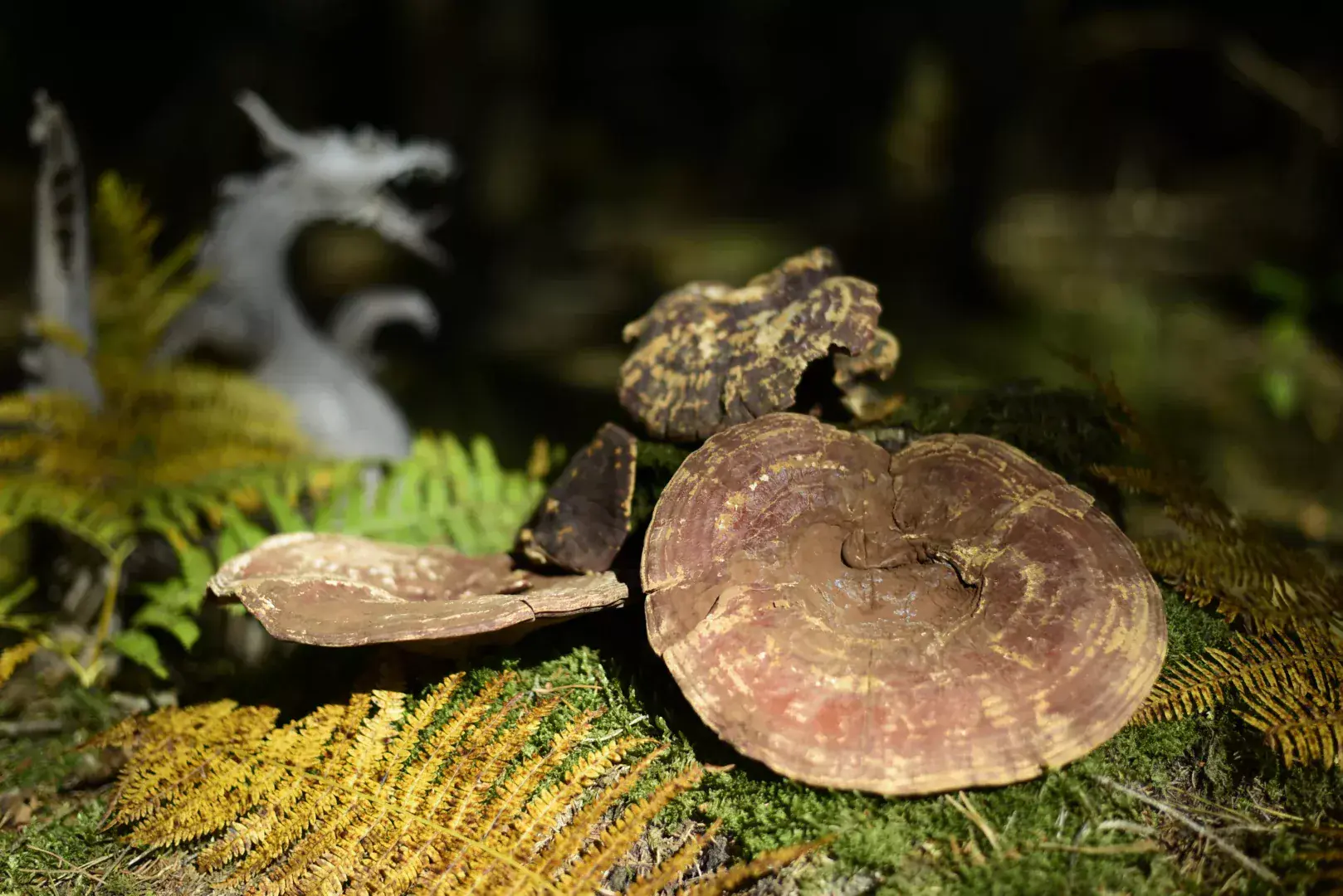
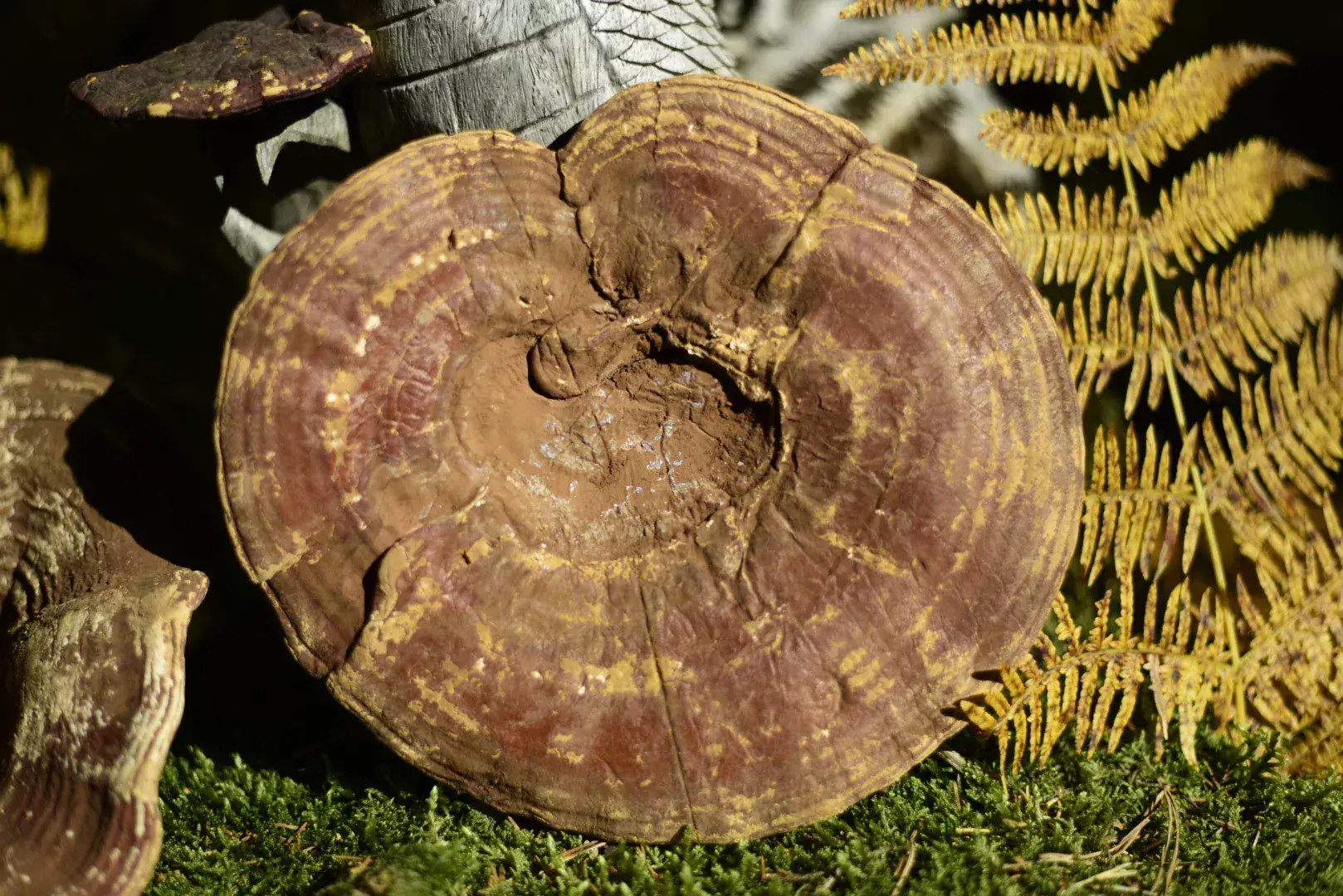
Reishi is Ganoderma lucidum (with its sister species Ganoderma sichuanense), a polypore of the Ganodermataceae family. It belongs to the kingdom Fungi, distinct from the plants and, on the tree of life, closer to the animals. Reishi grows on hardwoods (oak, maple, alder, beech) and forms a hard, almost woody fruiting body whose surface shines as if lacquered. This hardness has a practical consequence: the mushroom is too tough to be eaten as it is, so it is prepared as a long decoction or as an extract.
The two families of compounds (descriptive)
Reishi's chemistry falls into two broad classes, and they govern its preparation. On one side, the polysaccharides — above all the beta-glucans (β-1,3 and β-1,6-D-glucans) — which dissolve in water. On the other, the triterpenes — more than a hundred ganoderic acids identified, built on a lanostane skeleton — which dissolve only in alcohol. These triterpenes give reishi its deep bitterness.
Bitterness as a marker of quality
Chinese tradition reads bitterness as the direct sign of the mushroom's vigour: the more concentrated the triterpenes, the more bitter the cup, and the more highly it is prized. A reishi without bitterness has usually lost its triterpenes, through a water-only extraction, through mycelium diluted by the starch of its culture grain, or in a product softened for Western palates. Sweetening the cup with honey is a traditional practice; taking the bitterness out at the source leaves a product with little left to offer.
Why the double extraction (and the fruiting body)
This follows directly from the double solubility. Like chaga and lion's mane, reishi needs two separate extractions to deliver its full range: a water decoction for the beta-glucans, an alcohol maceration for the triterpenes, then the two combined. A simple infusion leaves the triterpenes behind. The second point of quality is the part used. The fruiting body — the visible mushroom — is the part documented over the centuries by the Chinese and Japanese pharmacopoeias. Mycelium grown on grain sells for less, is often diluted by the starch of the cereal it grows on, and is poorer in triterpenes. The INFUSE extract is a dual 15:1 extract of the fruiting body, with no mycelium or filler, and declared contents (≥20% beta-glucans, ≥4% triterpenes).
What the studies report
Pharmacological research on Ganoderma lucidum is abundant and calls for careful reading. The beta-glucans are described as immunomodulatory in in vitro work and in animal models; the triterpenes are the subject of in vitro studies describing hepatoprotective and anti-inflammatory effects. We report these lines of research as they stand, as leads consistent with a traditional use more than a thousand years old, and never as a promise of effect. In the INFUSE voice, reishi stays a companion for the long run.
The name as signature: lingzhi
Lingzhi (靈芝) deserves a pause. Ling (靈) denotes subtle power, the spirit that acts, the effective invisible; it is also the character used for mediums and for supernatural beings at work. Zhi (芝) names the mushroom itself. Lingzhi therefore reads, literally, as the mushroom of the subtle spirit that acts. Japanese uses the same characters (reishi, 霊芝); mannentake (万年茸) means "the ten-thousand-year mushroom"; in Korean it is yeongji. The name "mushroom of immortality" goes back to the Han texts, where lingzhi is the mushroom of the xian immortals: a name more than two thousand years old.
Six colours, five elements
The Shennong Ben Cao Jing, the classical Chinese materia medica, describes six coloured forms of lingzhi. Five of them answer to an organ in the Five Elements system — red (chi-zhi 赤芝, Fire, Heart), blue-green (qing-zhi 青芝, Wood, Liver), yellow (huang-zhi 黃芝, Earth, Spleen), white (bai-zhi 白芝, Metal, Lung) and black (hei-zhi 黑芝, Water, Kidney) — and a sixth is purple (zi-zhi 紫芝). In this system of correspondences, the colour of the mushroom indicated its affinity for an organ. Most of the reishi traded today is red, the most available and most studied form; the other colours survive in traditional medicine and are hard to find in the West.
Sources: Shennong Ben Cao Jing (classical Chinese pharmacopoeia) · ethnobotanical and pharmacological literature on Ganoderma lucidum · INFUSE Mushroom Extracts labels 2026. Traceability details being consolidated.
Read in the ForestThe articles that mention her.
Read the monograph: Reishi Mushroom →