⊹ To weave around
To accompany Ashwagandha
Click a card to see why it pairs — and choose your form.
✦ Ashwagandha · in one breath ✦
The strength of the horse — an adaptogenic root of Ayurveda.
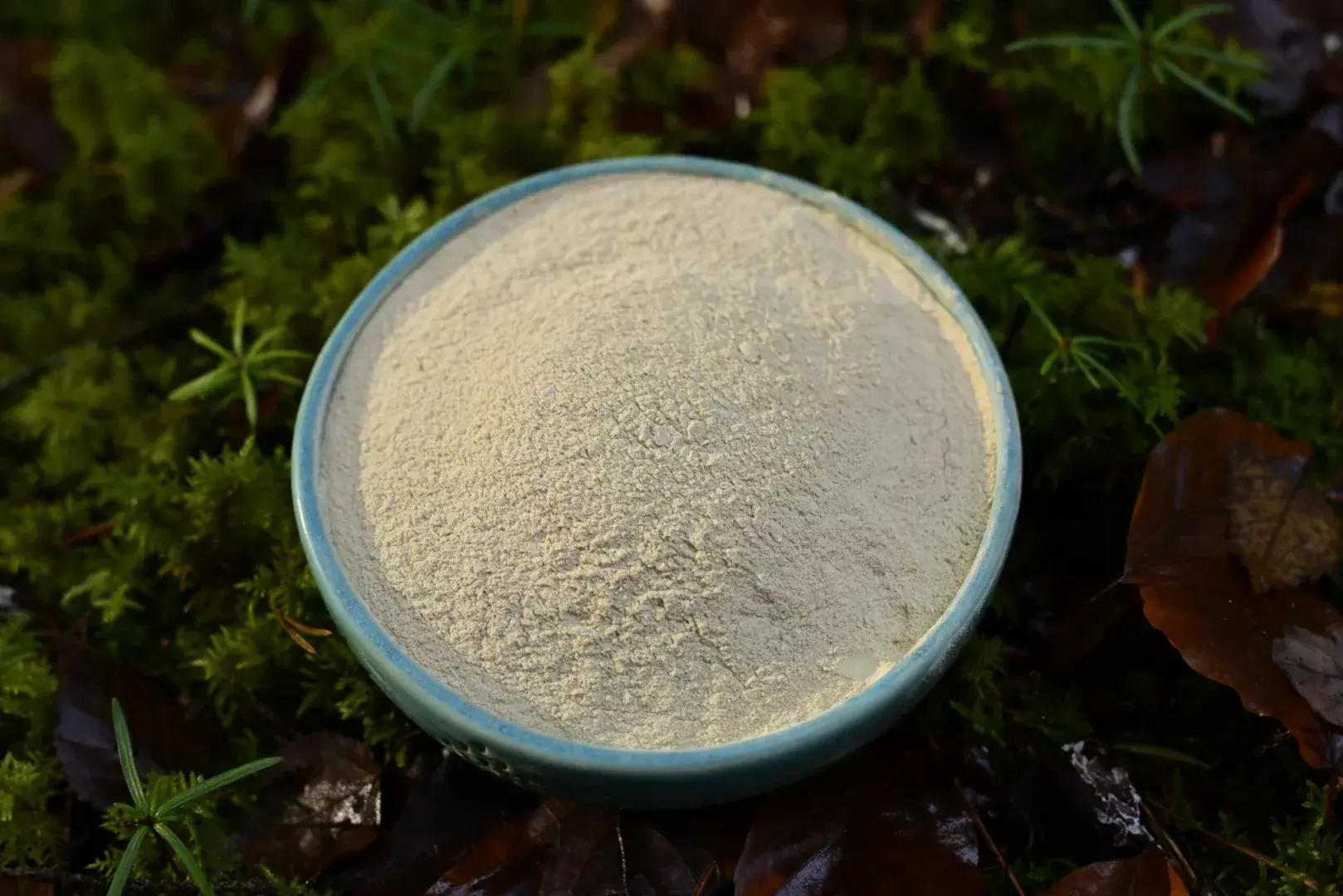
⊹ The path of the plant
⊹ Community voices
What the community murmurs.
Average · 22 reviews
including 19 left on our Etsy shop
Breakdown
Excellent product. I have been using it for several days. I found shape and dynamism. In addition, despite the stress, I remain calm. Very surprising.
Gwenaelle
Daily · left on our Etsy shop · 6 January 2024
Using it twice a day and can def see a difference. Keeping me mellow and balanced. Works great in a hot beverage!
Lauren Carrozzi
Daily · verified purchase · 27 October 2024
Ashwagandha being an adaptogen is great, so you can mix it with most things. I like it with guarana, but it's also pleasant with apple cider vinegar, lemon juice and hot water too.
James
Daily · left on our Etsy shop · 7 February 2025
I have always wanted to try ashwaganda, and I'm glad I did. As an adaptogen I'm really happy with how's it's working with my body!
Kathleen
Daily · left on our Etsy shop · 13 October 2023
Ask the Forest about Ashwagandha
408 books digested, 97,512 indexed passages. She answers on lineages, synergies, cautions, ritual variations.
⊹ FREQUENT QUESTIONS ⊹
We answer.
Should I take ashwagandha in the morning or in the evening?
Both gestures exist: the warm milk in the evening, or the cup in the morning. Ayurvedic tradition often favours the evening milk. She is a plant of rooting: choose the moment when you seek to come down.
What is the difference between whole root powder and a standardised extract?
The whole root powder (what INFUSE offers) contains the complete cortege of compounds of Withania somnifera, in the form Ayurveda has prepared for centuries. A third-party standardised extract concentrates certain compounds and better reproduces a dose, but moves away from the root as she grows. INFUSE chooses the whole root, slower, closer to the plant.
How long before I feel the effects of ashwagandha?
Tradition reads Ashwagandha in long time — about twenty-one days for the first signs, three months for deep reconstruction, one year to change foundations. She is not a plant of immediate effect. If you try her ten days and then abandon, you have not met her. Patience is part of the use.
How do I prepare ashwagandha powder?
The classic way — one teaspoon (3 to 5 g) in 250 ml of warm milk, plant-based or animal, with a pinch of cardamom or cinnamon, simmered five minutes. The fatty body and gentle heat carry the plant in depth. She can also be mixed into a smoothie or porridge. No need to filter.
Is ashwagandha legal?
Freely sold in France. Check the law in your country.
What precautions before taking ashwagandha?
Caution in case of thyroid disorder or treatment (she can affect the thyroid), pregnancy or breastfeeding (insufficient data), hormone-sensitive prostate cancer, and Solanaceae allergy. Rare cases of liver damage have been reported. Stop two weeks before surgery. When in doubt, consult before starting.
Ashwagandha or rhodiola — which one to choose?
Two adaptogens, two different gestures. Ashwagandha is a root of long cures, taken in warm milk — a plant of ground. Rhodiola is taken rather in the morning, over shorter periods.
Can I take ashwagandha every day over the long term?
This is even how tradition reads her — a plant of cure, taken continuously over several weeks then in windows with pauses, rather than as a one-off gesture. The dried root slowly loses activity over time (the herbalist literature places this decline around two years), hence the interest of quantities consumed within the year. For long-term treatment, ask a practitioner's advice.
⊹ Chapter · Questions ⊹
Ask, answer, share.
One question, one answer — sometimes several voices. The community answers first; INFUSE steps in when it should.
Nobody has opened a thread yet about this plant. You can be the one — a real question, a use, a doubt, a detail.
Anonymous if you prefer.
In depthbotany · phytochemistry · history
Botany — a nightshade that smells of horse
Ashwagandha is botanically Withania somnifera (L.) Dunal, of the Solanaceae family — the family of the tomato, the potato, henbane and mandrake. The root is slender and smooth, thirty to forty centimetres long and one to two centimetres thick; the orange-yellow seeds measure one to two millimetres (Rätsch, Encyclopedia of Psychoactive Plants, p. 543). She can be confused with Withania frutescens (Mediterranean), Withania aristata (Canary Islands) and small Physalis. Her native range forms a broad belt from North Africa and the Middle East, across the Arabian peninsula, to the Indian subcontinent and Southeast Asia: she thrives in dry climates and poor soils, which already says something about her temperament.
The name carries the plant. Ashva (horse) + gandha (smell) in Sanskrit: the root is said to smell of wet horse. The species name somnifera is Latin for "sleep-bringing". In English she is also called Indian ginseng and winter cherry (in French, ginseng indien); her botanical basionym is Physalis somnifera L. The chemistry of the root differs from that of the leaf, and most commercial supplements use the root (NIH Office of Dietary Supplements). INFUSE works with the whole root, ground to a powder, and uses no third-party standardised extract.
Phytochemistry — the withanolides and their companions
The signature compounds of Withania somnifera are the withanolides, a group of steroidal lactones named after the genus Withania, among them withaferin A. The root also holds sitoindosides (glycosides), alkaloids in modest amounts (tropine, cuscohygrine, withasomnine), choline, fatty acids and amino acids. The composition varies with the part of the plant, its origin and the age of the root, which is why a concentrated isolate does not match the root as it grows. This page names these compounds descriptively and attaches no promise of effect to them.
Lineage and long history — from rasayana to adaptogens
In Ayurvedic medicine, ashwagandha belongs to the rasayana, the rejuvenating plants. The word says literally "the path the rasa takes" — rasa being the plasma, the primordial tissue; the rasayana are the plants that sustain vitality over the long term (Winston & Maimes, Adaptogens, pp. 40-41; Frawley & Lad, The Yoga of Herbs, pp. 254-255). Named in the Charaka Samhita and the Sushruta Samhita, she carries several function-names there — balya (strength-giving), vajikari ("that makes one like a horse"), vrushya (plant of desire), rasayana (rejuvenating), pustida (nourishing) — which sum up the range of her traditional uses (status: attributed traditional use). Frawley and Lad describe her as sattvic, one of the best herbs for the mind, "nurturing and clarifying", calming and promoting "deep dreamless sleep"; energetically bitter, astringent and sweet, and warming, she lowers Vata and Kapha and raises Pitta.
Her map reaches beyond India. Rätsch notes that she was known in ancient Egypt, that she may have been used in Mesopotamia (if the reading of the Assyrian name is right), and that old Arabic sources called her sakran, "intoxicating". In India the aerial parts are smoked for coughs and asthma; the Assyrians used the root as a fumigant for aching teeth, and in Yemen the root is still used for toothache (Rätsch, pp. 542-544). In the twentieth century, Soviet research (Lazarev, then Brekhman) defined the category of adaptogens, into which ashwagandha is now placed.
What the studies report — with caution
Most of the clinical research on ashwagandha concerns concentrated extracts, rarely the whole root. These studies describe observations, do not hold for every person and do not establish a medical use. The heart of the traditional use, the slow restoration of the reserve, has no single laboratory correlate.
Safety and points of use
Several signals call for caution. On the thyroid, rises in T4 have been reported, a fall in TSH in subclinical hypothyroidism, and rare cases of thyrotoxicosis that resolved once the plant was stopped: monitoring and medical advice are needed with any thyroid treatment. Rare cases of liver injury, sometimes severe, have been linked to ashwagandha supplements — most often reversible on stopping, and on products whose composition was not always verified. In pregnancy and breastfeeding, a potential abortifacient effect has been raised (the American Herbal Products Association contests it) and the data are insufficient: avoid without supervision. Caution is also advised with hormone-sensitive prostate cancer, for heat constitutions (Pitta), since the root is warming, and with a nightshade (Solanaceae) allergy. Stop two weeks before scheduled surgery. The dried root slowly loses its activity (herbal literature puts this decline at around two years): keep it away from light and damp. This page documents a lineage and traditional uses; it is not medical advice, and in case of doubt the opinion of a health professional comes before the plant.