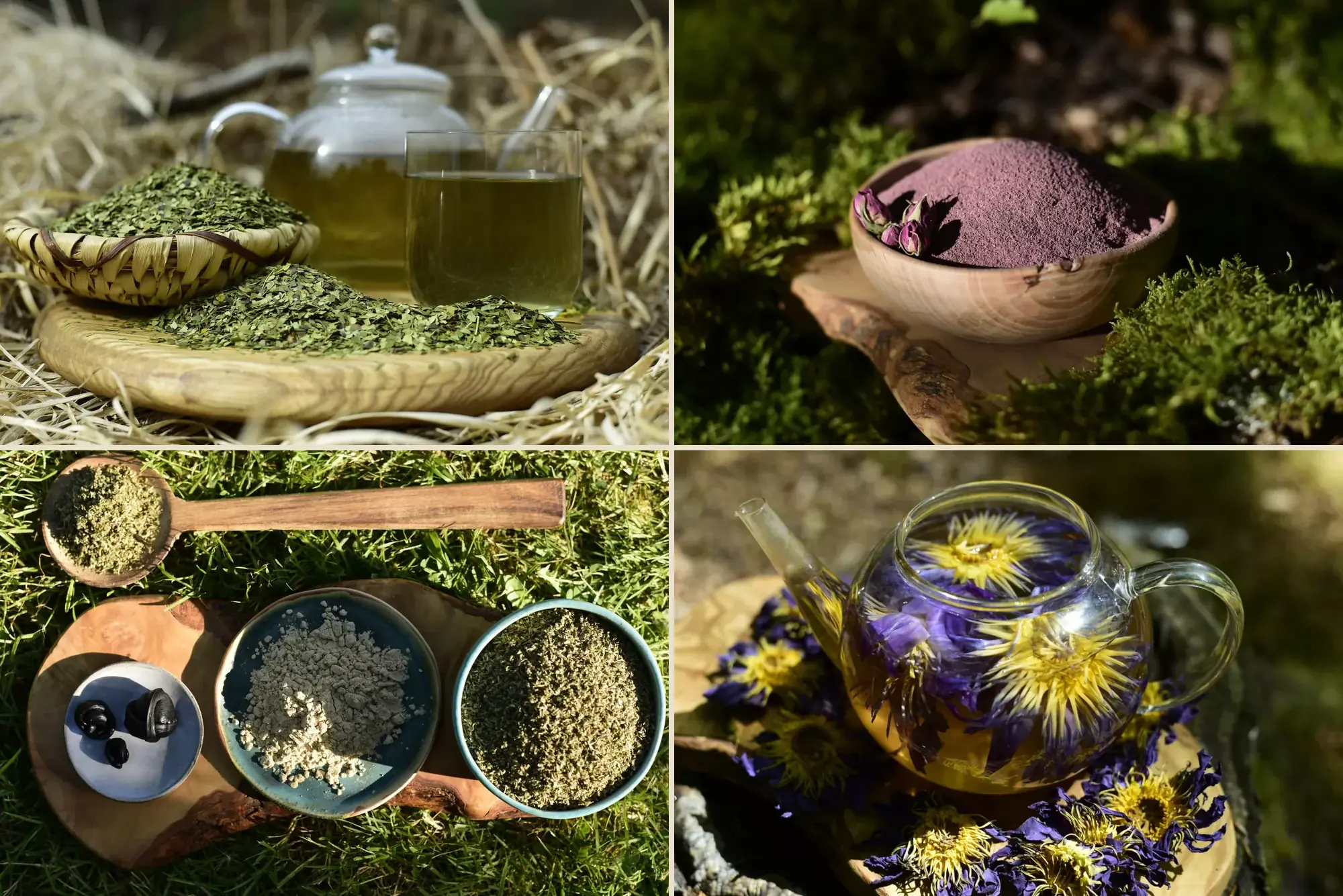
⊹ To weave around
To accompany Pink Lotus
Click a card to see why it pairs — and choose your form.
⊹ Community voices
What the community murmurs.
4.9/542 reviews, including 42 left on our Etsy shop
I’m a frequent purchaser from this shop, all items (I’ve purchased almost all of the products listed over the past couple of years) are always of a high quality and at a good price compared to what is available locally in my country. Thanks so much for your consistent great service, quick delivery and the great sample products I have received with my orders! I also appreciate that you often have great descriptions of what the products are typically used for which makes it easy for me to identify which products match my needs. I’ve tried many products from other shops previously but they were never as good and were more expensive than what this shop provides. I’ve done a huge amount of research on other suppliers products and always find this one to be the best available and they always pass our countries customs regulations.
kathyraynel
Nicely packaged, the pink lotus was great gave a feeling of euphoria when you smoke it. And thank you for the complementary blue lotus as well. With the pink lotus and blue lotus combined gives a great effect.
Jezabel
I already loved the Pink Lotus in Petals that I find deeply Relaxing and pleasant but the Pistils are still a little stronger. The two mixed, it's the top It makes everything soft and it makes you want to sleep Fan of this plant Top quality, smells super good with very good taste Totally recommend!
Nébuleuse
Read Pink Lotus through your world
The page reads from the ceremony side: the subtle senses, depth, the inner journey.
✦ Pink Lotus · in one breath ✦
Calming and euphoric — bodily relaxation, psychic insights, a support for meditative practices.
Signature INFUSEIntensity · scored out of 10
| contemplative | 10/10 | |
|---|---|---|
| sacred flower | 10/10 | |
| calm and euphoric | 9/10 | |
| meditation | 10/10 | |
| visible re-flowering | 9/10 |
Register Padma, flower of the Buddha, birth of Brahma, meditative practices · India · China · Buddhism · Sri Lanka
⊹ The path of the plant
⊹ FREQUENT QUESTIONS ⊹
We answer.
What is pink lotus (Nelumbo nucifera)?
Pink lotus is the sacred flower of India and Buddhist Asia, botanically named Nelumbo nucifera. She is called Padma in Sanskrit and flower of the Buddha. It is she that Hindu iconography places under Brahma and the Buddha — the flower that grows in the mud and opens intact above the water. INFUSE offers her whole flowers, stamens and a powder extract.
What are the felt effects of pink lotus?
Asian traditions describe pink lotus as both calming and subtly euphoric — a warm and lucid presence. She is taken in the evening for relaxation, before a meditative sitting, or as a ritual bath. She is a flower of contemplative moments.
How do I prepare a pink lotus infusion?
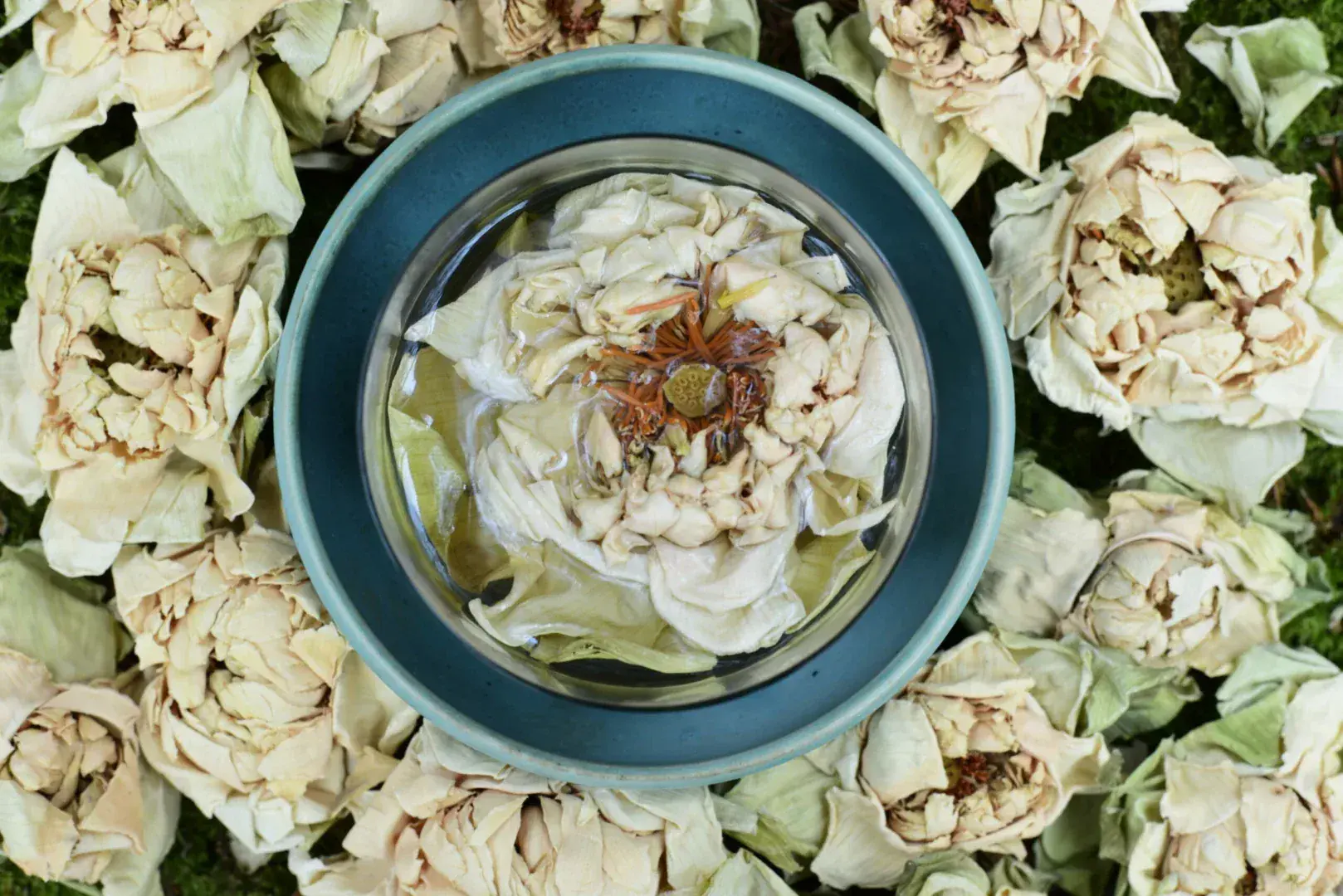
Place a whole flower (or a spoon of stamens) in a large cup, pour simmering but never boiling water, and let infuse 7 to 10 minutes. The same flower reinfuses two to three times. At one moment she stops floating, comes back down and reopens, submerged — it is magnificent to watch. In the evening, slowly.
What is the difference between pink lotus and blue lotus?
These are two distinct botanical families. Pink lotus is a true lotus, Nelumbo nucifera (Nelumbonaceae family), carried by Indian, Buddhist and Chinese traditions. Blue lotus is Nymphaea caerulea (Nymphaeaceae family), a water lily of Egyptian tradition. Different chemical profiles and lineages — a resemblance of shape.
Does pink lotus help to sleep?
Traditional Asian use situates her in the evening, as companion of relaxation and the sleep threshold. Many drink her before bedtime or during a yoga nidra practice. INFUSE formulates no medical promise — the flower accompanies an evening ritual, she heals nothing.
Can a lotus flower be reused several times?
Yes. One whole flower gives two to three successive infusions, each revealing a different nuance. Keep the flower in the cup between two waters. It is one of the joys of pink lotus — a single flower crosses an entire evening.
All questions
What precautions with pink lotus?
Start with a small quantity to observe your body's reaction. To avoid in case of pregnancy or breastfeeding without professional advice. Caution in case of antihypertensive, antidiabetic treatment, or medications acting on dopamine or serotonin. In case of Nelumbonaceae allergy, abstain. DYOR, as always.
Where do INFUSE's pink lotus flowers come from?
Our pink lotus flowers are harvested in the lakes of Sri Lanka, in collaboration with a small family business.
⊹ Chapter · Questions ⊹
Ask, answer, share.
One question, one answer — sometimes several voices. The community answers first; INFUSE steps in when it should.
Nobody has opened a thread yet about this plant. You can be the one — a real question, a use, a doubt, a detail.
In depthbotany · phytochemistry · historyRead
Botany — a true lotus, not a water lily
Nelumbo nucifera is one of only two living species of the genus Nelumbo — the sole genus of the Nelumbonaceae, an almost solitary botanical family. It is a common source of confusion: despite a striking resemblance, pink lotus is not a water lily. The Nymphaea (including the Egyptian blue lotus, Nymphaea caerulea) belong to the Nymphaeaceae, a distinct family, with their own chemical profiles and cultural lineages. The resemblance is the fruit of evolutionary convergence.
The word Nelumbo comes from the Sinhalese nelum, the name the people of Sri Lanka have given the flower since well before written memory. Nucifera means "nut-bearing": the flower's pierced receptacle holds its seeds in the open, like an upturned watering-can rose.
Two remarkable singularities
The seed that sleeps for centuries. Nelumbo nucifera seeds keep an exceptionally long capacity to germinate. Seeds unearthed from an ancient dried-up lake in Liaoning, China, sprouted after more than a thousand years in the ground. For the contemplative traditions the image is limpid: a potential that can wait a very long time before it finds the conditions for its germination.
The flower that warms itself. A phenomenon rare in the plant kingdom, the Nelumbo flower thermoregulates: it holds its internal temperature between 30 and 35 °C even when the air drops to 10 °C, probably to attract pollinators on cool nights. And the lotus effect — the self-cleaning of its leaves by an extremely hydrophobic waxy micro-structure — gave its name to a whole field of materials biomimicry, coined thus in 1997.
Phytochemistry (descriptive)
The flower contains several families of compounds studied over the past thirty years or so. Foremost is nuciferine, an aporphine-type alkaloid that pink lotus shares with blue lotus. Then come neferine, particularly present in the green embryo of the seed (Lian Xin), secondary aporphines (roemerine, lirinidine), and antioxidant flavonoids (kaempferol, quercetin, miquelianin — the latter fairly characteristic of lotus). The seeds bring amino acids, the rhizome polysaccharides, the whole astringent tannins.
On the level of mechanisms, in vitro and animal-model work reports that nuciferine modulates dopaminergic (D2, D5) and serotonergic (5-HT1A, 5-HT2) receptors, with a molecular profile that some studies describe as close to atypical antipsychotic compounds. Neferine is described in the literature for anxiolytic and antiarrhythmic effects. This data is, for the most part, preclinical: the pharmacology of Nelumbo nucifera is less studied than that of Nymphaea caerulea, and many traditional properties still await their clinical validation. INFUSE works the whole dried flower, never an isolate — the path Asia has followed for millennia.
A long lineage — India, Buddhism, China
The most famous Hindu image: Vishnu reclining on the serpent Shesha above the primordial waters, a pink lotus emerging from his navel, and Brahma seated at its summit beginning to manifest the universe. Creation there is not separate from the divine sleep — it emerges from it, through the lotus.
In Buddhism, the lotus runs through the whole iconography of awakening: the seven lotuses of the Buddha's first steps, the Lotus Sutra, the colour code (pink for the Buddha, white for mental purity, red for compassion, blue — Nymphaea — for wisdom, gold for perfection). The tantric system of the chakras is itself a series of lotuses blossoming along the spine, up to the Sahasrara, the thousand-petalled lotus at the crown of the skull, image of the union of individual and cosmic consciousness.
The Tra Sen — the art of slow perfume
In imperial Vietnam, fresh flowers were gathered at dawn around Lake Tay Ho, opened delicately, filled with five to seven grams of premium green tea, closed again with a thread, and left to perfume the tea through the night. In the morning the tea was dried and the work began again — five to seven nights, fresh flowers each time. For one kilo of finished tea, about ten kilos of flowers. This tea, the Tra Sen, was reserved for emperors; a few specialist families still keep it alive. The implicit teaching: certain kinds of beauty know no shortcut.
Safety notes
Pink lotus is generally well tolerated — its seeds, rhizomes and flowers have been eaten as food in Asia for millennia. The precautions concern mainly theoretical interactions: caution with hypotensive and antidiabetic medication (mild modulating effects reported), and with dopaminergic or serotonergic treatments (antipsychotics, SSRIs), as a precaution linked to the alkaloids. Clinical data insufficient for concentrated use during pregnancy or breastfeeding: abstain without supervision. Allergy to Nelumbonaceae: avoid. This text is informational and does not replace the advice of a health professional.
Read in the ForestThe articles that mention her.Read
⊹ Path of the Heart