⊹ To weave around
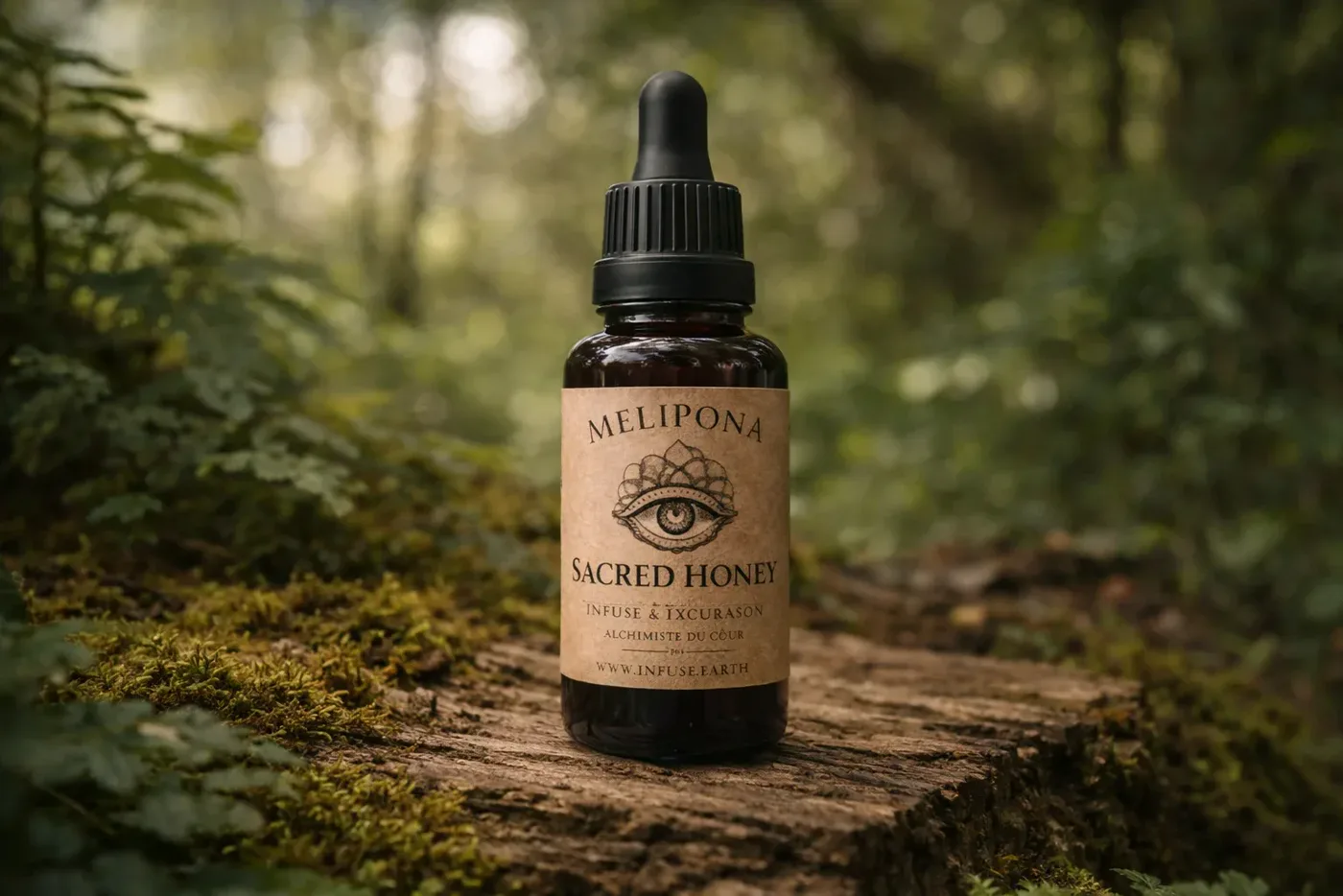
To accompany Melipona Sacred Honey
Click a card to see why it pairs — and choose your form.
Read it through your world
The whole page is read through this lens.
✦ Melipona Sacred Honey · in one breath ✦
The sacred honey of the stingless bees, kept by the Maya lineage.
⊹ The path of the plant
⊹ Community voices
What the community murmurs.
No testimony yet for this plant — nothing invented, nothing fabricated. If you have met it, your account can open the way for those who come after.
Ask the Forest about Melipona Sacred Honey
408 books digested, 97,512 indexed passages. She answers on lineages, synergies, cautions, ritual variations.
⊹ FREQUENT QUESTIONS ⊹
We answer.
What is Melipona honey (Xunán Kab)?
Melipona honey is produced by stingless bees native to Mexico and Central America — the queen species Melipona beecheii, which the Maya call Xunán Kab, the royal lady bee. Meliponiculture (the rearing of these bees) is attested for more than 3000 years in the Yucatán Peninsula.
How do you use Melipona honey?
Ceremonial way: a drop on the tongue during a meditative practice or an intention linked to perception and clarity. As offering: a drop in altar water or directly on a ritual object. In circle: pass the bottle — each person receives a drop with gratitude for the Maya lineage.
What does Melipona honey taste like?
Naturally more fluid and complex than common honey, shaped by the native tropical flora of the Yucatán — more floral, more citric, sometimes lightly fermented on the tongue. It is an honey of intention rather than kitchen: you taste it, you do not eat it.
Where does INFUSE's Melipona honey come from?
Sourced from a small rural collective in Mexico working in ancestral meliponiculture. Harvest taken without harming the colony or the Xunán Kab lineage. Bottled in France in 10 ml Violet Miron to preserve photosensitive compounds.
Why support Maya meliponiculture?
The Melipona beecheii species is today threatened by deforestation and habitat loss in the Yucatán. Supporting meliponiculture means supporting a living Maya lineage, an ancestral knowledge of more than 3000 years, and the whole ecosystem of which these stingless bees are key pollinators.
What precautions with Melipona honey?
Avoid in babies under 12 months (universal recommendation for any raw honey). Caution in case of known allergy to bee products. Minimal dose for those with diabetes. Do not exceed one drop per day in ceremonial use.
⊹ Chapter · Questions ⊹
Ask, answer, share.
One question, one answer — sometimes several voices. The community answers first; INFUSE steps in when it should.
- Anonymous voiceAug 4
Que peux apporter concrètement le miel Melipona lors d un rituel? Quels sont ses effets?
- flordelparaisoestelarINFUSE teamAug 6
Il peut également accompagner d'autres plantes en infusion, notamment le Cacao Cérémoniel, avec lequel il forme une alliance ancienne. Ses effets sont très subtils, il apporte surtout une qualité de présence et peut servir de support d'intention et être associé à une forte dimension symbolique. Il représente notamment la connexion au sacré et à la nature : les abeilles Melipona étant considérées comme précieuses dans certaines cultures, leur miel est vu comme un lien avec les cycles naturels, l'abondance et la gratitude et perçu comme un don sacré. Dans ce contexte, le sens que tu lui attribues et le cadre du rituel peuvent jouer un rôle plus important que ses propriétés intrinsèques elles-même.
- flordelparaisoestelarINFUSE teamAug 6
Le miel de Melipona est aujourd'hui principalement reconnu et utilisé comme puissant collyre. Il suffit de déposer une goutte dans chaque œil, idéalement en position allongée et en étant accompagné si possible afin que l'application puisse se faire en toute sérénité bien qu'il soit également possible de l'appliquer soi-même. Cette pratique est traditionnellement associée à une purification à la fois physique et énergétique du regard. L'expérience peut être intense : une sensation de chaleur ou de picotement est fréquente et s'accompagne souvent d'un important relâchement. Les larmes viennent naturellement, comme une invitation à laisser partir ce qui n'a plus besoin d'être porté. Au-delà du nettoyage des yeux, ce rituel est vécu par de nombreuses personnes comme un véritable nettoyage émotionnel. Il peut favoriser l'ouverture du cœur, permettre de libérer des émotions retenues et offrir un profond sentiment de clarté, de légèreté et de présence. C'est une expérience intime qui invite à accueillir ce qui émerge, avec douceur et sans résistance. Dans les traditions mayas, il était offert aux divinités et utilisé lors de cérémonies de passage, de guérison — pas nécessairement comme substance active mais plutôt comme substance de seuil : un élément qui adoucit le passage d'un état à l'autre, marquant l'entrée dans un temps sacré, adoucissant et ancrant le cœur pour travailler sur son ouverture de façon légère mais profonde.