Chaga « Yaga », the resilience of the wounded birch
A black lump on the living birch, ten winters or more to grow. The tradition of chaga, from the Khanty to the Anishinaabe shkitagen, and our chaga wild-harvested in Estonia.
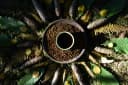 A planta deste artigoChaga Yaga · Inonotus obliquus4.9(28)desde € 16,50Ver →
The quiet kingdom — roots, polypores, mycelium. The resilience of the living, ready for every day.
Tradução portuguesa a caminho — este artigo é apresentado noutra língua.
Chaga, Inonotus obliquus, breaks through the bark of living birches and forms a black, hard, cracked lump, like charcoal stuck to the trunk. Underneath, the flesh is rusty orange. It takes ten years or more to grow, on a tree that is still alive. Its slowness is its signature.
The boreal belt
Chaga grows where birches grow, in the cold forests of the northern hemisphere. All along that belt, peoples know it: the Khanty of Western Siberia, whose use of it is documented from long ago, the Komi and the Sami in the north, and across the ocean the Cree, Innu, Ojibwe and Anishinaabe. The Khanty burned it slowly before plunging it into hot water for a decoction. Russian tradition made it an everyday drink; it is told, half legend, that Grand Prince Vladimir Monomakh drank its decoction in the 12th century.
The fire keeper
Among the Anishinaabe, chaga is called shkitagen, and it keeps the fire. Robin Wall Kimmerer tells it in Braiding Sweetgrass: a spark that falls on the shkitagen does not die, it smoulders in the body of the fungus, holds its warmth, and lights the flame again when it is needed.
On the Canadian side it is also said that the treasure lies neither in the birch alone nor in the chaga alone, but in their bond: two grandmothers leaning on each other. The harvest follows a protocol of respect: ask the tree, take only what is needed, let the small conks grow, give thanks, harvest in winter, detach without wounding the bark.
Kimmerer also recalls that the birch forests were tended by Indigenous burning. The fungus that keeps fire grew where people knew how to make fire. With logging and fire suppression, shkitagen is getting harder to find.
Our chaga, wild from Estonia
Our chaga is wild-harvested in Estonia, in the depth of winter, from the living tree, in forests away from heavy pollution. It is never cultivated.
- The powder (100 g, 200 g, 1 kg): for the decoction, or a spoonful in a warm drink.
- The 8:1 powdered extract (30 g): dual water and alcohol extraction, from a certified organic supply chain. Declared contents: at least 12% glucans and 0.5% betulin, a substance the fungus takes from its birch.
Wild chaga becomes scarce where birch forests retreat, and the superfood trade has over-harvested some regions. One more reason never to harvest from young trees, nor so much that the host suffers.
The gesture
- The decoction: two to three spoonfuls of powder in a litre of water, at a gentle simmer, 20 to 30 minutes, until very dark. A little plant milk for roundness. Chaga can be reused several times, simmering a little longer each round.
- The morning cup: a teaspoon of powder, 3 to 5 g, in plant milk or water just off the boil, around 80 °C.
- The extract: about 0.5 g, once or twice a day, in water, tea or food. It dissolves directly.
Chaga is never boiled hard, only simmered. Its taste is mild, between tea, coffee and caramel, with no caffeine. These are markers of use.
Precautions
- Pregnancy and breastfeeding: avoid, there is not enough data.
- Anticoagulants and antiplatelet drugs, blood pressure medication: medical advice first.
- Active autoimmune disease: medical advice.
- Chaga is high in oxalate: avoid with a history of calcium oxalate kidney stones, osteoporosis or a low-oxalate diet.
- Treated diabetes: medical advice.
- Stop two weeks before surgery.
When in doubt, your doctor before the mushroom.
Wild-harvested in Estonia, in winter, from the living tree, never cultivated. As a powder for decoction, or as an 8:1 dual extract, certified organic supply chain, at least 12% glucans and 0.5% betulin declared.
Discover INFUSE chaga →Where does the name chaga come from?
From Russian чага, borrowed from Komi-Permyak, a language of the Urals. The Anishinaabe call it shkitagen, the fire keeper.
Where does INFUSE chaga come from?
From Estonia. It is wild-harvested in winter, from living birches, and never cultivated.
Why a dual extraction for the extract?
Because its glucans dissolve in hot water and its betulin in alcohol. The 8:1 extract brings both together. The powder is made into a decoction.
Does chaga contain caffeine?
No. Many drink it in the morning instead of coffee, for its warm, earthy taste.
What precautions apply to chaga?
Avoid during pregnancy and breastfeeding, and with calcium oxalate kidney stones. Medical advice with anticoagulants, blood pressure or diabetes medication, and autoimmune disease. Stop two weeks before surgery.
Sources
- Robin Wall Kimmerer, Braiding Sweetgrass, Milkweed Editions, 2013: the Anishinaabe shkitagen.
- Our supplier's technical sheet: 8:1 chaga extract, dual extraction, declared contents.
 4.9(28)desde € 16,50Ver →
Também tens um relato para deixar na Floresta?
Partilhar um relato →O que esta leitura abriu
Sê a primeira voz. Cada palavra é relida antes de se juntar à leitura.
Inicia sessão para partilhar o que esta leitura abriu em ti.
Iniciar sessão →