Gotu Kola, the tiger's leaf
The small round leaf of the rice paddies where, legend says, the injured tiger comes to roll: its names in India, Sri Lanka, China and Korea, the morning kola kenda, and our leaf powder.
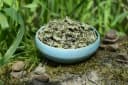 La pianta di questo articoloGotu Kola · Centella asiatica4.9(11)da 14,00 €Vedi →
The quiet kingdom — roots, polypores, mycelium. The resilience of the living, ready for every day.
Traduzione italiana in arrivo — questo articolo è mostrato in un'altra lingua.
A small, round, scalloped leaf that runs low along the rice paddies, the ditches and the shady gardens of tropical Asia. Legend says the injured tiger comes to roll in its green carpets. In India it is called mandukaparni, the frog leaf; in Sri Lanka it is the gotu kola chopped into the morning rice.
The tiger that rolls in the plant
An Asian legend tells that after a fight, the injured tiger seeks out the carpets of centella and rolls in them for a long time. The hunters following its tracks are said to have learned to recognise the plant this way. Korea has kept the name horangi-pul, "tiger grass", and English the same, tiger grass.
A plant of a thousand names
Centella asiatica has a name in every country where it grows, and each one looks at it from a different side.
- Mandukaparni, in Sanskrit: manduka, the frog, parni, the leaf.
- Gotu kola, in Sinhala: kola means leaf, and gotu calls up the little cup drawn by its rounded blade.
- Ji xue cao (积雪草), in Chinese: "the herb of gathered snow".
- Bai bua bok, in Thai: the leaf of the "earth lotus".
- Pegagan, in Indonesian.
- In English, Asiatic or Indian pennywort.
In India it also shares the name brahmi, "belonging to Brahma", with another plant, bacopa, Bacopa monnieri. Depending on the region and the book, the true brahmi is one or the other. What we offer as gotu kola is indeed Centella asiatica.
What Ayurveda says
The Charaka Samhita, in the first chapter of its book of treatments, devoted to rasayana, names the juice of mandukaparni among four preparations it calls medhya rasayana, from medha, the intellect.
Also known as the Fountain of Youth, it is held in India to be a highly spiritual herb: yogis have long drunk it around meditation. In our pages, it resonates with the crown chakra, the sahasrara, at the top of the head.
A leaf for the plate
In South and Southeast Asia, gotu kola is eaten before it is drunk.
- In Sri Lanka, kola kenda is a red rice porridge cooked in coconut milk, into which the green juice of freshly crushed leaves is poured at the end: it is eaten for breakfast. Gotu kola mallung mixes the finely chopped leaves with grated coconut, onion and a squeeze of lime, served beside the rice and curry.
- In Thailand, bai bua bok juice, bright green and sweet, is sold in the streets and drunk iced in the afternoon.
- In Indonesia, the raw leaves go with rice on plates of fresh vegetables, and the plant goes into jamu, the herbal preparations of Javanese families.
The plant
Centella asiatica, long named Hydrocotyle asiatica, is a small creeping perennial of the Apiaceae, the family of carrot, parsley and celery. It spreads by runners that take root at every node, and forms dense carpets in damp soil. Its round, crenate leaves stand at the end of long stalks; its tiny pinkish flowers hide beneath them in small umbels. Native to tropical and subtropical Asia, it has settled in most of the warm, wet regions of the world.
On the tongue the leaf is mild and grassy, with a slightly bitter, distinct finish: that is its signature.
Since the 2010s, Korean cosmetics have made it known worldwide under a short name, cica, taken from Centella asiatica. With us, it is drunk.
Gotu kola at the House
Our gotu kola is a leaf powder, in 100 g and 200 g pouches. The leaves are grown in northern India by a long-established family business. We met our Indian supplier, Amit, during our travels: Amit is highly knowledgeable in Ayurvedic medicine, and a marvellous Ayurvedic cook. The plant is grown in a natural setting, without chemicals; it does not carry European organic certification.
- In a drink or a smoothie: half a teaspoon of powder, whisked into warm plant milk, a juice or a morning smoothie until there are no more lumps. It is the gesture closest to the Thai juice.
- As a tea: half a teaspoon of powder for a large cup of hot water.
- In milk, the Ayurvedic way: the powder simmered gently in dairy or plant milk, with a pinch of ginger, and a little honey once it has cooled slightly. A rounder, cosier cup, for the evening.
Honey, milk or fruit soften its bitterness. We like it in the morning, as a gentle decoction, over a regular stretch: 7 to 21 days, then a break. It pairs with tulsi in a morning brew: two leaves of India in the same cup.
Precautions
- Pregnancy and breastfeeding: avoid as a matter of principle, and ask a health professional.
- Known allergy to Apiaceae (carrot, parsley, celery, fennel): caution. In sensitive people, the fresh leaf can cause contact dermatitis.
- Liver disease, or hepatotoxic medication: medical advice first.
- Barbiturates, benzodiazepines, painkillers, diuretics, diabetes medication: talk to your doctor before use.
- At high doses, headaches and palpitations have been reported: stay within the usual amounts.
When in doubt, your doctor before the plant.
A powder of Centella asiatica leaves, grown in northern India by a family business, in a natural setting, without chemicals. In 100 g and 200 g, for the warm morning drink or simmered in milk.
Discover INFUSE gotu kola →Why is it called the tiger's leaf?
An Asian legend tells that the injured tiger comes to roll in the carpets of centella. Korea calls it horangi-pul, "tiger grass", and so does English.
Are gotu kola and brahmi the same plant?
In India the name brahmi is shared between gotu kola (Centella asiatica) and bacopa (Bacopa monnieri), two distinct plants of Ayurveda. Our gotu kola is indeed Centella asiatica.
Is the cica of Korean skincare the same plant?
Yes: cica is a name taken from Centella asiatica. We offer it as a leaf powder, to drink.
How do I prepare gotu kola powder?
Half a teaspoon whisked into a warm drink, plant milk or a smoothie; or simmered in milk with a little ginger, and honey once it has cooled slightly.
Is your gotu kola organic?
It is grown in northern India, in a natural setting, without chemicals. It does not carry European organic certification.
What precautions apply to gotu kola?
Avoid as a matter of principle during pregnancy and breastfeeding, unless a health professional advises otherwise. Caution with an allergy to Apiaceae. Medical advice first with liver disease, or with barbiturates, benzodiazepines, painkillers, diuretics or diabetes medication. At high doses, headaches and palpitations have been reported.
Sources
- Charaka Samhita, Chikitsa Sthana, chapter 1 (Rasayana): the four medhya rasayana.
- David Frawley and Vasant Lad, The Yoga of Herbs, Lotus Press, 1986.
- INFUSE product sheet: form, origin, cultivation, preparation and precautions.
 4.9(11)da 14,00 €Vedi →
Hai anche tu un racconto da lasciare nella Foresta?
Condividere un racconto →Ciò che questa lettura ha aperto
Sii la prima voce. Ogni parola viene riletta prima di unirsi alla lettura.
Accedi per condividere ciò che questa lettura ha aperto in te.
Accedi →