⊹ To weave around
To accompany Gotu Kola
Click a card to see why it pairs — and choose your form.
Read it through your world
The whole page is read through this lens.
✦ Gotu Kola · in one breath ✦
Fresh, powerful, activating — she awakens the connection between body, spirit and breath.
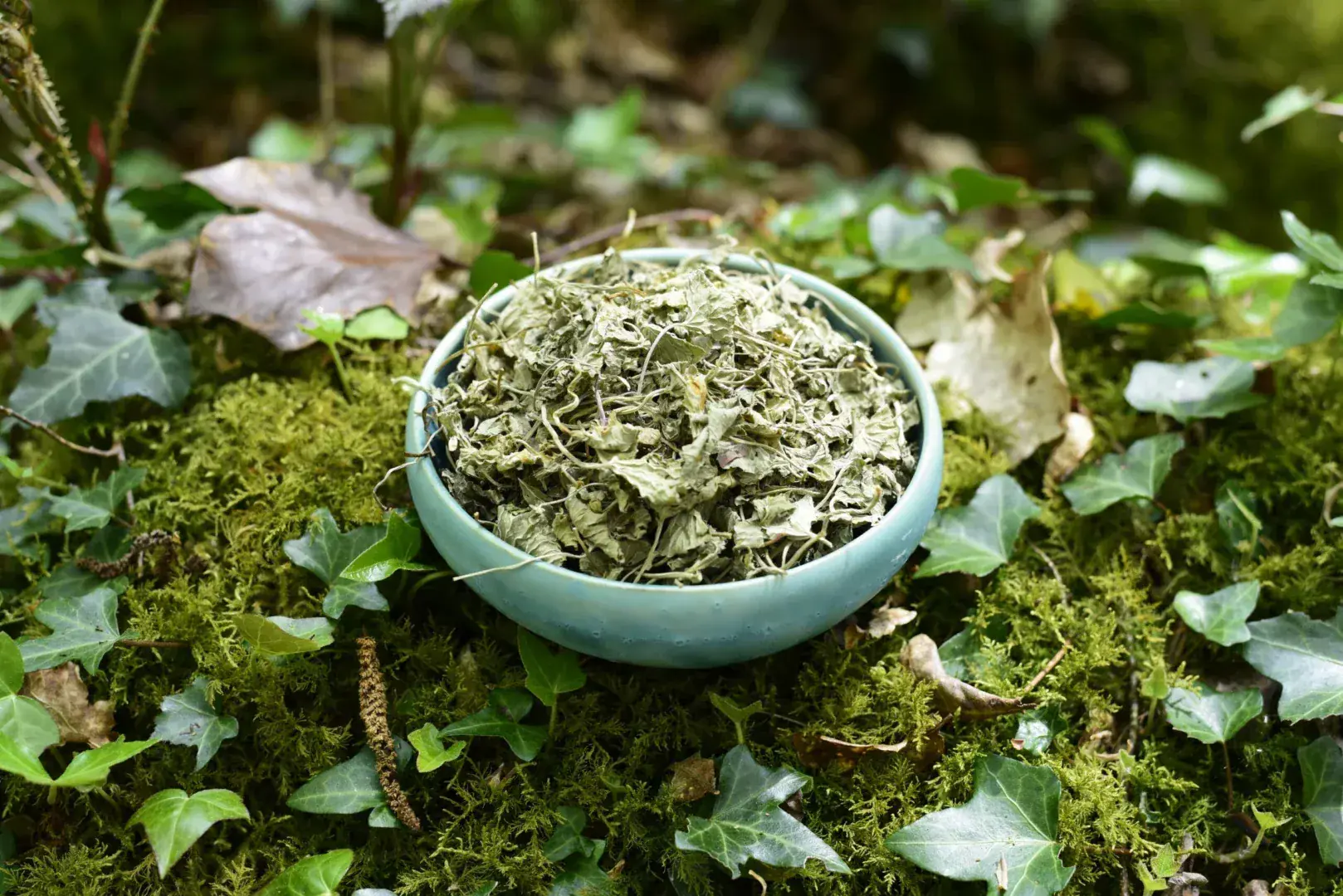
⊹ The path of the plant
⊹ Community voices
What the community murmurs.
Average · 9 reviews
including 9 left on our Etsy shop
Breakdown
Very refreshing and gets the mind flowing 🧠😌
ilzd354b
Daily · left on our Etsy shop · 19 March 2023
Surprised not so much by its taste as by its relaxing effects
gaelle
Daily · left on our Etsy shop · 8 April 2024
Ask the Forest about Gotu Kola
408 books digested, 97,512 indexed passages. She answers on lineages, synergies, cautions, ritual variations.
⊹ FREQUENT QUESTIONS ⊹
We answer.
What is gotu kola?
Gotu kola (Centella asiatica) is a small creeping plant of the Apiaceae family, the same as carrot and parsley. Her leaves, shaped like a small kidney, are harvested. Ayurveda counts her among her rasāyana, her regeneration preparations, and the South Asian tradition nicknames her the tiger leaf. She is a plant of daily cure.
What are the traditional uses of gotu kola?
Tradition uses gotu kola as a plant of longevity and clarity of mind, taken regularly over duration. In Ayurveda she is a Medhya Rasayana, a plant of the mental and regeneration; in traditional Chinese medicine she is called Ji Xue Cao; in Sri Lanka she is eaten every morning in kola kenda. INFUSE documents a tradition, not a medical protocol.
How do I prepare gotu kola powder?
The simplest way is half a teaspoon of powder whisked into a lukewarm drink, a plant milk or a smoothie. The Ayurvedic way simmers the powder in milk, sometimes with a little ginger or honey. The leaf leaves a slightly bitter aftertaste that milk or fruit soften.
Gotu kola and brahmi, are they the same plant?
It is a famous confusion. The name brahmi is shared between gotu kola (Centella asiatica) and bacopa (Bacopa monnieri), two distinct Ayurvedic rasāyana that the sources themselves do not separate. INFUSE keeps the distinction clear — what you hold here is indeed Centella asiatica, gotu kola, not to be confused with bacopa.
What is the traditional dosage of gotu kola?
As a tradition reference, herbalists cite about a teaspoon of dried leaves for a large cup of warm water, in long infusion. With INFUSE powder, half a teaspoon in a lukewarm drink is enough. These are references, not prescriptions; start small, observe, adjust.
Does gotu kola have side effects?
At usual doses, gotu kola is very well tolerated and consumed daily in Southeast Asia. The fresh leaf can provoke contact dermatitis in sensitive people; at high dose, headaches and palpitations have been reported. She can amplify sedatives and analgesics. In case of treatment, ask a doctor's advice.
Can I take gotu kola during pregnancy?
As a principle, no without medical advice. Sources recommend reserve during pregnancy and breastfeeding, for lack of sufficient studies. Ask a healthcare professional's advice before any use in these situations.
Why whole leaf powder rather than titrated extract capsules?
The market mostly offers gotu kola in standardised titrated extracts. INFUSE makes another choice, assumed — the dried whole leaf in powder, as she has been taken for centuries in infusion or decoction, to stay as close as possible to the daily traditional gesture rather than an isolated active.
⊹ Chapter · Questions ⊹
Ask, answer, share.
One question, one answer — sometimes several voices. The community answers first; INFUSE steps in when it should.
Nobody has opened a thread yet about this plant. You can be the one — a real question, a use, a doubt, a detail.
Anonymous if you prefer.
In depthbotany · phytochemistry · history
This descriptive section documents the botany, chemistry and long history of gotu kola. It makes no promise of efficacy: therapeutic uses belong to ongoing research and to medical advice, never to a product page.
Botany
Centella asiatica (synonym Hydrocotyle asiatica), also called asiatic pennywort, is a creeping perennial herb of the Apiaceae — the family of carrot, parsley, fennel and celery. She spreads by stolons, forming dense green mats in moist soils: roadsides, rice paddies, shaded gardens. Her rounded leaves, shaped like a kidney or a frog's foot (hence Mandukaparni), and her tiny flowers make her a discreet plant, almost invasive in good ground. Native to tropical and subtropical Asia, she has naturalised across most of the world's warm wetlands — Sri Lanka, Southeast Asia, China, Indonesia, Madagascar, tropical Africa, as far as the Americas. It is the aerial parts (the leaves) that are harvested.
Phytochemistry (descriptive)
Gotu kola's signature compounds are the triterpene saponins: asiaticoside (roughly 0.5 to 3.7% of dry weight according to pharmacological reviews), madecassoside (0.29 to 6.09%), asiatic acid (0.04 to 0.58%) and madecassic acid. The plant also contains flavonoids (quercetin, kaempferol, rutin), polyphenols, phytosterols (beta-sitosterol), amino acids and vitamins (B, C, K). These ranges are descriptive analytical data, varying with chemotype, season and terroir — they say nothing about an effect in the person who consumes the plant.
What the studies report
Modern research has taken a strong interest in Centella asiatica, to the point that one review speaks of a "remarkably broad" spectrum of activity. Studies in vitro and in animal models report that asiaticoside stimulates fibroblast proliferation and collagen synthesis (the lead that fed the wound-healing interest, and the cosmetic Cica wave), that asiatic acid is being studied as a neuroprotective agent in Alzheimer's and Parkinson's models, and that standardised triterpene extracts have been used clinically in chronic venous insufficiency. Several clinical trials have explored measures of cognition, attention and anxiety. This work describes research leads, often on titrated extracts rather than on the whole leaf in infusion; it is not proof of efficacy for a food use, and nothing here should be read as a promise of care.
Lineage and long history
Gotu kola is a case of ethnobotanical convergence: five civilisations with no direct contact — Ayurvedic India, Sri Lanka, the traditional medicine of China, the jamu of Indonesia, village Madagascar — identified her independently as a plant of cognition, longevity and skin care. Mentioned in the Charaka Samhita and the Sushruta Samhita, linked by Vedic tradition to the Sapta Rishis and to the sahasrara, woven into Sri Lankan daily life in kola kenda, she also fed the modern imagination of longevity through the figure of Li Ching-Yuen (the herbalist said to have lived 256 years, an age the chroniclers themselves hold to be a hoax). In the early 21st century, the Korean cosmetics industry brought her back to the centre of world attention under the name Cica, making a millennia-old medicinal plant visible to millions.
Safety notes
At usual doses, gotu kola is very well tolerated and is part of daily food in Southeast Asia. The documented points of caution: possible contact dermatitis from the fresh leaf in sensitive people; at high dose, headaches, palpitations, itching, even temporary loss of consciousness (Rätsch); possible amplification of barbiturates, sedatives and analgesics; caution in case of pre-existing liver disease; reserve during pregnancy and breastfeeding; care in people allergic to Apiaceae. To be taken in courses, with breaks, and never as a replacement for medical advice.