Guarana, the eye of the gods — when a child's death becomes a people's clarity
Warana — eye of the gods in the Sateré-Mawé language. When the fruit ripens, its scarlet skin opens to reveal a shape irresistibly evoking a human eye. Over a thousand years of use by the peoples of the Rio Maués basin. A stimulant unlike any other: slow-release, matrix-bound, civilisationally old.
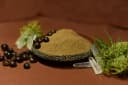 The plant of this articleGuarana · Paullinia cupana5.0(29)from €8.88View →
The master plants, approached with devotion — what they teach when we let them be what they are.
tagline · path
The name as a signature
The word guarana is a Portuguese corruption. The original name is warana — Sateré-Mawé language, Tupi-Mawé branch. The most precise translation: eye of the gods, or fruit resembling the eyes of the gods. Another, deeper reading in the people's culture: essence of knowledge, principle of all understanding.
The name is both descriptive and mythological. When the fruit ripens, the scarlet red skin opens, revealing a white pulp at the center of which appears a round black seed. The shape irresistibly evokes a human eye — the black iris at the center of the white, framed by red. The visual signature is central to the entire mythology of the plant: warana is literally an open eye in the forest.
Distinguishing warana from guarana isn't pedantic. It's political. Warana refers to the traditional Sateré-Mawé preparation, fair trade, cultural respect. Guarana refers to mass production, disconnected from the original culture — often roasted at high temperatures, mixed with synthetic caffeine, sold without benefits returning to the original people. The word guarana carries the decapitation of the sacred plant.
The plant as a person
Warana is a tonic companion of presence. Not quite daily (she is too powerful), not threshold (she doesn't open the invisible), not ceremonial in the strict sense for us (although for the Sateré-Mawé she is). Here is her temperament as it inscribes itself in the body of the one who receives her.
Awake, lively, present, focused. She does not scatter — she gathers. No nervous fluttering, but a concentrated presence like a wide-open eye. The central teaching is that awakening is not agitation. Industrial caffeine creates nervous excitement, a peak followed by a crash, a fragmentation of attention. Warana teaches another form of awakening: sustained, calm, focused, over time.
Receptive as well as active. The Sateré-Mawé people note that guarana not only provides energy — it also enhances receptivity, the ability to listen, and presence to what is happening. It is the open eye that sees, not just the body that acts.
Enduring. The absorption curve is unique: late plasma peak (60-90 min), effect felt for 4 to 6 hours, without the characteristic coffee crash. The tannin-saponin matrix slows caffeine release.
Policy. Choosing warana over industrial guarana is an economic act but also a political one. It supports a people who resist, who have registered their own brand to protect their plant, who have been fighting for thirty years for sovereignty over warana against biopiracy.
Of daytime vision. When consuming warana, one sees — in the sense of clear attention, stable focus, the ability to remain present to what is in front of oneself without slipping into rumination. The eye stays open without tension. Work progresses without having to be dragged out of a state of torpor.
Origin & tradition — the myth of the child
The Sateré-Mawé myth deserves to be fully held, not shortened. Here is the plot transmitted by the elders of the people, reported by the General Council of the Sateré-Mawé Tribe.
Long ago, in an Amazonian village, a child was born with extraordinary powers. Not spectacular magic — a gentle, present, attentive lucidity. He saw through the conflicts that could divide the villages. He saw hidden sorrows. He saw where to plant, where to fish, where to wait. His vision was a rare quality in the human world: he saw.
A jealous uncle — or in some versions, a jealous deity — murdered the child. The village was devastated. The elders wept for days. A benevolent deity, Tupã in some variants, then came to console the village. She told the elders to take the child's two eyes and plant them in the ground.
The left eye was planted in the forest. From there emerged wild guarana. The right eye was planted in the village. From there emerged cultivated guarana. And from the earth where the child himself was buried, the first Sateré-Mawé being arose. The Sateré-Mawé people consider themselves as directly descending from this mythical child whose eyes became the warana.
Three ritual inscriptions of warana in contemporary Sateré-Mawé life:
- Daily drink — a fragment of bastão grated into water, slowly sipped in the morning before hunting, fishing, working in the gardens. An ordinary practice that anchors the lineage.
- Tucandeira Ritual (or Waumat) — initiation of young men. They wear woven gloves containing hundreds of tucandeira ants (Paraponera clavata, bullet ant) whose sting is one of the most painful in the animal kingdom — like walking on hot coals with a rusty nail driven into the heel, according to entomologists. Warana is consumed before and during the ordeal. The implicit teaching: the plant of the unclosing eye is also the plant of presence to extreme pain without dissociation.
- Ceremonial preparations around union and fertility — traditional aphrodisiac dimension not as a direct sexual stimulant but as a general tonic that restores vitality including erotic capacity.
Detailed traditional preparation: harvest of ripe clusters; fermentation of seeds for several days; slow roasting over wood smoke; grinding into paste; shaping into bastões (hard cylinders); prolonged drying. To drink, grate the bastão into cold or warm water, traditionally with the pirarucu tongue (Amazonian fish with bony ridges). The pirarucu gives its tongue; the warana gives its awakening; the human, standing between the two, prepares the drink that connects him to both.
Colonial encounter: Jesuit missionaries documented the use of warana at the end of the 17th century — a stimulant preventing fatigue, hunger, and thirst among warriors and hunters during long expeditions. In the 19th century, guarana became a popular regional Brazilian tonic, integrated into European pharmacopoeias for migraines, dysmenorrhea, and general tonics. In the 20th century: massive industrialization (Antarctica Guaraná created in 1921), entry into Coca-Cola, Red Bull, etc. Biopiracy and cultural appropriation.
Constituents & mechanisms
Warana seeds contain 2 to 8% caffeine by weight (average 4-5%) — the highest natural caffeine concentration in the plant kingdom. Comparison: coffee contains 1-3% caffeine, tea about 1.5-3%. But pharmacology is not limited to this figure. It is the complete matrix that makes the quality of awakening.
Methylxanthines. Dominant caffeine. Theobromine and theophylline present in more modest amounts, contributing to cardiovascular and bronchial effects. Classic mechanism: adenosine receptor antagonism in the central nervous system.
Tannins and saponins — the keystone of the long and stable profile. Tannins represent 10 to 30% of the seed's weight. They bind to caffeine and slow its intestinal absorption, creating the gradual release that distinguishes warana from coffee. For coffee, the plasma caffeine peak is reached in 30-60 minutes and the effect declines rapidly. For traditional warana, the peak is later (60-90 min) and the effect lasts 4 to 6 hours without the crash. This difference is attributed to the bouquet of the plant matrix that modulates absorption and metabolism.
Antioxidant flavonoids. Catechins, epicatechins, procyanidins. Protective entourage that complements stimulation with a nutritional dimension.
Vitamins (A, E, B1 thiamine, B3 niacin, PP) and minerals (calcium, magnesium, iron, potassium, phosphorus). Essential amino acids. The whole seed is also nutritious — not a caffeine isolate.
Clinically documented mechanisms: CNS stimulation, moderate cardiac inotropic effect (increased contraction force), cerebral vasodilation (historical use against migraines), mild diuretic effect, moderate thermogenesis, improvement of attention/working memory/reaction time, delay of muscle fatigue onset, antioxidant.
Uses & preparations
Traditional Sateré-Mawé preparation: grate a fragment of bastão (hard cylinder of roasted paste) into 200-300 ml of cold or warm water. Drink slowly, with conscious presence. The act of grating, the contact with the paste, the slowness of dissolution — all this prepares the body to receive.
INFUSE shop variants. Whole seeds: remove the outer skin (which separates easily after roasting), suck the seeds like candies. Astringent-bitter-aromatic taste. Saliva gradually dissolves, slowly releasing active compounds. Valuable practice for long walks or work sessions. 1 to 2 seeds per intake. Powder format: 1 teaspoon (approx. 2-4 g) in 250 ml of water, smoothie, juice, yogurt, warm drink. Stir vigorously (the powder does not completely dissolve). Ideally drink in the first half of the day.
Prolonged buccal dissolution practice: the Sateré-Mawé who consume warana daily often keep a fragment of bastão slowly dissolving in the mouth for hours, rather than drinking the solution quickly. This practice maximizes gradual release and nurtures an ambient awakening — no peak, no crash, just an awakened presence that lasts all morning of hunting, or all day.
INFUSE Recipes: warana latte (1/2 tsp powder in a cup of warm plant milk, with cocoa, cinnamon, honey); focus smoothie (1 tsp powder + banana + almond milk + 1 tsp Mucuna + cocoa); long walk drink (1 tsp powder in 500 ml water, to sip over 2 hours).
Rhythm. Regular use possible (the Sateré-Mawé consume it daily, sometimes several times a day). For Western users: cycles of 4-5 days of use, 2-3 days of pause to preserve adenosine receptor sensitivity. Avoid late in the day. Not after 2 PM for those sensitive to caffeine.
Synergies
Sagan Dalya White Wings (Rhododendron adamsii) — awakened clarity. Guarana provides stimulation, Sagan Dalya brings luminous precision. A precious Siberian-Amazonian combination.
Mucuna pruriens — morning motivation combination. Mucuna provides the dopaminergic fuel to initiate action, warana supports alertness and duration. For difficult mornings.
Guayusa (Ilex guayusa) — another Amazonian tonic with slow release. Ecuadorian-Brazilian combination for long days without crash.
Shatavari (Asparagus racemosus) — stimulating balance + feminine grounding. Shatavari nuances the yang aspect of guarana with a more restful quality. Valuable for women in cycles of intense work.
Celastrus seeds (Celastrus paniculatus) — for intense cognitive focus. Synergy for demanding intellectual work days. Ayurvedic tradition of memorial knowledge.
Synergy not recommended: with other strong stimulants (high-dose yerba mate, coffee, concentrated theine). Risk of cardiovascular and nervous overstimulation. Warana stands on its own.
The open eye that sees, not just the body that acts. The presence endures. Attention settles without tension.
Difference between warana and guarana?
Why 4-7 times more caffeine than coffee and no crash?
During pregnancy or breastfeeding?
Does it replace coffee?
Why suck the seeds instead of drinking the powder?
The Tucandeira ritual, what does it bring to understanding warana?
Nuggets & legends
The child with seeing eyes. Before there was guarana, there was a child. This child possessed a rare quality: he saw. Not spectacular magic — a gentle, attentive lucidity. The uncle who killed him acted out of jealousy of this vision. When the child was planted in the ground, the eyes refused to stop seeing. They continued in the plant. When a Sateré-Mawé drinks warana, he opens the eyes of an ancestor.
The bastões passed down through generations. In the Sateré-Mawé tradition, guarana bastões are sometimes kept for several years — even passed on. A bastão made by an elder ten years ago, still grated today, carries the memory of this preparation. A practice that transforms warana into an object of family continuity.
The tongue of the pirarucu. The seemingly anecdotal detail of grating with a pirarucu tongue (large Amazonian fish with natural bony asperities) is not a frill. It is an act of alliance with another being of the forest. The pirarucu gives its tongue. The guarana gives its awakening. The human, standing between the two, prepares the drink that connects him to both. Not an industrial production — a weaving.
The Tucandeira and the open eye. Young Sateré-Mawé men wear woven gloves containing hundreds of tucandeira ants — Paraponera clavata, bullet ant — whose sting is described by entomologists as like walking on hot coals with a rusty nail driven into the heel. Warana is consumed during the ordeal. Plant of the eye that does not close, plant of presence to pain without dissociation. The initiated young man stays — the eye open.
The flower in the mouth. The Sateré-Mawé who consume warana daily often keep a fragment of bastão slowly dissolving in their mouth for hours, rather than drinking the solution quickly. This practice of prolonged oral dissolution maximizes gradual release and nurtures an ambient awakening — not a peak, not a crash, just an awakened presence that lasts all morning. It's a different way to consume caffeine than the frenetic one of Western coffee.
Warana and decolonization. The contemporary Sateré-Mawé, particularly through their General Council of the Sateré-Mawé Tribe (CGTSM) and fair partnerships like Guayapi, have been fighting for thirty years for sovereignty over their sacred plant. Warana® trademark registered, fair trade, consumer education, preservation of agroforestry against deforestation. Choosing warana is a political act.
The eye-pod. When the fruit ripens, the scarlet red skin opens, revealing a white pulp at the center of which appears a round black seed. The shape irresistibly evokes a human eye — black iris, white, framed in red. Nature inscribes in the very morphology the signature of the plant: open eye in the forest. Not a far-fetched metaphor — an obvious botanical signature.
Antarctica 1921. The industrialization of guarana begins with the soft drink Antarctica Guaraná created in 1921. Throughout the 20th century, the plant enters Coca-Cola, Red Bull, and all global energy drinks. Often roasted at high temperatures (destroying the tannin-saponin matrix), sometimes mixed with synthetic caffeine. INFUSE rejects this path and favors traditional warana.
Main sources
- Christian Rätsch — The Encyclopedia of Psychoactive Plants (2005). Reference ethnobotanical documentation.
- Dale Pendell — Pharmako/Dynamis: Stimulating Plants, Potions, and Herbcraft (2002). Excitantia Section. Precise poetic portrait of the unique awakening quality of warana.
- Christian Rätsch & Claudia Müller-Ebeling — The Encyclopedia of Aphrodisiacs (2013). Traditional Sateré-Mawé aphrodisiac dimension.
- General Council of the Sateré-Mawé Tribe (CGTSM) — communications and publications on traditional warana, registered Warana® brand, struggle for sovereignty over the plant.
- Cultural Survival — Eyes of the Forest (Sateré-Mawé perspective). Ethnographic report on warana culture and the preservation of agroforestry.
- PMC — Guarana's Journey from a Tonic in Native Amazon Tribes to Energy Drinks (article PMC 2887323). History of industrialization and questions of biopiracy.
Secondary sources
- Michel Pierre & Caroline Gayet — The Herbalism Bible. General tonic and plant for athletes and students. Historical European use for migraines and dysmenorrhea.
- Thomas Easley & Steven Horne — The Modern Herbal Dispensatory. Doses, forms, precautions. A cautious approach consistent with high caffeine content.
- UT Austin — Eye of Guarana (2024). Contemporary ethnographic report on warana culture.
- Guayapi — Warana from Land of Origin. Documentation distinction traditional warana vs industrial guarana, fair trade.
 5.0(29)from €8.88View →
You have a story to drop into the Forest too?
Share a story →90 min déjà parcourues · 96 min jusqu'au seuil de retour
What this reading opened
Be the first voice. Each word is read before joining.
Sign in to share what this reading opened in you.
Sign in →