⊹ To weave around
To accompany Guarana
Click a card to see why it pairs — and choose your form.
✦ Guarana · in one breath ✦
Alert, awake, focused — energy that lasts, without the coffee crash.
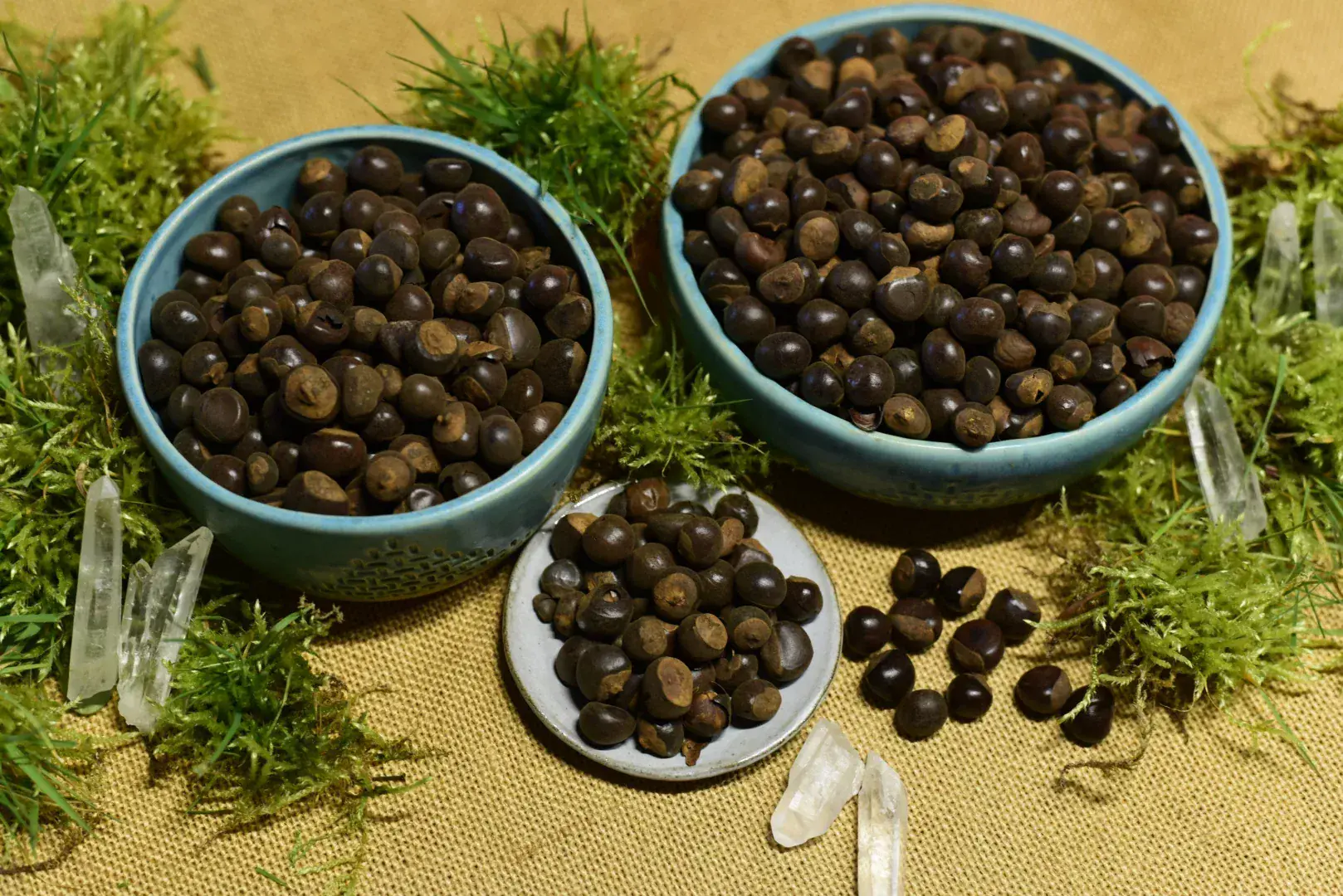
⊹ The path of the plant
⊹ Community voices
What the community murmurs.
Average · 29 reviews
including 27 left on our Etsy shop
Breakdown
Superb quality as always. This helps me a lot with relieving sinus pressure and alleviating fatigue and tiredness throughout the day, I like it cold with lemon juice and apple cider vinegar with some clean water. Fantastic merchant(s) with great focus on quality.
James
Daily · left on our Etsy shop · 11 January 2025
Excellent seller. Product came quickly and securely. The guarana gave me a real boost during my work day and also helped me focus better on my meditation. Would recommend 😀
Barry
Daily · left on our Etsy shop · 18 January 2024
I've only have been trying this for three days and it has instantly boosted my memory & boosted my energy nothing like a high then a crash it's just perfect and lasts all day I can take four 800mg-1600mg at 6 a.m. and it will last all day even to the next day I will buy again.
Samonyai
Daily · left on our Etsy shop · 20 June 2021
Very good quality. I take a whole seed as a candy from time to time when I need an extra boost of energy
Arber Jolldashi
Daily · verified purchase · 4 November 2024
This is very potent and I take about half a tea spoon in my mouth and then chase it with juice to wake me up after an afternoon nap. Thanks DreamHerbsTemple
ridlond
Daily · left on our Etsy shop · 24 August 2019
A must have when you need a little boost to keep you going through the day.
Victor charmetton
Daily · verified purchase · 10 September 2024
Wow, what an amazing product! I had to order another batch and wish i could give more than 5 stars. The quality is very wild regarding caffeine, and this product is the highest quality guarana i have tried yet. Besides good products, the sellers and costumer service is way supreme and above average
Anna
Daily · left on our Etsy shop · 9 February 2023
Ask the Forest about Guarana
408 books digested, 97,512 indexed passages. She answers on lineages, synergies, cautions, ritual variations.
⊹ FREQUENT QUESTIONS ⊹
We answer.
What are the traditional uses of guarana?
Guarana has been used for centuries by the peoples of Brazilian Amazonia, notably the Sateré-Mawé, as an awakening agent. She is a strongly caffeinated plant — the most caffeinated in the vegetal kingdom — whose caffeine, bound to the seed's tannins and saponins, releases slowly. Hunters and shamans drank her to hold long vigilance. This page documents a lineage and a traditional use.
Does guarana contain more caffeine than coffee?
Yes, by far. The guarana seed contains 2 to 8% caffeine by weight (4 to 5% on average), against 1 to 3% for the coffee bean — the highest known natural caffeine concentration in the vegetal kingdom. But the experience differs from coffee: guarana's caffeine, taken in a matrix of tannins, releases more slowly.
Is guarana really stronger than coffee caffeine?
This is a widespread myth. The often-cited "guaranine" is NOT a different molecule — it is chemically the same thing as caffeine. Guarana is therefore not a caffeine "4 to 7 times stronger". What changes is the release — slow, thanks to tannins — not the molecule's potency. At equal caffeine dose, the effect is more spread out in time, not more intense.
Why doesn't guarana give the coffee crash?
In the seed, caffeine is bound to tannins and saponins that slow her intestinal absorption. Where coffee's caffeine peak arrives in 30 to 60 minutes and falls quickly, guarana rises later (60 to 90 minutes) and the felt effect stretches over 4 to 6 hours, more regular. Gradual release is the plant's signature.
How do I consume guarana powder?
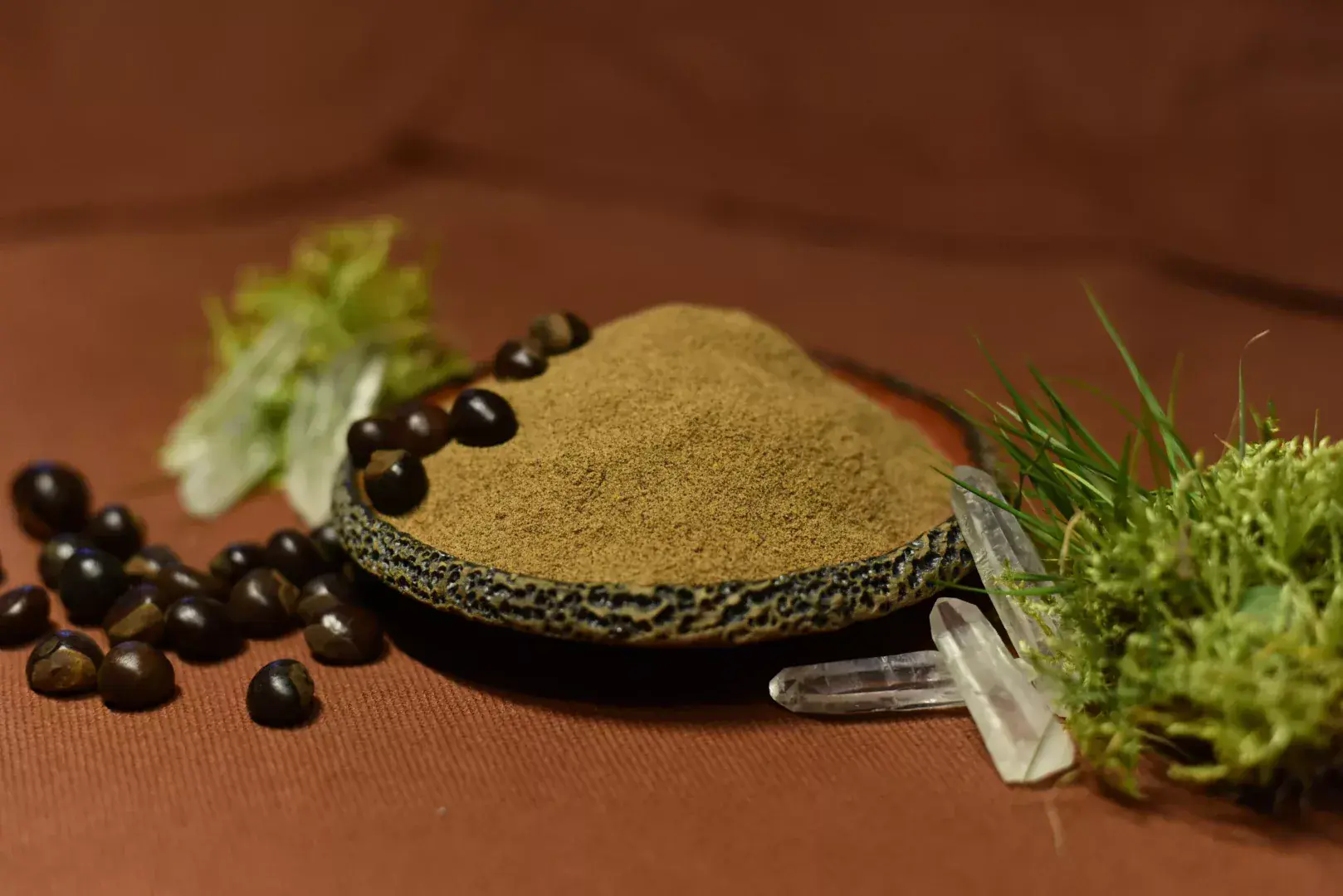
INFUSE offers guarana as seed powder. A teaspoon dilutes in a cup of warm plant milk or simmering water, in the morning; she can also be mixed cold in a smoothie, juice or yoghurt. The taste is frankly bitter and astringent — plant milk, a pinch of cacao or a little honey soften her. To take early in the day, never in the evening.
How much guarana per day?
Amazonian tradition dilutes a fragment of grated stick in water, without a fixed dose. As a common-use reference, a teaspoon of powder (about 2 to 4 g) in the first half of the day is enough; guarana's caffeine being slow, no need to load. Start with a small quantity, especially if you are sensitive to caffeine.
Does guarana prevent sleep?
It can. She is a strongly caffeinated plant and the stimulating effect, because it releases slowly, can last several hours. Better to reserve her for the morning and avoid her at the end of the day for people sensitive to caffeine, who can feel the effect until late.
Is guarana contraindicated during pregnancy?
As a precaution, yes. Caffeine crosses the placenta and passes into breast milk; guarana, very caffeinated, is therefore to avoid during pregnancy and breastfeeding. She is also contraindicated in children and requires caution in case of cardiovascular disorders, anxiety or insomnia. When in doubt, ask a doctor's advice.
What's the difference between warana and guarana?
Warana is the original name, in Sateré-Mawé language, of the traditional preparation of the plant. Guarana is the Portuguese corruption of the word, become the name of mass production — often roasted at high temperature, sometimes added with synthetic caffeine for sodas and energy drinks. The plant is the same; the manner of treating and respecting her is not.
⊹ Chapter · Questions ⊹
Ask, answer, share.
One question, one answer — sometimes several voices. The community answers first; INFUSE steps in when it should.
Nobody has opened a thread yet about this plant. You can be the one — a real question, a use, a doubt, a detail.
Anonymous if you prefer.
In depthbotany · phytochemistry · history
Botany
Guarana, Paullinia cupana H.B.K., belongs to the Sapindaceae family (the family of lychee and longan), tribe Paullinieae. It is a woody climbing vine that can exceed twelve metres, with a smooth stem, large leaves composed of five leaflets, and small scentless white flowers. The fruit is a three-chambered capsule generally containing a single round seed about one centimetre across, with two starch-rich cotyledons. A wild form (var. typica) and a cultivated form (often reported as var. sorbilis) are usually distinguished.
The visual singularity is famous: at maturity, the scarlet-red skin of the capsule opens and reveals a white pulp at the centre of which the black seed appears — the image of a human eye, a dark iris ringed with white and red. This botanical signature runs through the whole mythology of the plant. Harvesters do not open the crop before the first "eye" has opened on the vine.
Phytochemistry (descriptive)
Guarana seeds contain 2 to 8% caffeine by weight (4 to 5% on average) — the highest known natural caffeine concentration in the plant kingdom, where the coffee bean holds 1 to 3% and tea about 1.5 to 3%.
A word on "guaranine": the term sometimes names guarana's caffeine as though it were a separate, more powerful molecule. This is inaccurate. Guaranine is chemically identical to caffeine. Guarana is therefore not a caffeine "four to seven times stronger" — an idea widespread in marketing that confuses the molecule with its release. What distinguishes guarana is the matrix that surrounds its caffeine.
Alongside caffeine are other methylxanthines in smaller amounts — theobromine and theophylline — as well as a significant share of tannins (10 to 30% of the seed's weight) and saponins. It is these tannins that bind to the caffeine and slow its intestinal absorption. Added to these are antioxidant flavonoids (catechins, epicatechins, procyanidins), vitamins (A, E, B1, B3, PP) and minerals (calcium, magnesium, iron, potassium, phosphorus). The whole seed is nutritive — not a caffeine isolate.
The absorption curve
It is the pharmacokinetics that make guarana's reputation. For coffee, the plasma caffeine peak is reached in 30 to 60 minutes, then the felt effect declines fairly quickly. For traditional guarana, the peak is later — 60 to 90 minutes — and the felt effect stretches over 4 to 6 hours, without the characteristic "crash". This difference is attributed to the tannin-saponin matrix, which modulates the absorption and metabolism of caffeine. It is this long, stable profile that matches, in experience, the "hunter's wakefulness in the forest" rather than the peak-then-fall of a cup of coffee.
Worth noting: industrial roasting at high temperature degrades part of this matrix, and many mass-market preparations add synthetic caffeine on top of it — which brings the finished product closer to the abrupt spike it was meant to avoid.
What the studies report
The scientific literature describes, for caffeine and guarana, several effects: stimulation of the central nervous system through antagonism of adenosine receptors, a moderate cardiac inotropic effect, cerebral vasoconstriction (behind a historical use against migraine), a mild diuretic effect, moderate thermogenesis. Studies also report effects on attention, working memory and reaction time, as well as a delay in the onset of fatigue during effort. These data describe pharmacological properties and study observations; they do not constitute a promise of efficacy for any particular condition, and guarana is not a medicine.
Lineage and long history
The use of guarana is documented by Jesuit missionaries from the late 17th century — the first written description, in 1669, is due to J. F. Betendorf — as a stimulant staving off fatigue, hunger and thirst among warriors and hunters on long expeditions. In the 19th century, guarana became a popular regional Brazilian tonic, then entered European pharmacopoeias for migraine and as a general tonic; its high caffeine content was identified in 1840.
The 20th century is that of industrialisation: the fizzy drink Antarctica Guaraná was created in 1921, and the plant became an ingredient of energy drinks worldwide. This trajectory fed debates about biopiracy and cultural appropriation. The Sateré-Mawé, through their General Council (CGTSM) and fair-trade partnerships, have for decades led a work of sovereignty over their plant — registering the Warana® trademark, valuing traditional agroforestry, distinguishing the warana prepared in respect of the lineage from mass-market guarana. Christian Rätsch speaks of a sacred plant "decapitated" by industry, reduced to its single active compound. It is this memory, and this patient preparation, that INFUSE chooses to hold.
Safety
Guarana is a strongly caffeinated plant; all the precautions linked to caffeine apply, amplified by the high content. Caffeine crosses the placenta and passes into breast milk: avoid during pregnancy and breastfeeding. Not recommended for children. Caution in case of cardiovascular disorders or cardiac medication, anxiety, rhythm disorders and insomnia; palpitations, nervousness or sleep disturbances are possible in sensitive people. Chronic use at high doses can sustain a caffeine dependence. To be kept to the first half of the day, starting with small quantities. In case of doubt or ongoing treatment, seek the advice of a health professional.