⊹ To weave around
To accompany Wild Poppy
Click a card to see why it pairs — and choose your form.
⊹ Community voices
What the community murmurs.
4.9/5116 reviews, including 113 left on our Etsy shop
If someone was to tell me I’d have more than 3-4 hours undisturbed sleep I’d never believe them, I had over 5, after years of trying valerian & passion flower teas; fly algaric tinctures and Cbd, not at the same time, only 2 products at once and still waking every few hours, I’ve finally found my sleep, I love all dream herbs products so far, and happily building my own little collection from their shop to drink as I need, absolutely amazing 🫶🏼 namaste
Dorit Phipps
This tea helps me fall asleep. I have been prescribed sleeping medication for a long time. Thanks to this tea I can do without medication. Great product, I can recommend it, thank you very much
Reviewed by Inactive
I can't say enough how great my appreciation for this seller is. Considering that this package came from France to here in Delaware I'm honestly surprised that I got it so fast. The Corn Poppy petals are super high quality and they also sent a sample of Nymphaea Alba that is on Par with the potency of the Alba that I have grown in the past and superior to all domestic sources that I've ever had the pleasure to enjoy! Thank you very much for your great service. To all interested in trying Papaver Rhoeas for yourself I promise that you'll not find better from any other sources. Thanks again and be well! Tim
Dionysoshaman
✦ Wild Poppy · in one breath ✦
She soothes restlessness and assures deeply regenerative nights.
Signature INFUSEIntensity · scored out of 10
| threshold of sleep | 10/10 | |
|---|---|---|
| guard raised | 9/10 | |
| not the opium poppy | 10/10 | |
| priestess of the night | 9/10 | |
| sacred ephemeral | 9/10 |
Register den of Hypnos, the flower Morpheus holds out, rakta-posto red poppy, Klatschmohn that snaps · mythic Greece · Demeter Hypnos Morpheus · ayurvedic vaidyas · Morocco wild harvest
⊹ The path of the plant
⊹ FREQUENT QUESTIONS ⊹
We answer.
Does wild poppy contain opium?
No. The corn poppy (Papaver rhoeas) is a species distinct from the opium poppy (Papaver somniferum). She contains neither morphine, nor codeine, nor thebaine, and has no narcotic addictive potential. It is precisely for this that she has remained in free use through the centuries.
Does wild poppy make you sleep?
In European tradition, wild poppy is the flower of sleep — Hypnos, Greek god of sleep, lived in a cave surrounded by poppies. An infusion of petals in the evening accompanies the end of day and falling asleep. Her strength is in regularity, not intensity: an evening ritual held for several weeks changes the texture of nights.
What's the difference between wild poppy and opium poppy?
These are two species of the same genus Papaver, but botanically separate. The opium poppy (Papaver somniferum) produces morphine and codeine; the wild poppy (Papaver rhoeas) contains none. The wild poppy carries other alkaloids, gentle and without documented dependence.
How do I prepare a wild poppy tea?
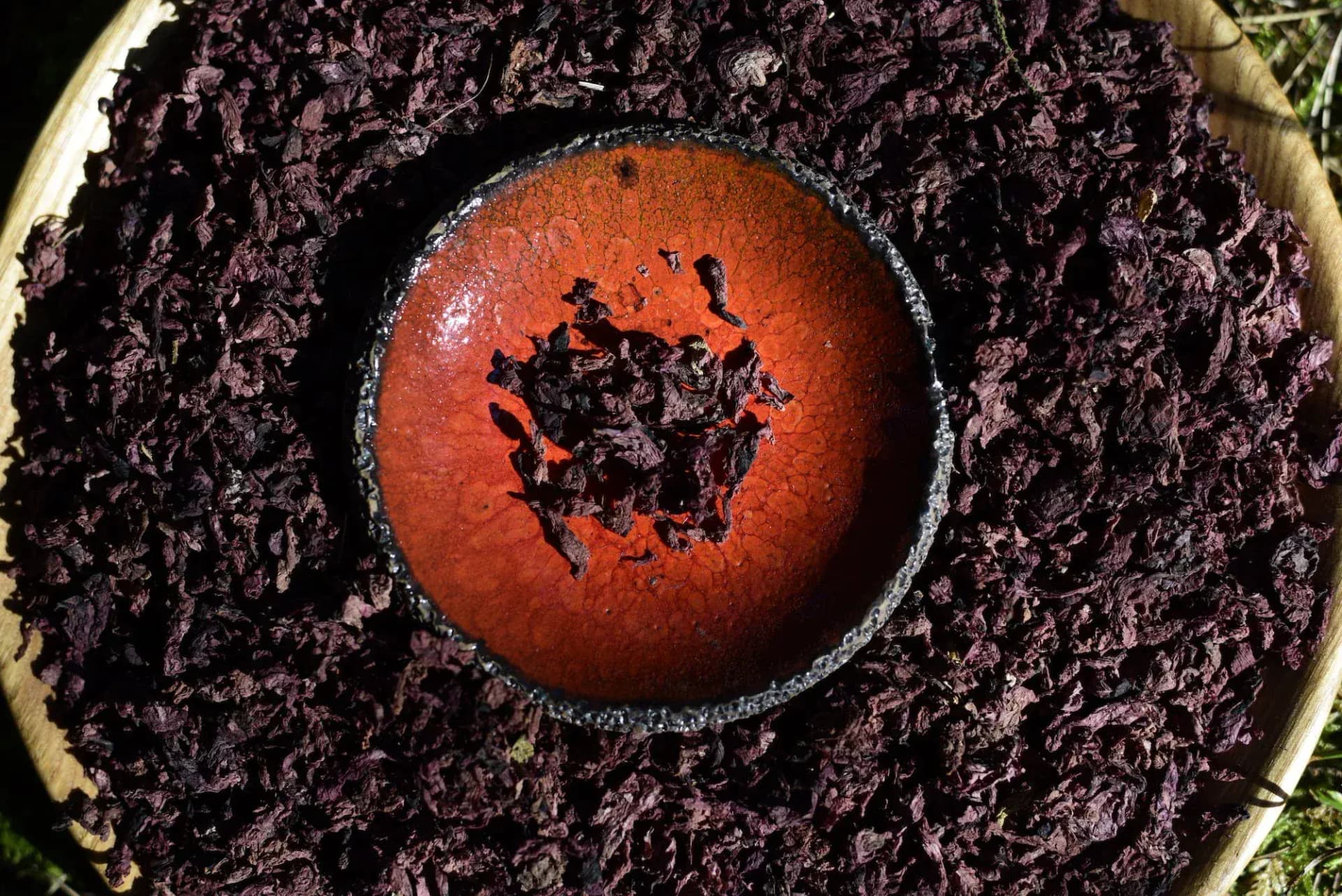
Pour a teaspoon of dried flowers into a cup, with simmering water never boiling (about 80°C), and let infuse 7 to 10 minutes covered. Water too hot dulls the colour. The infusion takes a silky violet-red tint, with a delicate floral taste. To drink in the evening.
Does wild poppy create dependence?
No. Without morphine or codeine, the wild poppy has no addictive potential documented over several centuries of use. It is one of the reasons tradition used her where habit was feared, including for children and the elderly.
Can wild poppy be given to children?
Mediterranean tradition gave poppy syrup to nervous children or those who could not find sleep. INFUSE however recommends reserving any use in children to the accompaniment of an herbalist, and avoiding concentrated or regular uses without follow-up.
All questions
When to drink wild poppy?
In the evening, before bedtime, to make the end of day a threshold rather than a drift. The wild poppy likes to be awaited — choosing an hour and holding to it installs the ritual better than an isolated cup.
Are there contraindications to wild poppy?
Avoid during pregnancy and breastfeeding as a precaution (insufficient data). Caution in case of intake of sedatives (benzodiazepines, opioids, sedative antihistamines) — ask for medical advice before associating. Avoid in case of poppy allergy. When in doubt, your doctor before the plant.
⊹ Chapter · Questions ⊹
Ask, answer, share.
One question, one answer — sometimes several voices. The community answers first; INFUSE steps in when it should.
Nobody has opened a thread yet about this plant. You can be the one — a real question, a use, a doubt, a detail.
In depthbotany · phytochemistry · historyRead
For those who want to go further than the cup — the botany, the chemistry, the long history and the safety of the corn poppy. This section documents a tradition and a state of research; it prescribes nothing.
Two poppies, never confused
The first fact to set down is botanical, and it is non-negotiable. Papaver rhoeas — the corn poppy, the field poppy, the Flanders poppy — is a species distinct from Papaver somniferum, the opium poppy. Both belong to the genus Papaver (family Papaveraceae), but they are two separate plants (Christian Rätsch, The Encyclopedia of Psychoactive Plants, pp. 415-416; Pierre Gayet, La Bible de l'Herboristerie, pp. 867-870). The corn poppy contains neither morphine, nor codeine, nor thebaine — none of the morphine alkaloids of opium. The Ayurvedic language makes the same separation: rakta-posto, the red poppy, is never krishna-posto, the opium poppy. It is this absence of narcotic potential that explains why the corn poppy has remained in free use across the centuries, where its darker cousin was watched and then regulated.
Botany — sister of the wheat
Papaver rhoeas is an annual native to Europe, North Africa and temperate Asia. It co-evolved with human agriculture: it loves turned soils, ploughed fields, the margins of crops. Wherever humanity sowed wheat or barley, the poppy followed — hence the English name corn poppy. Its tiny seeds can lie dormant in the earth for several decades and germinate as soon as light reaches them after the soil is disturbed. It is this trait that set the fields of Flanders ablaze with red in the spring of 1915: the shells had woken seeds that had sometimes slept since Napoleonic times. The flower itself is fragile in the extreme — a gust is enough to tear away its four silken petals, and once cut, it wilts within a few hours.
Descriptive phytochemistry
The corn poppy carries a set of isoquinoline alkaloids, dominated by rhoeadine and rhoeagenine (rhoeadine type, roughly half the total), accompanied by roemerine (aporphine type), mecambrine, salutaridine and protopine. None of these compounds is structurally related to morphine. An LC-MS profiling published in PMC in 2018 (Identification and metabolite profiling of alkaloids in aerial parts of Papaver rhoeas) identifies more than twelve specific alkaloids. Alongside the alkaloids, the flower contains anthocyanins (notably a cyanidin glycoside), red pigments and antioxidants — it is their fragility to light that makes drying in the shade essential: when the red fades, the material withers. To these are added flavonoids, astringent tannins and emollient mucilages.
What the studies report
Research on Papaver rhoeas remains mostly traditional and pre-clinical; there are no large human clinical trials. A review published in PMC in 2023 (Papaver Plants: Phytochemical and Nutritional Composition) surveys the ethnobotanical uses and the activity described in animal pharmacology. Rodent studies report a mild sedative activity (attributed to a GABA-ergic modulation by the rhoeadines), an anxiolytic action, and — an interesting lead, but one to be confirmed in human clinical work — an easing of morphine withdrawal and of stress sensitisation. None of these results constitutes proof of efficacy in humans: they are laboratory observations that illuminate the traditional use without medically validating it. Epistemic honesty requires saying so — the corn poppy's validation rests first on a long, continuous use, not on a clinical corpus.
Long history — from Demeter to Flanders
The symbolic charge of the genus Papaver has surrounded the Mediterranean since Greek antiquity, where the poppy was consecrated to Demeter, goddess of wheat and harvest (Rätsch, pp. 407-409). The most telling myth is that of the grieving mother: deprived of Persephone, Demeter could no longer sleep, until the gods offered her the poppy — and the return of sleep let her negotiate her daughter's return six months out of twelve. Hypnos, god of sleep, and his son Morpheus, god of dreams, are depicted holding a poppy stem. Pliny mentioned the syrup of petals for insomnia; Hildegard of Bingen prepared it in the 12th century for restless nights and states of deep sorrow. The Syrupus Rhoeados still appears in the 19th-century American pharmacopoeia (King's American Dispensatory), and the Sirop de Coquelicot is handed down in Provence following a recipe nearly unchanged for three centuries. In the 20th century, after John McCrae's poem In Flanders Fields (1915), the Flanders poppy became the universal emblem of remembrance for those who died in war.
Safety
At traditional infusion doses, the corn poppy is considered very safe, with no documented critical threshold. The contraindications are mainly a matter of general pharmacological prudence: avoid during pregnancy and breastfeeding (insufficient data); caution when taking sedative medicines (benzodiazepines, opioids, sedative antihistamines), whose effects could add up; avoid in case of a known poppy allergy; caution in case of severe hepatic or renal impairment (metabolism of the alkaloids); and caution before driving or operating machinery after a full evening infusion. For children, traditional use exists but should remain framed by an herbalist. When in doubt, the advice of a health professional takes precedence over the plant.
Read in the ForestThe articles that mention her.Read
Read the monograph: Wild Poppy →
⊹ Deep & Restorative Sleep