⊹ To weave around
To accompany Palo Santo
Click a card to see why it pairs — and choose your form.
The first to talk about it?
✦ Palo Santo · in one breath ✦
The gentle smoke that warms and sanctifies the space, in an instant.
Signature INFUSEIntensity · scored out of 10
| soft, warm smoke | 10/10 | |
|---|---|---|
| resinous wood | 9/10 | |
| opening of the space | 9/10 | |
| cut by hand, not sawn | 8/10 | |
| cousin of frankincense | 8/10 |
Register holy wood, woody-citrus smoke, large cut sticks, certified harvest · Bursera graveolens · Burseraceae · Ecuador
⊹ The path of the plant
⊹ FREQUENT QUESTIONS ⊹
We answer.
What is Palo Santo?
Palo Santo (Bursera graveolens), literally 'holy wood', is a South American tree of the Burseraceae family — the same as frankincense and myrrh. Its aromatic, resin-rich wood gives off, when burned, a soft, woody and slightly citrus smoke. It is traditionally burned in sticks to perfume and open a space, and has long served to keep mosquitoes away.
Where does INFUSE's Palo Santo come from and how is it harvested?
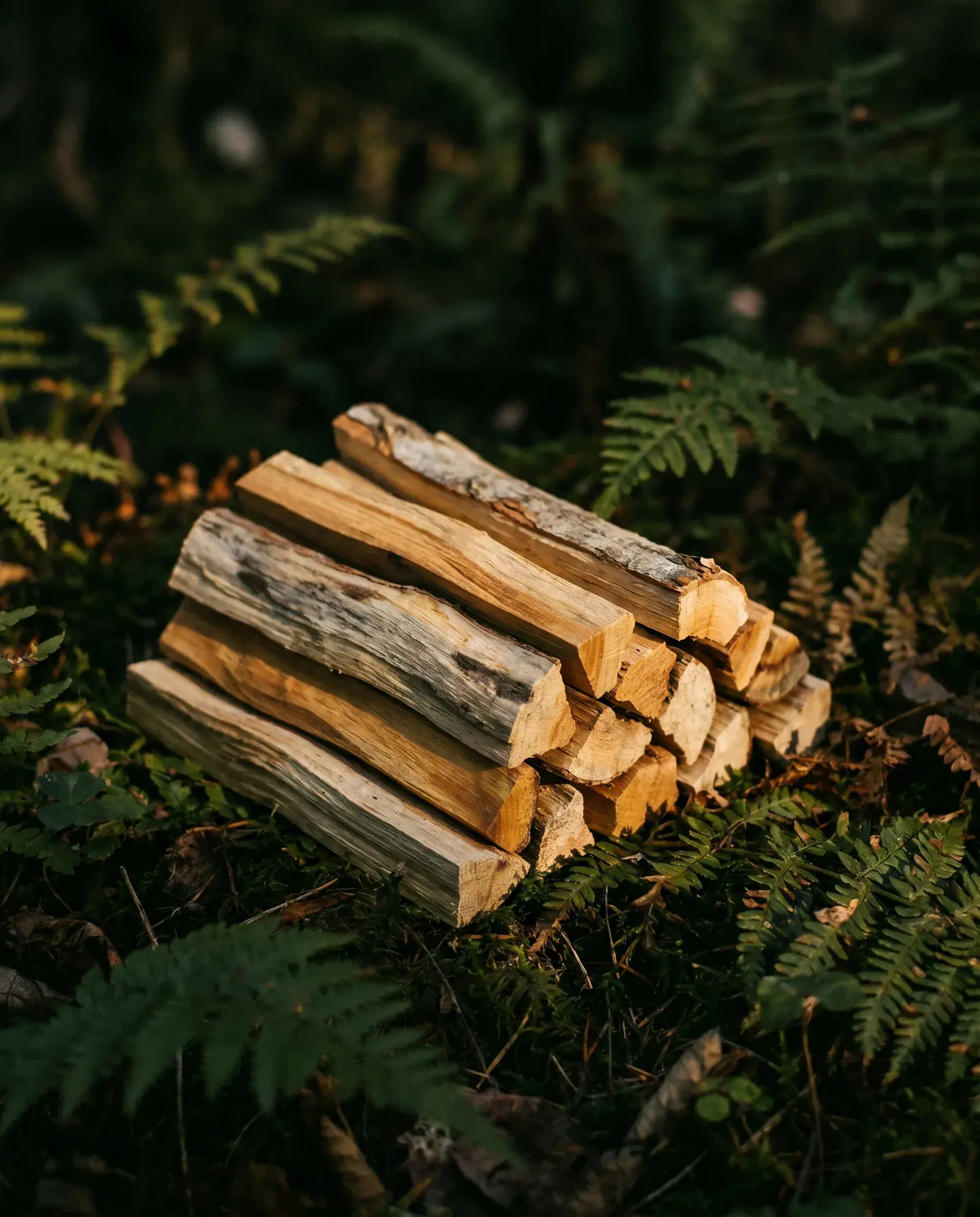
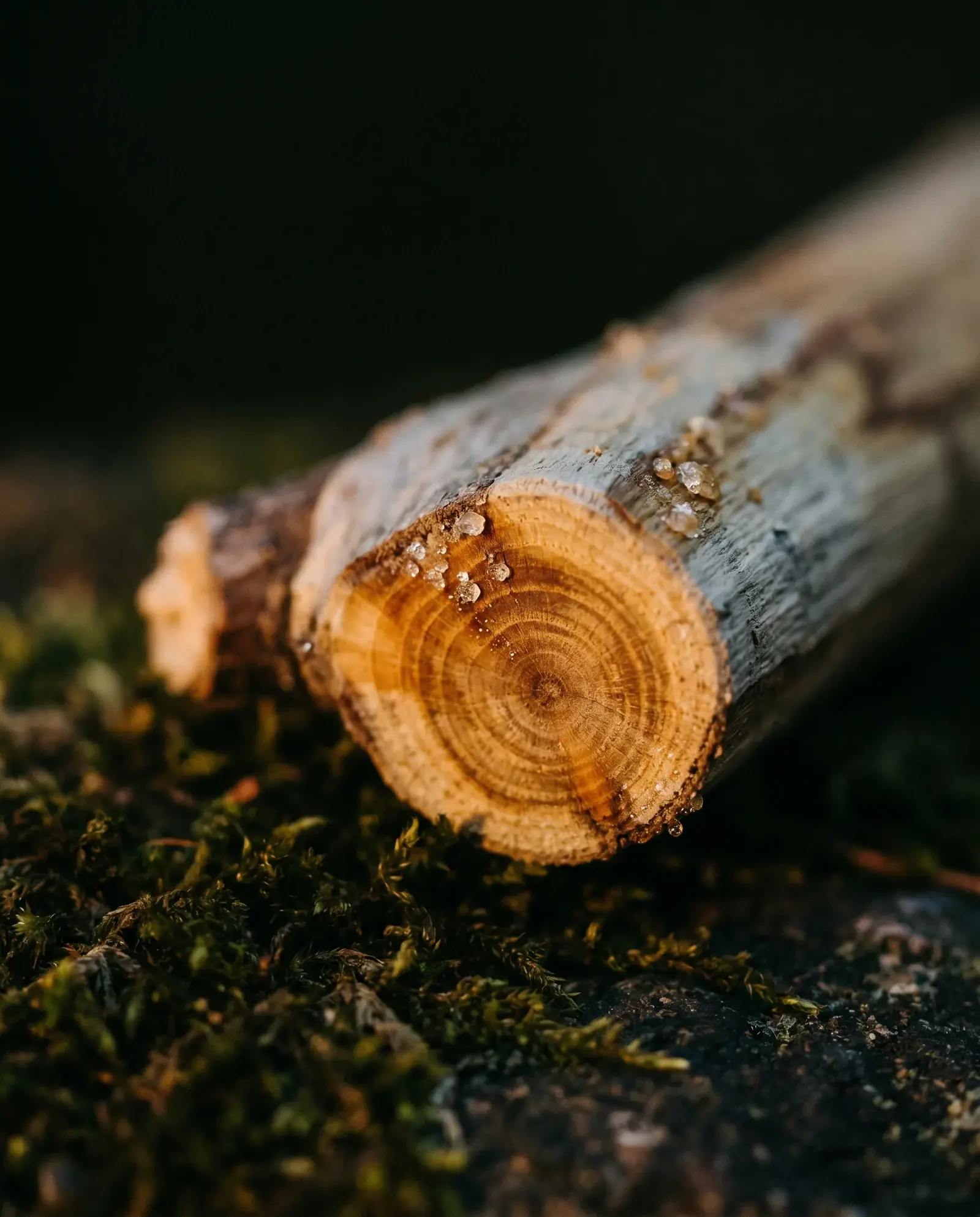
Our Palo Santo comes from Ecuador, under certified harvest. These are large sticks hand-cut rather than machine-sawn: sawing produces a dust that loses material, whereas cutting preserves the wood and its resin. The precise details of the certification and the batch are documented by our supplier.
Why cut sticks and not sawn ones?
Because sawing the wood creates sawdust — a dust that represents lost material, and therefore wood sacrificed for nothing. Our large sticks are hand-cut (chopped), which keeps the wood's integrity and its resinous charge. It is a harvesting detail that says a lot about the care given to the resource.
How do I use a Palo Santo stick?
Light one end of the stick in the flame for 20 to 30 seconds, then blow: the wood glows and smokes slowly. Move the smoke around the room or around yourself with intention, a dish underneath. The stick goes out by itself within seconds once set down — just leave it on a non-flammable support. A single stick relights many times before being used up.
Why does my palo santo keep going out, and how do I put it out?
It is the nature of the wood: dense and resinous, it glows, then goes out by itself within seconds. That is also why one stick relights many times. For a longer smoke, hold the tip in the flame for 30 seconds to a minute, tilted downward so the fire climbs the wood, then blow out the flame; when the smoke fades, light it again. To put it out sooner, press the tip into a dish of sand or against ceramic. Light the tip, blow out the flame, let it smoke.
What is the difference between Palo Santo and white sage?
Two smoke plants, two registers. Palo Santo is a resinous wood with a soft, sweet and citrusy smoke, associated with opening and warming a space. Sage has a more herbaceous, resinous smoke, often linked to clearing. Many use them as complements. In both cases, the essential is the gesture and respect for the plant and its tradition.
All questions
Is Palo Santo endangered? Is it sustainably harvested?
Bursera graveolens, the palo santo that is burned, is listed as Least Concern on the IUCN global Red List (2019 assessment) and is not in the CITES appendices. In Peru, however, the national list classes it as critically endangered (decree 043-2006-AG), and only wood from fallen or naturally dead trees may be used there. The ethical standard lives in one gesture: only dead wood is taken, the living trees stay standing, and the resin concentrates in wood left on the ground for several years. Our wood comes from Ecuador, under certified harvest; for the detail of harvesting practices, we refer to our supplier's documentation.
Bursera graveolens or Bulnesia sarmientoi: which palo santo is protected by CITES?
Two trees share the name. Bursera graveolens, of the frankincense and myrrh family, grows in the dry forests of Ecuador and Peru: it is the wood of our sticks. Bulnesia sarmientoi, the palo santo of the Gran Chaco (Argentina, Paraguay, Bolivia), is a very hard wood that gives guaiac wood essential oil. It is this one that has been listed in CITES Appendix II since 2010: its logs, sawn wood, powder and extracts cross a border only with an export permit. Bursera graveolens is not listed.
What precautions apply to Palo Santo smoke?
Any smoke remains smoke: ventilate, limit prolonged inhalation, caution in case of asthma or respiratory fragility. Keep infants, very sensitive people and animals away during the fumigation. Never leave a glowing stick unattended and set it on a non-flammable support. Occasional ritual use, not daily. Do your own research (DYOR).
Is palo santo safe for cats and dogs?
In the absence of studies on palo santo itself, here is what is known about smoke indoors: a 2018 veterinary study (Lin et al., 348 dogs and cats) found more respiratory disease in cats living with indoor air loaded with fine particles, and more incense burning in the homes of dogs with respiratory disease. Light it in a ventilated room with the door open, so the animal can walk away, and away from any animal that has trouble breathing.
How do you smudge with palo santo?
With a window open, light the tip, blow out the flame, and carry the smoking stick from room to room, from the corners toward the door, a dish underneath. When the smoke fades, light it again. In our House we say it makes any space, any moment, any being sacred, and brings light and warmth in an instant.
Can you burn sage and palo santo together?
Yes, many people light them one after the other in the same room: white sage for its dense, herbal smoke, palo santo for its soft, woody, citrus smoke. Two smokes call for twice the air: keep the window open.
⊹ Chapter · Questions ⊹
Ask, answer, share.
One question, one answer — sometimes several voices. The community answers first; INFUSE steps in when it should.
Nobody has opened a thread yet about this plant. You can be the one — a real question, a use, a doubt, a detail.
In depthbotany · phytochemistry · historyRead
Botany
Bursera graveolens is a tree of the dry tropical forests of the Pacific coast of South America (Ecuador, Peru) and Central America, belonging to the Burseraceae family. It is the same family as the frankincense (Boswellia) and myrrh (Commiphora) trees: woods and resins renowned worldwide for their scent on combustion. The epithet graveolens means "strong-smelling". The tree loses its leaves in the dry season and concentrates, in its heartwood, essential oils rich in limonene and α-terpineol — hence the characteristic citrus note of its smoke. These compounds form and concentrate slowly, which explains why wood dead for several years is the most aromatic.
Harvesting practice and sustainability
Contrary to a widespread idea, Bursera graveolens is not classed as an endangered species. The sustainability question bears on the way of harvesting. The sector's ethical standard consists of taking only naturally dead wood — fallen branches and trunks of trees dead for several years — and not felling living trees: not only is this more respectful of the dry forest, but it is also this matured wood that has developed the most resin and therefore the best scent. Programmes of regulated harvest and reforestation exist in Ecuador and Peru. Our wood is announced as certified harvest from Ecuador by our supplier; we report this information without over-interpreting it. The detail of the sticks — hand-cut rather than sawn — comes from the same concern: avoiding the loss of material as sawdust.
Fumigation across cultures
Burning a wood or a resin to perfume, mark a threshold or accompany a moment of attention is one of the most universal human gestures: temple incense, Central American copal, sandalwood and agarwood in Asia, mountain juniper in Europe, imphepho in southern Africa. Palo santo takes its place in this great conversation of smoke — each one with its tree, its smell and its meaning. Its resinous, citrusy softness has made it, beyond its area of origin, one of the most appreciated smoke woods; all the more reason to use it with measure and respect for the resource.
Read in the ForestThe articles that mention her.Read
⊹ Incense & Sacred Waters