⊹ To weave around
To accompany Agua de Florida
Click a card to see why it pairs — and choose your form.
✦ Agua de Florida · in one breath ✦
It brings you back into the body, clears the field, opens the space and revives the spirit.
⊹ The path of the plant
⊹ Community voices
What the community murmurs.
No testimony yet for this plant — nothing invented, nothing fabricated. If you have met it, your account can open the way for those who come after.
Ask the Forest about Agua de Florida
408 books digested, 97,512 indexed passages. She answers on lineages, synergies, cautions, ritual variations.
⊹ FREQUENT QUESTIONS ⊹
We answer.
What is Agua de Florida (Florida Water)?
Agua de Florida is a ceremonial water — a floral cologne based on alcohol and essential oils of citrus, flowers and spices (orange blossom, bergamot, lavender, clove, cinnamon). Born in New York in 1808 under the Murray & Lanman formula, it was adopted across Latin American curanderismo and Caribbean espiritismo as the water of limpia — sprayed to purify a space, a body, to open a circle.
How do you use Agua de Florida?
External and ceremonial use only. A fine mist on the hands, the nape, the face, or in the air of a room to refresh and cleanse it. Used to mist an altar, open or close a circle, anoint a candle, cleanse crystals and tools. A few sprays are enough — it is a concentrated water with high alcohol content.
What is the difference between Agua de Florida, Kananga and Citricus?
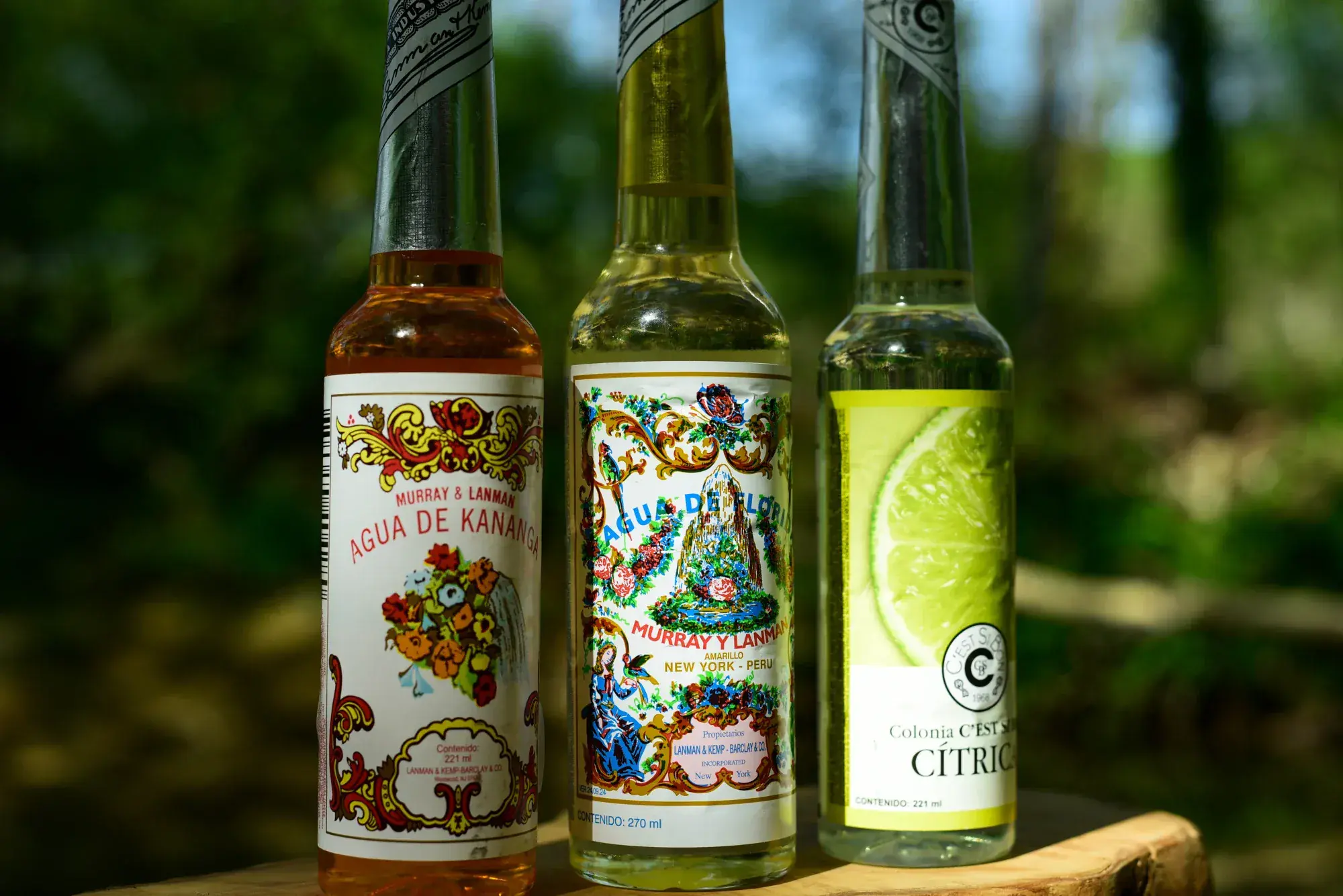
Three waters, three signatures. The Florida (221 ml) is the classic floral-citrus cologne, balanced and fresh — the reference water of limpia. The Kananga (221 ml) is built on ylang-ylang flower (Cananga odorata) — denser, sweeter, traditionally linked to ancestor work and prosperity in Afro-diasporic traditions. The Citricus (211 ml) is the most lively, dominated by citrus — solar, tonic, to sweep away heaviness.
Is Agua de Florida drinkable?
No. It is a ceremonial water based on alcohol (around 75-80 % vol.) and essential oils, intended for external and ritual use — to spray, mist, perfume a space. It is not for ingestion and does not replace any tea or care. The soplo gesture (water taken in the mouth then projected as a fine mist) involves no swallowing.
Where does INFUSE's Agua de Florida come from?
INFUSE sources its Agua de Florida from Peru, where the limpia tradition is alive and these ceremonial waters accompany the daily life of healers.
What is Agua de Florida used for in purification ritual?
It opens the space. Misted before a ceremony to cleanse the air and mark a threshold, applied to the hands before holding a circle, sprayed after to close and refresh. In curanderismo it accompanies limpia — energetic cleansing — alongside palo santo or copal smoke.
Is Agua de Florida legal?
Yes. Freely sold in France and the European Union. Like any product based on alcohol and essential oils, keep it away from flames and out of children's reach, and use externally only.
How many sprays at a time?
A few are enough. Agua de Florida is very concentrated — 2 to 4 mists toward the four directions of a room, or a few drops in the palms rubbed before touching the nape, temples and heart. Precision of gesture matters more than quantity; one bottle lasts a long time when ritual sobriety is respected.
⊹ Chapter · Questions ⊹
Ask, answer, share.
One question, one answer — sometimes several voices. The community answers first; INFUSE steps in when it should.
Nobody has opened a thread yet about this plant. You can be the one — a real question, a use, a doubt, a detail.
Anonymous if you prefer.
In depthbotany · phytochemistry · history
What Agua de Florida Is
Agua de Florida — "Florida water," also spelled Agua Florida, Florida Water in English — is a cologne born in the United States at the beginning of the nineteenth century. Its name comes from the Spanish florido, "flowery," and from the romantic idea of a floral "fountain of youth." The best-known formula, registered by the New York house of Murray & Lanman in 1808, became the reference: a fresh fragrance based on alcohol and essential oils, sold first as a toilet cologne, then adopted far beyond that.
For Agua de Florida had a singular fate. From a simple toilet water it became, across all of Latin America and the Caribbean, a ceremonial and spiritual water — a ritual object in its own right. It is this second life that interests us: the gesture.
Typical composition
The traditional recipe pairs an alcohol base (generally between 75 and 80 % vol.) with a bouquet of essential oils and aromatic essences. The most frequently cited components: citrus (bergamot, lemon, orange blossom, neroli), flowers (lavender, rose, ylang-ylang), spices (clove, cinnamon, nutmeg), sometimes with a touch of wood (cedar, vetiver) for the enveloping base note.
Each maker keeps its own formula, so there is no single recipe but a family of variations around this floral-citrus-spiced profile. Reading the labels, one often finds the following molecules — whether drawn from the natural essences or added synthetically to stabilise the fragrance: limonene (citrus), linalool (lavender, orange blossom), citral (lemon, lemongrass), eugenol (clove), geraniol (rose, geranium), coumarin (cut hay). Modern, widely distributed waters often combine natural essences and synthetic molecules — it is the standard practice of the cologne industry; we say so plainly.
INFUSE offers three variations. The classic Agua de Florida holds the floral-citrus balance. The Agua de Kananga (Kananga Water) is built on the ylang-ylang flower (Cananga odorata), a Southeast Asian tree whose yellow blossom gives off a dense, sweet, heady scent — hence a deeper, more enveloping water. The Agua Citricus, by contrast, pushes the citrus notes, for a bright and luminous water.
Florida Water in curanderismo
It is in South America — in Peru especially, but also in Colombia, Ecuador, across the whole Andean and Amazonian world — that Agua de Florida became a tool of spiritual healing. The curanderos (healers) use it in the limpia, the energetic cleansing: they take it into the mouth to spray it as a fine mist — the celebrated soplo — over a person's body, over a space, over the plants of a ceremony. Water, breath and fragrance combine to "wash" what is heavy, the hucha of Andean cosmology.
Amazonian vegetalistas — heirs to a medicine founded on work with the master plants — also use Agua de Florida in their ayahuasca circles, notably for the limpias that punctuate the ceremony between its phases. The fresh scent serves as a sensory reorientation: it reminds the body that it has skin, a nose, a threshold, in spaces where boundaries can turn fluid.
Florida Water in Afro-diasporic traditions
The same use exists — and with comparable intensity — in the Afro-diasporic traditions of the Caribbean, the southern United States and Brazil. In Louisiana Hoodoo, it is used to protect a home, draw luck, scent the gris-gris. In Cuban Santería, it accompanies offerings to the orishas and the cleansing of altars. In Puerto Rican and Cuban Espiritismo, it is mixed into the water of altar glasses to purify what is dedicated to the dead. In Brazil it appears in Candomblé and Umbanda. The logic is everywhere the same: a water of passage and purification, set at the threshold between the ordinary and the sacred.
The Agua de Kananga, a gentler derivative, is in several of these traditions linked more particularly to ancestor work, to prosperity, and — an inheritance of ylang-ylang's reputation across the Caribbean basin — to a light, enveloping aphrodisiac quality.
Documented traditional uses
The ceremonial uses best documented across these lineages:
- Purify a space — mist or sprinkle in a room, toward the directions, over the thresholds.
- Cleanse a body — the limpia, by sprinkling or by breath (soplo).
- Open and close a circle — mark the beginning and the end of a ceremony.
- Anoint the tools — candles, crystals, pendulums, working objects.
- Honour the ancestors — scent the water and the altars dedicated to them (a favoured use of the Kananga).
- Protect a home — sprinkle the thresholds, the corners, the windows after a difficult energetic charge (grief, argument, an imposing presence).
- Refresh and recentre — a more everyday, almost secular use, inherited from its life as a cologne.
A note on safety and transparency
A frank word, because it is part of the product. Agua de Florida is a water high in alcohol: it is flammable and intended for external use. It is not to be drunk, replaces no care and holds no medical virtue — it is a ritual and fragrant object, nothing more, nothing less. The citrus essential oils it contains can be photosensitising: avoid direct sun exposure after applying it to the skin.
Sources: history of the Murray & Lanman cologne (1808) · literature on Andean and Amazonian curanderismo (limpia, soplo, hucha) · ethnography of the Afro-diasporic uses of Florida Water and Kananga Water (Hoodoo, Santería, Espiritismo, Candomblé), notably Luisah Teish, "Jambalaya: The Natural Woman's Book" · note on ylang-ylang in Christian Rätsch's Encyclopedia of Aphrodisiacs · manufacturer composition sheets. INFUSE traceability details are being consolidated.