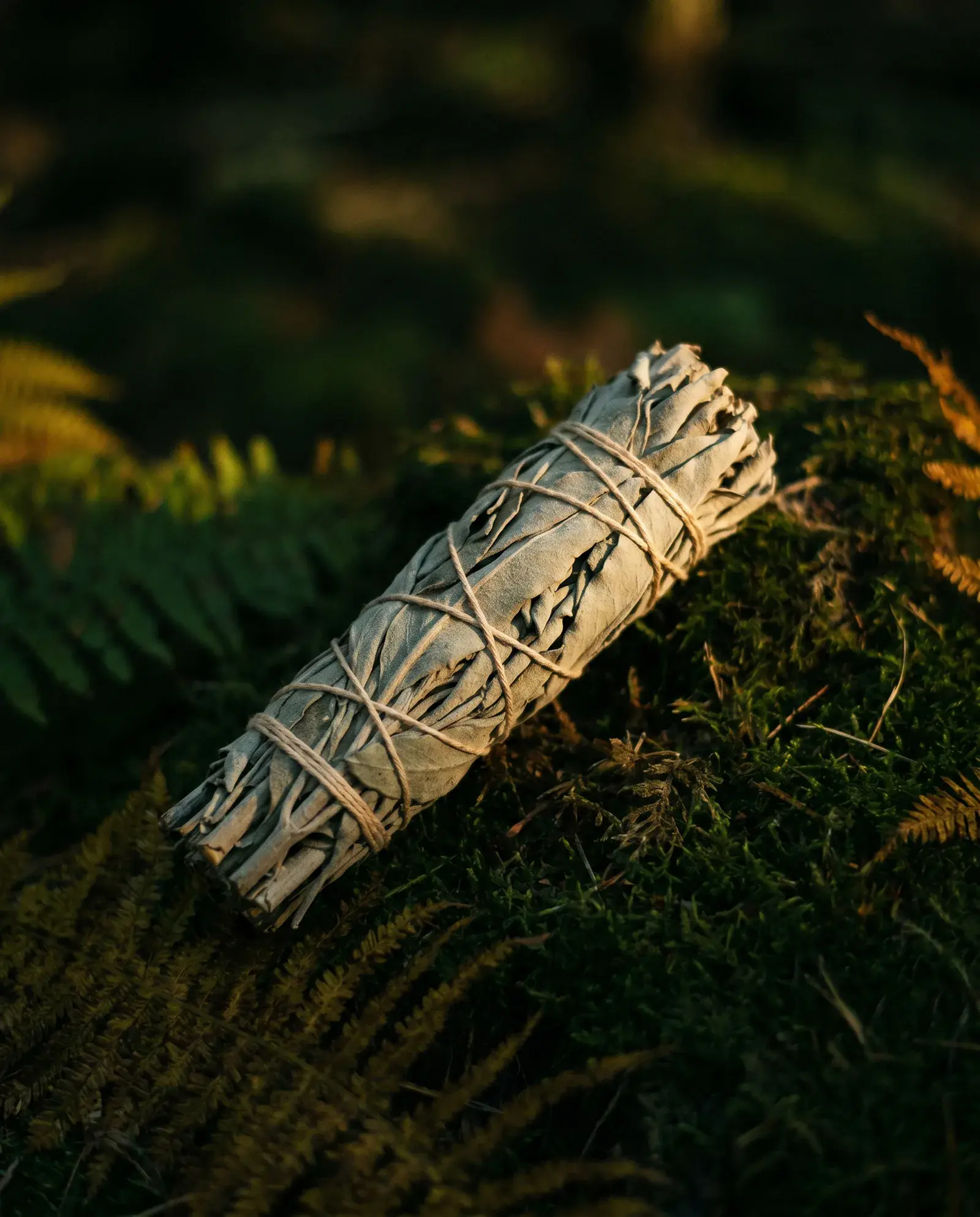
✦ White Sage · in one breath ✦
The leaf that opens a space — a gesture as old as the world, in ritual sobriety.
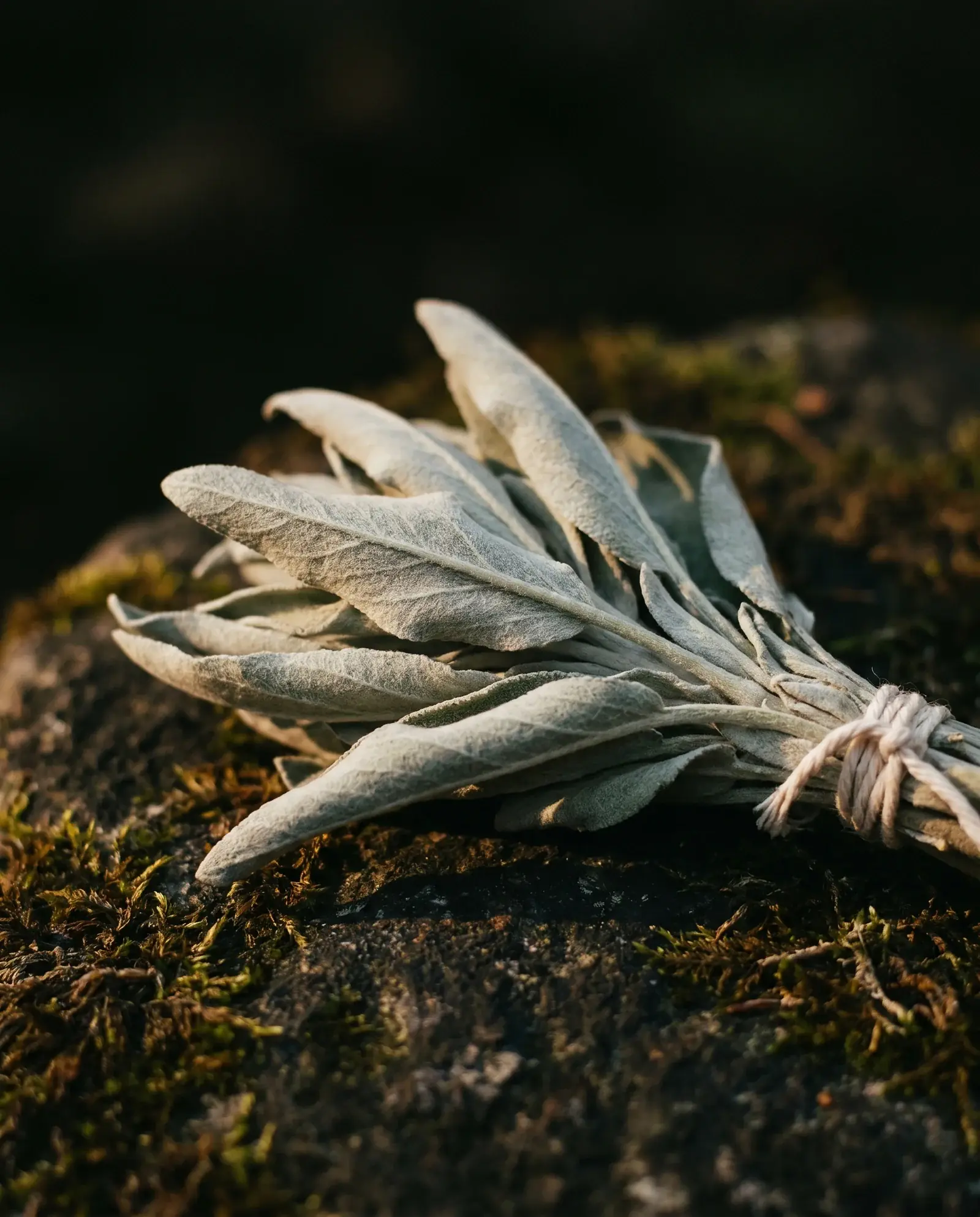
⊹ The path of the plant
⊹ Community voices
What the community murmurs.
No testimony yet for this plant — nothing invented, nothing fabricated. If you have met it, your account can open the way for those who come after.
Ask the Forest about White Sage
408 books digested, 97,512 indexed passages. She answers on lineages, synergies, cautions, ritual variations.
⊹ FREQUENT QUESTIONS ⊹
We answer.
What is a white sage bundle?
It is a bundle of dried white sage leaves tied into a stick (ours is about 15 cm), meant to be burned in fumigation. You light the tip, let the flame die out, and the bundle smoulders, releasing a dense aromatic smoke. It is a practice of opening and clearing a space, found — in very different forms — across many cultures.
How do I light and use a sage bundle?
Light the tip of the bundle in the flame for a few seconds, then blow gently to put out the flame: it is the embers that smoke. Move the bundle around the room or around yourself with intention, keeping a dish underneath for the ash. To put it out, press the glowing tip into a container of sand or ash — never leave it unattended. Ventilate the room afterwards.
Where does this white sage come from and how is it harvested?
Our white sage is wild-harvested in the foothills of the Himalayas, in the Rishikesh region, via a direct contact on site. A note of botanical honesty: the best-known 'white sage' (Salvia apiana) is native to California. A white sage harvested in the Himalayas is therefore either a species cultivated locally or a neighbouring species of the Salvia genus — we mark the exact species as 'to confirm' rather than certify an identity we have not verified.
Are white sage and Native American smudge the same thing?
No, and this matters. Smudging with white sage is a ceremonial practice proper to Indigenous peoples of North America, with its gestures, its songs and its sacred context. Burning sage at home to perfume or clear a space is not a smudge: it is a fumigation. We do not take the Native American ritual for our own; we offer a plant to burn, inviting you to honour — not imitate — the tradition from which its name comes.
What is the point of burning sage?
In ordinary use, sage is burned to perfume a place, mark a threshold (a move, a beginning, an ending) or simply create a moment of attention and calm. The smoke has a characteristic resinous, herbaceous smell. Beyond the symbol, some work describes a purifying effect of certain plant smoke on ambient air — but the essential remains the gesture and the intention you put into it.
What precautions apply to sage smoke?
Any smoke remains smoke: ventilate, limit prolonged inhalation, caution in case of asthma or respiratory fragility, and keep very sensitive people, infants and animals away during the fumigation. Never leave a glowing bundle unattended and put it out completely after use. People allergic to Lamiaceae (mint, lavender, common sage) stay cautious.
⊹ Chapter · Questions ⊹
Ask, answer, share.
One question, one answer — sometimes several voices. The community answers first; INFUSE steps in when it should.
Nobody has opened a thread yet about this plant. You can be the one — a real question, a use, a doubt, a detail.
Anonymous if you prefer.
In depthbotany · phytochemistry · history
### Botany
Sage belongs to the genus Salvia, the largest of the Lamiaceae family (the family of mint, lavender, rosemary and thyme), with nearly a thousand species spread across almost every continent. Sages share an aromatic chemistry rich in essential oils (terpene compounds such as 1,8-cineole, camphor, thujones, borneol depending on the species), which explains their pronounced scent and the dense smoke they give off when burned.
"White sage" in the strict sense designates Salvia apiana, a shrub with whitish, resinous leaves endemic to southern California and northwestern Mexico. A so-called "white" sage harvested in the Himalayas cannot therefore be presumed to be apiana: it is either an introduced, cultivated apiana, or another Salvia species with pale, aromatic leaves. This is why we indicate the species of our batch as to confirm: naming rightly is part of the respect owed to the plant.
### Fumigation across cultures
Burning aromatic plants to purify, perfume or open a space is one of humanity's most widespread ritual gestures: the incense (frankincense, myrrh) of the temples of the Near East and the Mediterranean, juniper and thyme burned in the Alps and the Balkans, sandalwood and resins in Asia, imphepho in southern Africa, copal and palo santo in Latin America, the smudge with white sage among several Indigenous peoples of North America. Each tradition has its plant, its gesture and its meaning — and it matters not to confuse them or melt them into a single, indistinct "spirituality of smoke".
### Honouring without appropriating
Smudging is a sacred ceremony for many Indigenous nations of North America, long repressed then protected as a religious practice. The global popularity of "smudge sticks" has brought two drifts: the wild over-harvesting of *Salvia apiana* on Californian lands, which threatens the wild populations and Indigenous communities' access to their plant, and the reduction of a living rite to a decorative accessory. Offering a sage to burn calls for lucidity: we speak of fumigation, not smudge; we source outside the threatened wild areas of California; and we invite you to honour the tradition from which the name comes, without borrowing its sacred gestures. Smoke can be a right gesture if it stays in its place.
« Every plant is a door. White Sage opens onto a long companionship — listen to it more than you measure it. »