Tulsi (Ocimum sanctum): myths, Ayurvedic tradition and botany of holy basil
The holy basil India prays to every morning before drinking it: the story of Vrinda, the courtyard altar, the plant's yearly wedding, its three varieties and the way we brew it.
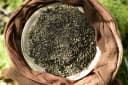 The plant of this articleTulsi - Holy Basil · Ocimum tenuiflorum (syn. Ocimum sanctum)5.0(14)from €7.00View →
The plants that walk with the cycles, to live inside them fully.
The holy basil India prays to every morning before drinking it. In the courtyards of Hindu homes it grows on a small altar of earth or masonry, the tulsi vrindavana, and it is often the first presence greeted each day. Tradition reads its Sanskrit name, tulasī, as "the Incomparable". It is also called the Queen of Herbs, and Vrinda, after the woman it was born from.
Vrinda, the woman who became a plant
The Puranas tell her story in several ways. In the best-known version, from the Padma Purana and the Shiva Purana, Vrinda is the wife of the asura Jalandhara, and a devotee of Vishnu. As long as she stays faithful to her husband, Jalandhara cannot be defeated. So Vishnu takes on his appearance and comes to her; the spell broken, Jalandhara falls in battle.
When Vrinda discovers the trick, she curses Vishnu: let him become stone. He becomes the shaligram, the black stone his devotees still venerate, often a fossil ammonite gathered from the bed of the Gandaki river in Nepal. From her ashes the tulsi grows, and Vishnu promises that no worship of him will be complete without a tulsi leaf.
The Brahma Vaivarta Purana gives another version, and every region has its own. They all arrive at the same place: the plant and the goddess are one. The woman who walks around the tulsi in the morning is greeting Vrinda herself.
The courtyard altar
The tulsi vrindavana is a pot or a small square platform, in the middle of the inner courtyard or in front of the door. Every morning a woman of the house waters the plant, lights an oil lamp, recites a prayer, walks around it (parikrama, circumambulation) and touches a leaf to her forehead. This daily practice, the Tulsi Puja, holds prayer and everyday life together: it is one and the same gesture.
In the worship of Vishnu and Krishna, a tulsi leaf is laid on every offering of food, as the story promised. Vaishnava devotees wear beads carved from tulsi stems around their necks, and count their mantras on a rosary of the same wood, the tulsi mala.
Tulsi Vivaha, the plant's wedding
Every year, in the month of Kartik (October-November), India marries the tulsi. Between Prabodhini Ekadashi and the full moon of Kartik, the plant is dressed as a bride: a sari, bangles, vermilion. The groom is the shaligram, or an image of Krishna. The family celebrates the wedding as it would a daughter's, with songs and sweets, and the wedding season opens after it. Only a person can be wed: the feast says what tulsi is to those who pray to it.
What the texts say
The two great treatises of Ayurveda, the Charaka Samhita and the Sushruta Samhita, name the plant, often as surasa. Ayurveda places it among the rasayana, "the path of essence": plants taken every day, over time. In Tamil Nadu, Siddha medicine calls it thulasi.
Tulsi Tea strengthens faith, inspiration, compassion, and spiritual clarity.
The plant
Ocimum tenuiflorum, long named Ocimum sanctum, is a member of the Lamiaceae, cousin to kitchen basil, mint and rosemary. It has the square stem of its family, oval, lightly toothed and downy leaves, and small white or purplish flowers in spikes. Rubbed between the fingers, a leaf releases a warm, peppery scent with a note of clove. Native to the Indian subcontinent, it is grown throughout tropical Asia.
India distinguishes three:
| Variety | Leaf | Taste |
|---|---|---|
| Rama Tulsi | light green | sweet, floral, fresh |
| Krishna Tulsi | purple, the dark complexion of Krishna | peppery, with notes of clove |
| Vana Tulsi | the forest tulsi (vana), often Ocimum gratissimum | bright, lemony, reminiscent of eucalyptus |
Tulsi at the House
We offer two varieties, Rama Tulsi and Lemon Vana: two flavours, one sacred plant. They are dried leaves from India, from a certified organic supply chain and laboratory-tested.
- The tea: one to two teaspoons of dried leaves in water just off the boil, around 90 °C, five to ten minutes, then strain.
- The moment: any time of day, morning or evening. A cup is often enjoyed after a meal.
- The rhythm: one to two cups a day, in cycles of 7 to 21 days, with breaks between cycles.
The gesture of the Indian courtyard travels well: a leaf touched to the forehead before it goes into the cup. Rama and Lemon Vana also go well with a few rose petals, and ashwagandha simmered in the morning milk keeps company with tulsi sipped through the day. In a pot on a sunny balcony, tulsi grows happily in summer; it does not like frost.
For those who want the prayer in the first sip.
Precautions
- Pregnancy and trying to conceive: abstain (animal data at high doses).
- Breastfeeding: ask a health professional.
- Known allergy to basil or other Lamiaceae: avoid.
- Anticoagulants, diabetes medication, thyroid disorder or medication: medical advice first.
- Planned surgery: stop about two weeks before.
When in doubt, your doctor before the plant.
Two varieties, Rama Tulsi and Lemon Vana, as dried leaves from India, from a certified organic supply chain and laboratory-tested. One to two teaspoons in water just off the boil, five to ten minutes.
Discover INFUSE tulsi →What does tulsi mean?
Tulasī, in Sanskrit, is read in the tradition as "the Incomparable". The plant also bears the names Queen of Herbs and Vrinda, the woman of the Puranic story from whom it was born.
What is the difference between Rama, Krishna and Vana Tulsi?
Rama has light green leaves and a sweet, floral taste. Krishna, purple, is peppery, with notes of clove. Vana, the forest tulsi, is bright and lemony. We offer Rama and Lemon Vana.
What is Tulsi Vivaha?
The yearly wedding of tulsi to Vishnu, in the form of the shaligram, or to an image of Krishna. It is celebrated in the month of Kartik, in October or November, and opens the wedding season in India.
How do I make tulsi tea?
One to two teaspoons of dried leaves in water just off the boil, around 90 °C, five to ten minutes. One to two cups a day, in cycles of 7 to 21 days, with breaks.
Can I drink tulsi in the evening?
Yes. Tulsi is drunk at any time of day, and an evening cup is part of our own habits.
What precautions apply to tulsi?
Abstain during pregnancy and when trying to conceive; ask a professional while breastfeeding. Avoid with an allergy to basil or Lamiaceae. Medical advice first with anticoagulants, diabetes or thyroid medication. Stop about two weeks before surgery.
Sources
- Padma Purana and Shiva Purana: the story of Vrinda and Jalandhara.
- Brahma Vaivarta Purana: the story of Tulasi.
- Charaka Samhita and Sushruta Samhita.
- David Frawley and Vasant Lad, The Yoga of Herbs, Lotus Press, 1986.
- Frederick J. Simoons, Plants of Life, Plants of Death, University of Wisconsin Press, 1998.
- INFUSE product sheet: varieties, origin, certification, preparation and precautions.
 5.0(14)from €7.00View →
You have a story to drop into the Forest too?
Share a story →What this reading opened
Be the first voice. Each word is read before joining.
Sign in to share what this reading opened in you.
Sign in →