Calea Zacatechichi: the Chontal plant of lucid dreaming
Thle-pela-kano — leaf of God. The first oneirogenic plant validated in a double-blind study (Mayagoitia, Díaz & Contreras, 1986). A plant of the Chontal of Oaxaca — not Aztec, not generically Mexican. The full protocol, the lineage honoured, the sourcing comparison, and everything the generalist web pages dilute.
 La pianta di questo articoloCalea Zacatechichi · Calea zacatechichi (Calea ternifolia)4.8(268)da 7,20 €Vedi →
Le dernier territoire souverain. On y entre par les plantes, par le silence, par le retour aux songes des anciens.
tagline · path
Traduzione italiana in arrivo — questo articolo è mostrato in un'altra lingua.
— Short answer. To use Calea zacatechichi in a lucid-dreaming practice, the path documented by the Chontal of Oaxaca and confirmed by the Mayagoitia study (1986) holds in six gestures: write a precise question before sleep · prepare three to five grams of dried leaves as a slow infusion under 80 °C, covered, twelve minutes (honey essential — the bitterness is legendary) · drink thirty to sixty minutes before sleep · set a notebook and a lamp beside the bed · combine with the WBTB protocol (Wake-Back-To-Bed) by waking four to five hours after going to bed to take fifty centilitres more of the infusion · write immediately on partial or morning waking, before the images fade. Cycle to respect: one to two nights a week at most, a three-week break every two months. The plant is legally free in most countries (banned in Poland since 2009 and in Louisiana since 2005). This article documents the Chontal lineage, the detailed protocol, the published pharmacology, the comparison with Silene capensis, Mugwort, Entada rheedii, Sinicuichi and Wild Asparagus, and the question of sourcing. —
The name as a signature — Chontal, Nahua, and ethnic precision
A plant carries the name of those who received it. When the internet writes "Aztec Dream Herb," it displaces a living lineage towards an empire that collapsed five centuries ago. Calea zacatechichi is not an Aztec plant in the sense of having been central to the Templo Mayor. It is the plant of Oaxaca — in continuous, documented use among the Chontal of the Sierra Sur, and reported among other Oaxacan peoples such as the Mixe and the Zoque-Popoluca. Its use predates by far the North American ethnobotanists who first documented it in the twentieth century.
The Chontal name of the plant — thle-pela-kano — translates literally as "leaf of God" or "leaf that clears the senses." The Nahuatl name — thlepatli, or zacatechichi (from zacate, grass, and chichi, bitter) — means "bitter grass." The double naming already states the double function: what Western science calls an oneirogen, the Chontal call a leaf that opens a channel — and the Nahua, naming it by its bitterness, also named the first initiation. That bitterness is not a flaw in the plant. It is its gate.
The living lineage — the Chontal of Oaxaca
Today it is among the Chontal — a neighbouring people in the south-east of the state of Oaxaca, speaking a language isolate called Tequistlatec — that the use of Calea is best documented ethnographically.
Thomas MacDougall, an American ethnobotanist who lived in Mexico for three decades, was the first to document Chontal use seriously, in the 1960s. He sent samples to Richard Evans Schultes at Harvard; Schultes passed them to his former student José Luis Díaz, then in Mexico. It is this chain — Chontal → MacDougall → Schultes → Díaz — that led to the 1986 study and to the scientific creation of the oneirogen concept. Schultes and Hofmann placed Calea in Plants of the Gods in 1992, giving it its first lasting worldwide visibility.
The founding 1986 study — the scientific birth of the oneirogen concept
Before 1986, the word "oneirogen" did not exist in Western psychopharmacology. Substances that altered sleep were classed in two categories — hypnotics (which induce sleep) and stimulants (which disturb it). The idea that a substance could specifically alter the quality of the dream, without inducing or preventing sleep, had no pharmacological category. Calea zacatechichi forced that category into being. The Mayagoitia–Díaz–Contreras study, published in the Journal of Ethnopharmacology, took ten human volunteers, gave them a Calea infusion in a double-blind design against placebo, and measured the effects on sleep and dreaming by questionnaire and by EEG.
The results were clear and reproducible. The subjects on Calea reported significantly more dreams than on placebo, with longer and more detailed recall. The EEG trace revealed an increase in light sleep (stages N1 and N2), a relative decrease in deep sleep (N3), and a higher number of short spontaneous awakenings during the night. These awakenings, occurring on exit from REM, are precisely what allows a dream to be remembered: the brain consolidates a dream into long-term memory only if a window of wakefulness immediately follows the dreaming phase. Calea does not make more dreams — everyone dreams every night, on average four to six cycles. It raises the probability of reporting their content in the morning.
| Mesure | Groupe placebo | Groupe Calea (infusion) | Significativité |
|---|---|---|---|
| Nombre de rêves rapportés / nuit | 1,4 en moyenne | 3,2 en moyenne | p < 0,01 |
| Durée moyenne de rappel | brève, mots isolés | longue, scènes structurées | p < 0,05 |
| Sommeil léger N1+N2 (% du total) | environ 50 % | environ 62 % | p < 0,05 |
| Éveils spontanés courts / nuit | 2 à 3 | 5 à 7 | p < 0,01 |
| Hypersalivation, ataxie, nausée | absente | légère à fortes doses (>5g) | observé qualitativement |
| Perception subjective du temps écoulé | normale | légèrement ralentie | p < 0,05 |
Pharmacology — a pharmacognostic mystery
Calea is, to this day, one of the great mysteries of modern pharmacognosy. No major alkaloid has been identified — whereas most psychoactive plants owe their effect to alkaloids (DMT, mescaline, morphine, scopolamine, harmaline). The main active candidates identified are germacranolide sesquiterpenes — molecules typical of the Asteraceae family — named caleicins I and II, caleochromenes A and B. To these sesquiterpenes are added acacetin (a bioactive flavone well studied for its modest anxiolytic effects in mice), abundant chlorogenic acid (an antioxidant), and several bitter compounds not yet fully characterised that contribute to the plant's gustatory signature.
The mechanism is not elucidated. No purified fraction reproduces the oneirogenic effect of the full decoction. The serious hypotheses converge towards a multi-compound synergy acting probably on the GABAergic system (light sleep, lowered waking threshold) and possibly on the cholinergic system (dream memory, REM transition). The pharmacognostic work remains open. It is one of those cases — frequent in ethnobotany — where tradition documents an effect before analytical chemistry knows how to break it down.
The full protocol — six gestures for the lucid-dreaming practice
The protocol described here merges the Chontal tradition documented by MacDougall and Rätsch with the contemporary adjustments practised by the DreamWork communities for lucid dreaming specifically. It is descriptive, not prescriptive. Each dreamer adjusts to their own window of exploration. The dream notebook is non-negotiable — without an immediate written trace, the oneirogenic work is lost. What sets this practice apart from a mere ingestion of herb is the formulated intention and the discipline of the written return.
| Geste | Description précise | Timing | Détail pratique |
|---|---|---|---|
| 1. Intention écrite | Formuler une question précise sur le carnet de rêves | En début de soirée, calmement | Une seule question. Précise. Personnelle. Pas une demande générale (« montre-moi des choses »), une demande spécifique (« qu'est-ce qui bloque ma relation avec X ? »). |
| 2. Infusion lente | 3 à 5 g de feuilles séchées dans 250 ml d'eau à 80°C | 30 à 60 minutes avant le coucher | Couverte 12 minutes. Miel abondant obligatoire. Filtration soigneuse (les fibres irritent la gorge). Boire en deux à trois gorgées. |
| 3. Espace préparé | Obscurité totale, silence, carnet et lampe à portée | Au moment du coucher | Téléphone hors de la chambre. Pas d'écran 60 minutes avant. Une couverture supplémentaire (légère sensation de fraîcheur fréquente). |
| 4. Pause WBTB | Wake-Back-To-Bed : se réveiller 4-5 h après le coucher | Au cycle REM tardif | Boire 50 cl d'infusion tiède (préparée à l'avance, conservée en thermos). Rester éveillé 20-30 min en pensant à la question. Se rendormir. |
| 5. Réveil documenté | Noter immédiatement avant de se lever, avant de parler | Au réveil matinal naturel | Tout : images, dialogues, sensations corporelles, émotions. Même les fragments. Même incompréhensibles. La main écrit avant que la tête juge. |
| 6. Relecture interprétative | Relire en fin de matinée ou en début d'après-midi | Plusieurs heures après | Souligner les motifs récurrents. Croiser avec la question initiale. Le sens émerge souvent au troisième jour de pratique, pas au premier. |
The full Chontal path rounds out the infusion with a cigar rolled from the same leaves, smoked alongside the tasting. The double route of administration potentiates the effect — the smoke delivers the volatile compounds more quickly into the blood through the lungs, the decoction delivers the water-soluble compounds more slowly through digestion. The combination creates a peak and a plateau, where the infusion alone gives a flatter curve. Contemporary practices in Europe and North America have largely abandoned the cigar for legal and respiratory-comfort reasons; the effect remains significant without it, but the full path was codified for a reason.
The WBTB protocol — Wake-Back-To-Bed — is the most useful contemporary innovation for lucid dreaming specifically. Waking on purpose four to five hours after going to bed coincides with the peak of REM density at the end of the night. Taking a little more infusion at that moment, staying awake twenty to thirty minutes while thinking explicitly about lucid dreaming (the MILD or WILD technique, depending on the school), then going back to sleep, significantly multiplies the chances of becoming lucid in the next cycle. Experienced users report that the Calea + WBTB combination is one of the most reliable gentle pharmacological routes to inducing dream lucidity, surpassed only by galantamine (an alkaloid of Galanthus nivalis, a stronger but also more interventionist route).
| Voie | Dose unitaire | Fréquence maximale | Signaux du corps à surveiller |
|---|---|---|---|
| Infusion (feuilles séchées) | 3 à 5 g · eau 80°C · 250 ml · 12 min couverte | 1 à 2 nuits / semaine | Nausée légère (amertume) acceptable. Salivation > arrêter. |
| Capsules (poudre) | 0,5 à 1 g par capsule, 1 à 2 capsules | 1 à 2 nuits / semaine | Effet plus lent (60-90 min), plus difficile à doser fin. |
| Teinture (alcool 40°, 1:5) | 30 à 60 gouttes sublingual | 1 à 2 nuits / semaine | Plus rapide (30 min). Évite l'amertume gastrique. |
| Cigare cérémoniel (voie Chontal) | 1 à 2 g de feuilles roulées | En complément, pas seul | Toux fréquente. Voie traditionnelle, peu pratiquée hors Mexique. |
| Smoke blend (Mugwort + Calea) | 2 à 3 g du mélange | En soirée précédant le coucher | Goût plus doux. Effet plus subtil sur le rêve. |
| WBTB (en complément infusion soir) | 50 cl d'infusion tiède | À 4-5 h après coucher | Réveil à programmer. Rester éveillé 20-30 min. |
Comparison with the other oneirogens — a table of differentiation
Calea is not alone in the oneirogenic register. Six other documented plants specifically alter the quality of the dream without inducing sleep. Each has its lineage, its pharmacology, its kind of dream. The frequent confusion online — which presents them as interchangeable — erases what the traditions precisely distinguished. The table below summarises what separates these plants for a dreamer who wants to choose with discernment.
| Plante | Lignée | Type de rêve | Lucidité | Effet éveillé | Difficulté |
|---|---|---|---|---|---|
| Calea zacatechichi | Chontal d'Oaxaca | Diagnostique, oraculaire, lié à la question posée | Élevé avec WBTB | Léger calme, amertume gustative | Élevée (amertume, intention requise) |
| Silene capensis (Undlela Ziimlophe) | Xhosa d'Afrique du Sud | Clair, fluide, lié à la lignée ancestrale | Modéré | Aucun (oneirogène pur) | Moyenne (préparation moussée) |
| Mugwort (Artemisia vulgaris) | Européenne, anglo-saxonne, taoïste | Vivide, coloré, riche en symboles | Faible à modéré | Légèrement amer-aromatique | Faible (très accessible) |
| Entada rheedii (African Dream Bean) | Bantou, Zulu, swahili | Vivide, profond, parfois prémonitoire | Modéré | Aucun | Moyenne (préparation graine) |
| Sinicuichi (Heimia salicifolia) | Aztèque, Otomí, Tepehua, Mazatec | Mémoriel, rétrospectif (rouvre les souvenirs) | Faible | Légère euphorie, audition jaune-or | Moyenne (fermentation) |
| Wild Asparagus (Asparagus racemosus / Shatavari oneirogène, ou Asparagus cochinchinensis Tian Men Dong) | Taoïste, ayurvédique | Léger, doux, ouverture du cœur | Faible | Légèrement sédatif | Faible |
| Yauhtli (Tagetes lucida, estragon mexicain) | Aztèque, Huichol, Mazatec | Brumeux, visionnaire, lié au feu | Faible à modéré | Aromatique, anisé | Faible |
Three nuances this table condenses but that living practice distinguishes. First: Calea is the only one of the seven to depend so strongly on the intention. Silene capensis, by contrast, opens a channel even without a precise question — its Xhosa lineage regards it as a call to the ancestors, who answer what they have to answer. Calea, for its part, asks the question. Second: Calea is one of only two (with Silene) to be documented scientifically in a controlled human study. The others rest on ethnography and community reports — which does not lessen their value, but is a different quality of evidence. Third: the best-documented combination for lucid dreaming specifically is Calea + Mugwort, Calea bringing the semantic depth, Mugwort bringing the visual and symbolic vividness.
The question of sourcing — verify before buying
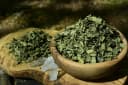
Calea zacatechichi grows wild in the Mexican sierras — Oaxaca, Chiapas, Veracruz — and in some more limited regions of Costa Rica and Honduras. Its commercial cultivation is limited and unevenly controlled. The contemporary market presents three cases: the wild leaf harvested traditionally (rare, costly, sourced in Oaxaca), the greenhouse-grown leaf (more common, quality varying by grower), and the leaf mixed with other, less active Asteraceae (a documented case of adulteration, especially on generic marketplaces). The authenticity crisis does not have the media scale of the blue lotus one, but it exists.
Three visual and olfactory tests to recognise a good-quality Calea, on receiving the lot. First test: the shape of the leaf. Calea ternifolia has elongated, lanceolate leaves with a slightly toothed edge, often in whorls of three (hence the ternifolia). A fine, homogeneous powder makes any verification impossible — always prefer whole or half-broken leaves. Second test: the colour. Greyish-green tending slightly towards olive-green, never dark brown (a sign of long oxidation) nor pale yellow (a sign of a too-late harvest or excessive drying). Third test: the smell, which is the most reliable indicator. A fresh Calea gives off a characteristic bitter-hay signature, slightly camphored, with a sharp herbaceous base. An odourless plant is suspect. A plant that smells only of generic hay has probably been cut with another Asteraceae (chamomile, echinacea).
Fact sheet
Precautions and red lines
Synergies — seven companion plants
Calea and Mugwort (Artemisia vulgaris) — the most practised combination for lucid dreaming. Mugwort enriches the visual and symbolic vividness of dreams; Calea brings the semantic depth and the recall. Together they make dreams charged with images and meaning. Practised in short cycles, one as an evening infusion, the other as a herb pillow (a sachet of dry herb slipped under the pillowcase). The European path and the Mexican path recognise each other.
Calea and Silene capensis (Undlela Ziimlophe) — an intense pairing, to handle with discernment. As both plants are pure oneirogens, their combination can produce dreams of high emotional density. Test them separately first over several weeks, then combine at doses halved for each. The Erowid reports document a few strong experiences and a few nights of overwhelm. A once-a-month cycle at most if combining.
Calea and Entada rheedii (African Dream Bean) — the classic "dream stack" of advanced oneironauts. Three lineages (Chontal, Xhosa, Bantu) in a triad. To be practised after several months of individual use of each plant. Not for first experiments.
Calea and Bobinsana (Calliandra angustifolia) — a cardio-oneiric pairing. Bobinsana opens a quality of tenderness and emotional presence that softens Calea's diagnostic dreams, which can be confronting. To consider if the regular practice of Calea produces recurrent, trying dreams — Bobinsana can soften the channel without altering its truth.
Calea and Yauhtli (Tagetes lucida, Mexican tarragon) — a Mexican cosmological pairing. Yauhtli is the "plant of the fog" of the Mexica, used by the Huichol and the Mazatec to prepare the frame of ceremonies. Alongside Calea, it prepares the mental space — a light smoke bath or an evening infusion preceding the Calea night.
Calea and Authentic Blue Lotus (verified Nymphaea nouchali var. caerulea) — for the nights when one seeks an open heart before the oneiric descent. The lotus brings a soft euphoric calm that eases the threshold of sleep; Calea then works on the quality of the dream. The pharaonic path + the Mexican path, two traditions of the threshold.
Calea and Passionflower (Passiflora incarnata) — a soft pairing, for the first nights of practice. Passionflower relaxes the physical body without touching the oneiric pharmacology; Calea can then unfold its work without the resistance of bodily tension.
The dream is a channel. The question is: do you have a real question to put to it? Without a question, the leaf gives you light sleep. With a question, it sometimes gives you an answer.
Frequently asked questions
How do you use Calea zacatechichi for lucid dreaming?
The documented protocol for lucid dreaming combines the Chontal tradition and the contemporary WBTB technique (Wake-Back-To-Bed). In practice: write a question in the dream notebook before bed · prepare 3 to 5 g of dried leaves as a slow infusion in 250 ml of water at 80 °C, covered, 12 minutes (honey essential — the bitterness is very intense) · drink 30 to 60 minutes before going to bed · set notebook and lamp beside the bed · wake on purpose 4 to 5 hours later, drink 50 cl of warm infusion kept in a thermos, stay awake 20–30 minutes while thinking explicitly about lucid dreaming, then go back to sleep · write immediately on partial waking and on morning waking, before the images fade. Cycle to respect: 1 to 2 nights a week at most, a 3-week break every 2 months.
What is the correct dosage of Calea zacatechichi?
The documented window of exploration sits between 3 and 5 g of dried leaves as a slow infusion under 80 °C, covered, 12 minutes, for the main route. Capsule route: 0.5 to 1 g of powder per capsule, 1 to 2 capsules. Tincture route (40° alcohol, 1:5 ratio): 30 to 60 drops sublingually. The minimal dose (0.5 g) is recommended for the first use, to assess personal tolerance and sensitivity. Use cycle: 1 to 2 nights a week at most, never more than 3 consecutive nights (fast pharmacological tolerance). A 3-week break every 2 months. Descriptive dosage synthesised from Rätsch and MacDougall; to be assessed with a health practitioner in case of psychotropic treatment.
Is Calea zacatechichi psychoactive during the day?
The waking effect of Calea is very modest, almost imperceptible for many users. A slight slowing of pace, a slight relaxation, sometimes a subtle visual softness, never a hallucination or a radical change of consciousness. It is in sleep that the plant unfolds its main action — a change in the quality of sleep (lighter, more spontaneous awakenings) and an amplification of dream recall. Calea is not a plant of trance or waking vision. It is a pure oneirogen, unlike Sinicuichi or Salvia divinorum, which have a clear waking action. For that reason, it is compatible with a working life — evening use only, never during the day.
What is the difference between Calea zacatechichi and Silene capensis for dreaming?
Both plants are pure oneirogens documented in human study, but their signatures differ. Silene capensis (Undlela Ziimlophe), a Xhosa plant of South Africa, opens an ancestral channel — the dreams are described as clear, fluid, like a stream of water, often felt as visits from the ancestors. The traditional preparation is frothed (the root beaten in water until a foam forms) and swallowed on an empty stomach in the morning. Calea, a Chontal plant of Oaxaca, produces diagnostic dreams tied to the question asked — well drawn, carrying a message, sometimes confronting. The traditional preparation is the evening infusion + cigar. To sum up: Silene opens towards the past and the lineage; Calea opens towards the present question. For a beginning dreamer, Silene is often softer; Calea asks for more discipline (written intention, bitterness, respected cycle).
Calea zacatechichi during pregnancy or breastfeeding?
Contraindicated. Human toxicological data on pregnancy and breastfeeding are absent for Calea. The germacranolide sesquiterpenes — the active candidate compounds — can in theory cross the placental barrier and pass into breast milk. As a precaution, avoid throughout pregnancy and for the whole duration of breastfeeding. This precaution applies equally to MAOIs, SSRIs, tricyclics and any ongoing psychotropic treatment: medical advice is imperative before any use.
Why is Calea so bitter and how do you make the bitterness bearable?
Calea's extreme bitterness is its evolutionary signature — the plant's strategy to deter herbivores. It is also, according to the Chontal tradition, its first initiation: only those who pass the bitterness receive the dream. To make it bearable: plenty of honey (essential — without honey, many do not get past the first sip), lemon juice as a complement, drinking in two or three quick gulps rather than sipping (less prolonged contact with the taste buds). Alternative route: capsules of dry powder (a slower effect, 60–90 min, but avoids the taste entirely) or a sublingual tincture (40° alcohol partly masks the bitterness). The traditional Chontal path does not sweeten the plant. It is a posture one respects or transforms — each dreamer chooses.
Is Calea zacatechichi legal in France and Europe?
Yes, Calea zacatechichi is legally free in France and in the great majority of European countries (Belgium, Spain, the United Kingdom, the Netherlands, Germany, Italy). Two notable exceptions: Poland, which listed it among regulated substances in 2009, and the US state of Louisiana, which banned it in 2005. These bans are contested by the ethnobotanical community as inappropriate — Calea has no documented addictive potential and its traditional use is strictly cyclical-ceremonial, not recreational. Check local law before ordering, especially in case of cross-border travel.
Nuggets and legends — what the lineage carries
First nugget. The Chontal name thle-pela-kano — leaf of God — is an ontological statement. For the Chontal, the plant is a direct messenger of the divine through the dream. When you drink Calea, you do not use a tool. You enter into correspondence with a presence. That grammar — the grammar of the plant-person — is the same as that of the Mazatec about the mushrooms, of Robin Wall Kimmerer about sweetgrass, of the Shipibo about ayahuasca. An animist cosmology that has never stopped being practised, despite five centuries of evangelisation. To honour Calea is to hold that grammar rather than translate it into dry pharmacology.
Second nugget. The 1986 Mayagoitia study created a word. The word "oneirogen" did not exist before. Psychopharmacology classed substances as hypnotics (which induce sleep), sedatives (which ease it), stimulants (which prevent it). The idea that a substance could change the quality of the dream without touching the quantity of sleep had no category. Calea forced that category to appear. It is the founding epistemological event of the field today called dream pharmacology. In that sense, Calea is not only a plant — it is an instrument that allowed Western science to find out it had a cognitive blind spot about the dream.
Third nugget. Thomas MacDougall, the American through whom Western science met Calea, was an atypical ethnobotanist. No formal university affiliation for a long time, a life split between New York and Mexico, more than forty years walking the Sierras of Oaxaca, Chiapas, Veracruz. It was he who sent the first samples to Schultes at Harvard in the 1960s. Without MacDougall, no Mayagoitia 1986 study, no Plants of the Gods 1992, no word oneirogen. A plant sometimes depends on the patience of a single man to cross an epistemic frontier.
Fourth nugget. The pharmacology of Calea resists isolation. No purified compound reproduces the effect of the full decoction. This is rare in modern pharmacognosy — the great majority of traditional psychoactive plants have had their active principles identified (mescaline from peyote, DMT from chacruna, salvinorin A from Salvia divinorum, scopolamine from datura). Calea resists. The whole plant does something its fractions do not reproduce. It is a pharmacological vindication of the INFUSE philosophy — the whole dried leaf, not a standardised extract. Here the traditional path is also the scientifically most effective path.
Fifth nugget. Oneiromancy — divination through sleep — is not exclusively Chontal. It is an anthropological universal. Asclepius among the Greeks and his incubatio rite in the temple-clinics of Epidaurus. The dream oracles of Mesopotamia. The North American sweat lodges. The muthi-dreams of the South African sangoma. The rûh of the Sufis. The incubation dream of the Japanese Buddhist temples. Calea takes its place in this worldwide lineage of the dream as a cognitive tool, and it is one of the last specimens in continuous use, scientifically validated, commercially accessible. That accessibility is precious and fragile. It depends on respect for the plant — cyclical use, not recreational, the lineage named.
Sixth nugget. The Chontal sentence — "she shows you what is wrong inside you" — carries an implicit ethic. The plant does not give you what you want. It shows you what asks to be seen. Many contemporary users, drawn by the promise of lucid dreaming, are surprised to find that their first Calea nights deliver confronting dreams — unresolved relationships, old fears, troubling recurrent patterns. This is not a malfunction of the plant. It is its signature. It is a diagnostic plant. Lucid dreaming comes afterwards, once the dreamer has accepted the leaf's primary function.
INFUSE's Calea Zacatechichi
To go further
 4.8(268)da 7,20 €Vedi →
Hai anche tu un racconto da lasciare nella Foresta?
Condividere un racconto →The documented protocol for lucid dreaming combines the Chontal tradition and the contemporary WBTB technique (Wake-Back-To-Bed). In practice: write a question in the dream notebook before bed · prepare 3 to 5 g of dried leaves as a slow infusion in 250 ml of water at 80 °C, covered, 12 minutes (honey essential — the bitterness is very intense) · drink 30 to 60 minutes before going to bed · set notebook and lamp beside the bed · wake on purpose 4 to 5 hours later, drink 50 cl of warm infusion kept in a thermos, stay awake 20–30 minutes while thinking explicitly about lucid dreaming, then go back to sleep · write immediately on partial waking and on morning waking, before the images fade. Cycle to respect: 1 to 2 nights a week at most, a 3-week break every 2 months.
104 min déjà parcourues · 130 min jusqu'au seuil de retour
Ciò che questa lettura ha aperto
Sii la prima voce. Ogni parola viene riletta prima di unirsi alla lettura.
Accedi per condividere ciò che questa lettura ha aperto in te.
Accedi →