Guarana, the eye of the gods — the child whose eyes became a seed
The Sateré-Mawé myth of the child whose eyes were planted in the earth, the bastão grated on the tongue of the pirarucu, the seed's caffeine told plainly, and our guarana powder from Brazil.
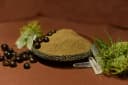 Växten i den här artikelnGuarana · Paullinia cupana4.9(31)från 10,00 €Se →
The master plants, approached with devotion — what they teach when we let them be what they are.
Svensk översättning kommer snart – artikeln visas på ett annat språk.
When the guarana fruit ripens, its scarlet husk splits in two. Inside, white flesh; at the centre of the flesh, a glossy black seed. On the vine, dozens of open eyes look out at the forest. The gatherers wait until the first one has opened before harvesting.
The Sateré-Mawé of the Brazilian Amazon call it warana. It is often translated as "the eye of the gods", after the fruit; we also keep another meaning, handed down with the plant: warana, the "Essence of Reason".
The child who could see
The origin myth is told among the Sateré-Mawé and their neighbours, the Mundurucú. In a village there lived a child who could see: hidden quarrels, unspoken sorrows, the place to plant and the place to fish. A jealous spirit killed him.
A kindly deity then told the elders to take the child's two eyes and put them in the earth. The left eye was planted in the forest: from it grew wild guarana. The right eye was planted in the village: from it grew cultivated guarana. And from the earth where the child had been buried rose the first Sateré-Mawé.
That is why the fruit has the shape of a living eye. The Sateré-Mawé call themselves the descendants of that child, and warana holds the centre of their cosmology, as an ancestral presence. Those incredible seeds have always been considered of high spirituality, sacred and full of wonder!
The vine and the seed
Paullinia cupana is a woody vine of the Sapindaceae, the family of lychee and longan. It climbs more than twelve metres, bears five-leaflet leaves and small, scentless white flowers. Each capsule usually holds a single round seed, about a centimetre across.
Botanists distinguish a wild form and a cultivated one, like the myth with its two eyes. The Sateré-Mawé grow it among the forest trees, on their lands of the Andirá-Marau.
The bastão and the tongue of the pirarucu
The traditional preparation takes time. The fruits are soaked to remove the husk, the seeds are gently roasted over the fire, ground, and the paste mixed with a little cassava flour or cacao. It is kneaded, then shaped into hard sticks about thirty centimetres long, dried in the sun or over a low fire: the bastão. A bastão keeps for years; sometimes it is handed down.
To drink, a fragment of the stick is grated into a bowl of water. The traditional grater is the bony tongue of the pirarucu (Arapaima gigas), the great fish of the Amazonian rivers. The pirarucu gives its grater, warana gives its seed, and the person, standing between the two, prepares the drink that binds them to both. The taste is bitter, astringent, with a note of smoke.
Sateré-Mawé hunters took the seed with them for the day. Warana also accompanies the Tucandeira, or Waumat, the initiation in which young men put their hands into woven gloves full of tucandeira ants (Paraponera clavata), whose sting is feared: and they stay, eyes open.
From Betendorf to soft drinks
In 1669 the Jesuit missionary Betendorf described the drink among the peoples of the Amazon; it is the first written description. In the nineteenth century guarana became a popular drink in Brazil and entered the European pharmacopoeias. In 1840, chemists showed that the "guaranine" drawn from the seed is the same molecule as the caffeine in coffee.
In 1921 the soft drink Antarctica Guaraná was born in Brazil; the seed then went into drinks the world over, sometimes topped up with synthetic caffeine. Christian Rätsch speaks of a sacred plant "beheaded", reduced to a single compound. Facing this history, the Sateré-Mawé, through their General Council (CGTSM) and fair-trade partners, have defended the name warana and their way of growing it for decades.
What the seed contains
The guarana seed contains 2 to 8% caffeine by weight, 4 to 5% on average; the coffee bean contains 1 to 3%. It is the same molecule. The often-quoted "guaranine" is not a separate substance, and guarana is not a caffeine "four to seven times stronger": that idea has run through marketing for a long time, and it is false.
In the seed, caffeine sits alongside a little theobromine, tannins, saponins, vitamins and minerals.
Guarana at the House
Our guarana comes from Brazil, the land of the plant and of the peoples who domesticated it. It comes from small rural communities, as a roasted seed ground to a powder. It is from a certified organic supply chain, checked by a certification body. In 100 g, 200 g and 1 kg.
- In warm plant milk or water just off the boil: a teaspoon of powder, in the morning.
- As an infusion: a teaspoon in hot water, ten minutes, then strain.
- As a decoction: a teaspoon, at a gentle simmer for five to ten minutes.
- Cold: a teaspoon in a smoothie, a juice or a yoghurt.
The bitterness softens with plant milk, a pinch of ceremonial cacao or a little honey, in the spirit of the original cassava-and-cacao mix. A cup is drunk early in the day, in small sips, like a day breaking. Guarana is drunk as the eyes open.
Precautions
- Guarana is a strongly caffeinated plant, and caffeine is a stimulant. All the precautions of caffeine apply, heightened by the seed's content.
- Do not combine it with other sources of caffeine (coffee, tea, mate, guayusa, caffeinated soft drinks).
- Keep it for the morning: in sensitive people, caffeine can act for several hours and delay sleep.
- Pregnancy and breastfeeding: avoid. Caffeine crosses the placenta and passes into breast milk.
- Children: not recommended. For adults only.
- Cardiovascular disorders, heart rhythm disorders, hypertension, heart medication, anxiety, insomnia: medical advice first.
- Ongoing treatment, in particular stimulant medication or heart treatment: talk to your doctor.
- Sensitivity to caffeine (palpitations, jitteriness): start with a small amount.
- Daily use in large amounts can lead to caffeine dependence; on stopping, headaches and irritability for a few days.
When in doubt, your doctor before the plant.
Roasted seed ground to a powder, imported from small rural communities in Brazil, from a certified organic supply chain checked by a certification body. In 100 g, 200 g and 1 kg.
Discover INFUSE guarana →Sateré-Mawé guarana and the other plants of gods and initiations, people by people: divine masculine herbs.
Sources
- Smith, N. & Atroch, A. L. (2010), Evidence-Based Complementary and Alternative Medicine 7(3): the history of guarana, from Betendorf (1669) to Antarctica Guaraná (1921).
- Christian Rätsch, The Encyclopedia of Psychoactive Plants, Park Street Press, 2005: entry Paullinia cupana.
- General Council of the Sateré-Mawé tribe (CGTSM): warana and its cultivation.
- Cultural Survival, "Eyes of the Forest": the Sateré-Mawé point of view.
- Our supplier's technical sheet: origin, form, certification.
 4.9(31)från 10,00 €Se →
Få vårt veckobrev.
Har du också en berättelse att lämna i Skogen?
Dela en berättelse →Det som den här läsningen öppnade
Bli den första rösten. Varje ord läses igenom innan det ansluter till läsningen.
Logga in för att dela det som den här läsningen öppnade i dig.
Logga in →