Guayusa, the Jaguar Spirit — the calm energy of the Kichwa warrior
The Amazonian holly the Kichwa drink before dawn while telling each other the night's dreams: the wayusa upina, the tomb of Niño Korin, the word Runa, and our leaves from Ecuador.
 Växten i den här artikelnGuayusa · Ilex guayusa5.0(93)från 8,50 €Se →
Celebrate and stay present. The plants that dance with you and leave your tomorrow intact.
Svensk översättning kommer snart – artikeln visas på ett annat språk.
It is three in the morning in a Kichwa house in the Ecuadorian Amazon. The fire has been relit, a pot of leaves simmers on it. The family sits around, the gourds are passed from hand to hand, and the elders ask: what did you dream last night? This rite has a name, the wayusa upina: "drinking guayusa".
Guayusa is the Jaguar Spirit. A calm energy, present, available, playful, with an open heart. The Kichwa sum it up in one word: Runa.
An Amazonian holly
Ilex guayusa belongs to the holly genus, the trees that stay green through winter. Its cousins are mate (Ilex paraguariensis) from the south of the Americas and yaupon (Ilex vomitoria), from which the peoples of the North American south-east drew the "black drink" of their councils.
It is an evergreen tree about fifteen metres tall, with oval, glossy leaves, that grows only in the humid forests of the western Amazon: mostly in Ecuador, at the margins of Peru and Colombia. In cultivation it hardly ever flowers. People have been taking cuttings and planting it for so long that it barely has a wild state left: guayusa lives where families take care of it.
The Kichwa call it wayusa, the Shuar and the Achuar wayus. English has nicknamed it the night watchman.
The wayusa upina
Among the Amazonian Kichwa, in Ecuador and northern Peru, people used to rise between three and four in the morning. Guayusa was heated on the fire, drunk together, and the elders spoke. The night's dreams were told and then interpreted, and the day was decided from them: who would go hunting, who would stay in the gardens, who would go visiting. This is where children learned to tell their dreams and read omens.
The anthropologist Eduardo Kohn, who lived among the Runa of Ávila, describes waking in the middle of the night for a gourd of guayusa, and a fine grammar for reading dreams: dogs' dreams are read literally, human dreams as metaphors (How Forests Think, 2013).
A 2026 study adds a nuance: in daily life, dream interpretation around guayusa has become rare. The rite still lives at community gatherings. Guayusa's bond with dreaming runs through the morning's spoken word.
The Shuar, the Achuar and the omen
Among the Shuar and the Achuar, peoples that older ethnography grouped under the name Jivaro, the men drink the decoction together before dawn, for about an hour, sharing their dreams and reading the coming day. They even make bowls set aside for guayusa, the guayuceros. Rafael Karsten, who visited them at the start of the twentieth century, reports an omen: to see guayusa boiling over in a dream announces a good hunt.
The Achuar drink large quantities before dawn, then make themselves vomit: a deliberate purge, learned within the rite.
Ecuador also lends it a legend: the loved one to whom you offer guayusa will always come back, however far the journey has taken them.
The tomb of Niño Korin
In Bolivia, at Niño Korin, a tomb of the Tiwanaku culture held the burial of a medicine man. Among his belongings: a bundle of guayusa leaves, radiocarbon-dated to around the year 355. They still contained caffeine.
Guayusa does not grow in Bolivia. These leaves had therefore travelled from the Amazon up to the high plateaus of the Andes, and they went with him into death.
In writing, the Jesuit Juan Lorenzo Lucero described in 1683 guayusa drunk every day among the Jivaro. In recent years, Kichwa cooperatives have made it known to the world, grown in the chakras, the forest gardens where it grows beside cacao and banana trees.
Runa
Runa means, in Kichwa, the person, the human being: it is the name the Kichwa give themselves. The Kichwa people describe the effects of guayusa as making them feel Runa, translating as "fully alive".
Guayusa also goes into our Love Elixir, with damiana, blue lotus and rose: there, it is the Jaguar Spirit.
What the leaf contains
Guayusa leaves contain caffeine, typically 1.7 to 1.8%, sometimes 3 to 4%, with a record of 7.6% measured on one wild plant; the content varies a great deal from tree to tree. There is also a little theobromine, the alkaloid of cacao, traces of theophylline, and polyphenols. It is a caffeinated plant, like coffee and tea.
Guayusa at the House
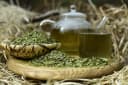
Our guayusa comes from Ecuador, its home ground. The leaves are harvested and then dried; the resin paste is a dense extract drawn from these same leaves. The taste is mellow, earthy, lightly sweet, with a note of hazelnut, less tannic than green tea.
- As an infusion: two teaspoons of leaves, five to ten minutes in water just off the boil. The leaves can be steeped again several times.
- As a decoction, the traditional way: a tablespoon of leaves, at a gentle simmer for about twenty minutes, or a long time on the fire in the Shuar manner. They can be used up to four times.
- In a gourd, like mate.
- The resin paste: from the size of a grain of rice to that of a chickpea, under the tongue or dissolved in a hot or warm drink.
A cup at dawn, notebook open. If there are several of you, you tell each other the night, as around the Kichwa fire; alone, you write it down.
Precautions
- Guayusa is rich in caffeine: keep it for the morning and daytime, never the evening.
- Do not combine it with other sources of caffeine, or multiply strong cups. The Achuar describe the signs of too strong a dose: severe headaches, bloodshot eyes, unpleasant sensations.
- Caffeine sensitivity, anxiety, hypertension, heart conditions or heart medication: the same care as with strong coffee, and medical advice when in doubt.
- Stimulant medication: medical advice first.
- Pregnancy and breastfeeding: like any source of caffeine, limit it sharply, or avoid it. Ask a healthcare professional.
- Children: not recommended.
When in doubt, your doctor before the plant.
Whole leaves from Ecuador, from 50 g to 1 kg, and a dense resin paste extracted from the same leaves, in 5 g and 20 g. Our batch is sold without organic certification.
Discover INFUSE guayusa →Sources
- Christian Rätsch, The Encyclopedia of Psychoactive Plants, Park Street Press, 2005: entry Ilex guayusa (Niño Korin, caffeine content, the Shuar omen after Karsten).
- Rafael Karsten, The Head-Hunters of Western Amazonas, 1935.
- Dueñas, J. F. et al. (2016), "Amazonian Guayusa (Ilex guayusa Loes.): A Historical and Ethnobotanical Overview", Economic Botany 70(1).
- Eduardo Kohn, How Forests Think, University of California Press, 2013.
- Espinosa Andrade & Vásquez-Castillo (2026), PLoS One: the wayusa upina today.
- Our supplier's technical sheet: origin and forms.
 5.0(93)från 8,50 €Se →
Få vårt veckobrev.
Har du också en berättelse att lämna i Skogen?
Dela en berättelse →Det som den här läsningen öppnade
Bli den första rösten. Varje ord läses igenom innan det ansluter till läsningen.
Logga in för att dela det som den här läsningen öppnade i dig.
Logga in →