Yellow maca: the everyday food of the Andean plateau
Six to seven roots in ten in the fields of Junín: yellow maca, the one families on the plateau eat every day, sun-dried, then cooked as a porridge or in milk.
 Tämän artikkelin kasviPerulainen maca · Lepidium meyenii4.9(12)alk. 8,50 €Katso →
The plants that walk with the cycles, to live inside them fully.
Suomenkielinen käännös on tulossa – tämä artikkeli näytetään toisella kielellä.
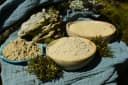
On the Junín plateau, in central Peru, above 4,000 metres, maca is harvested at the end of the dry season. Six to seven roots in ten come out of the ground yellow, a pale yellow verging on cream, with white flesh. This is yellow maca, the one families on the plateau eat every day, the way potatoes are eaten elsewhere. In the Andean reading of the three colours, the most abundant is the one for every day, for everyone.
A root that is eaten
Maca, Lepidium meyenii, is a small crucifer, a cousin of radish and watercress. Its fleshy part, between root and stem, swells for seven to nine months beneath a rosette of leaves pressed flat to the ground. Dried, it is mostly carbohydrate, about 60%, with 10 to 14% protein, 8% fibre and a little fat, plus minerals: potassium, calcium, iron, magnesium, zinc. It is the make-up of a staple food, and that is how the plateau treats it.
The peoples of the high plateaus were growing it long before the Inca empire. The Incas found it there, and brought it into their economy.
The time of drying
Fresh maca does not keep, and it is not eaten raw over time: its glucosinolates, the sulphur compounds of the cabbage family, are the reason. Families spread it out in the plateau sun for two to three weeks, sometimes up to three months. The root hardens until it is almost a stone. It then keeps for a long time, and tradition says it mellows with age, like a harvest left to age in a cellar.
Before it is eaten, it is rehydrated and cooked, in water or in milk, in the pot of the day. Gelatinisation, gentle cooking under pressure, is the modern version of that gesture: it gives a powder that sits more easily on the stomach.
The cooking of the plateau
Three preparations come back again and again in the families of Junín, and in the markets of Peru.
- The mazamorra de maca: a thick porridge, the dried root cooked for a long time with water or milk, sugar and cinnamon.
- The maca con leche: the powder whisked into hot milk, the morning drink.
- The jugo de maca: a hot, thick drink, served by the glass in Peruvian markets.
Maca powder is smooth, slightly sweet, with notes of caramel and malt. It goes well with cacao, milk, vanilla and cinnamon, and it finds its way into cakes, porridges, and little balls of oats and dates.
Yellow maca at the House
We offer it as a powder, in 100 g or 200 g. It comes from the high plateaus of Junín-Pasco, above 4,000 metres, and from a certified organic supply chain, inspected by a certification body. Red is also in the catalogue; black is temporarily out of stock.
The House maca con leche
A spoonful in the morning drink, day after day.
- A cup of warm plant milk, oat, almond or coconut.
- Half a teaspoon of yellow maca to begin with (2 to 3 g), then a teaspoon (about 5 g).
- Half a spoonful of cacao, a pinch of cinnamon, a little honey or maple syrup.
- Two to three minutes at a simmer, whisking.
With plant milk and cacao, maca becomes a delicious and very nourishing traditional preparation. In the kitchen you can go up to two teaspoons, in a vanilla oat porridge or a cake batter. Maca is taken regularly, over weeks, like a food; a break now and then is welcome.
For its sisters, there are red maca and black maca. Maca also goes into our Adaptogenic Blend, with ashwagandha, shatavari, mucuna and chaga.
Precautions
- Thyroid disorder: the glucosinolates of crucifers can interfere with thyroid function. Prefer the cooked or gelatinised form and ask for medical advice.
- History of hormone-dependent cancer, severe endometriosis, hormone treatment: ask for medical advice before use.
- Pregnancy and breastfeeding: not enough data, ask a practitioner.
- Digestion: some discomfort is possible at first with raw powder; the gelatinised form is gentler.
- In the evening: taken late, maca can disturb the nights of sensitive people. Morning or midday.
Peruvian maca powder, yellow or red, in 100 g or 200 g. A root of the Junín-Pasco high plateaus, from a certified organic supply chain, inspected by a certification body.
Discover Peruvian maca →Sources
- G. F. Gonzales, "Ethnobiology and Ethnopharmacology of Lepidium meyenii (Maca), a Plant from the Peruvian Highlands", Evidence-Based Complementary and Alternative Medicine, 2012.
- C. F. Quirós and R. Aliaga Cárdenas, "Maca (Lepidium meyenii Walp.)", in Andean Roots and Tubers, IPGRI, 1997.
- Our supplier's sheet: origin, colours available, certification.
 4.9(12)alk. 8,50 €Katso →
Tilaa viikon kirjeemme.
Onko sinullakin kertomus jätettäväksi Metsään?
Jaa kertomus →Mitä tämä lukeminen avasi
Ole ensimmäinen ääni. Jokainen sana luetaan ennen kuin se liittyy tähän tekstiin.
Kirjaudu sisään jakaaksesi, mitä tämä lukeminen avasi sinussa.
Kirjaudu sisään →