⊹ To weave around
To accompany Peruvian Maca – Yellow, Red & Black
Click a card to see why it pairs — and choose your form.
Read it through your world
The whole page is read through this lens.
✦ Peruvian Maca – Yellow, Red & Black · in one breath ✦
Vitality and endurance — an adaptogenic root that supports the body through stress and fatigue.
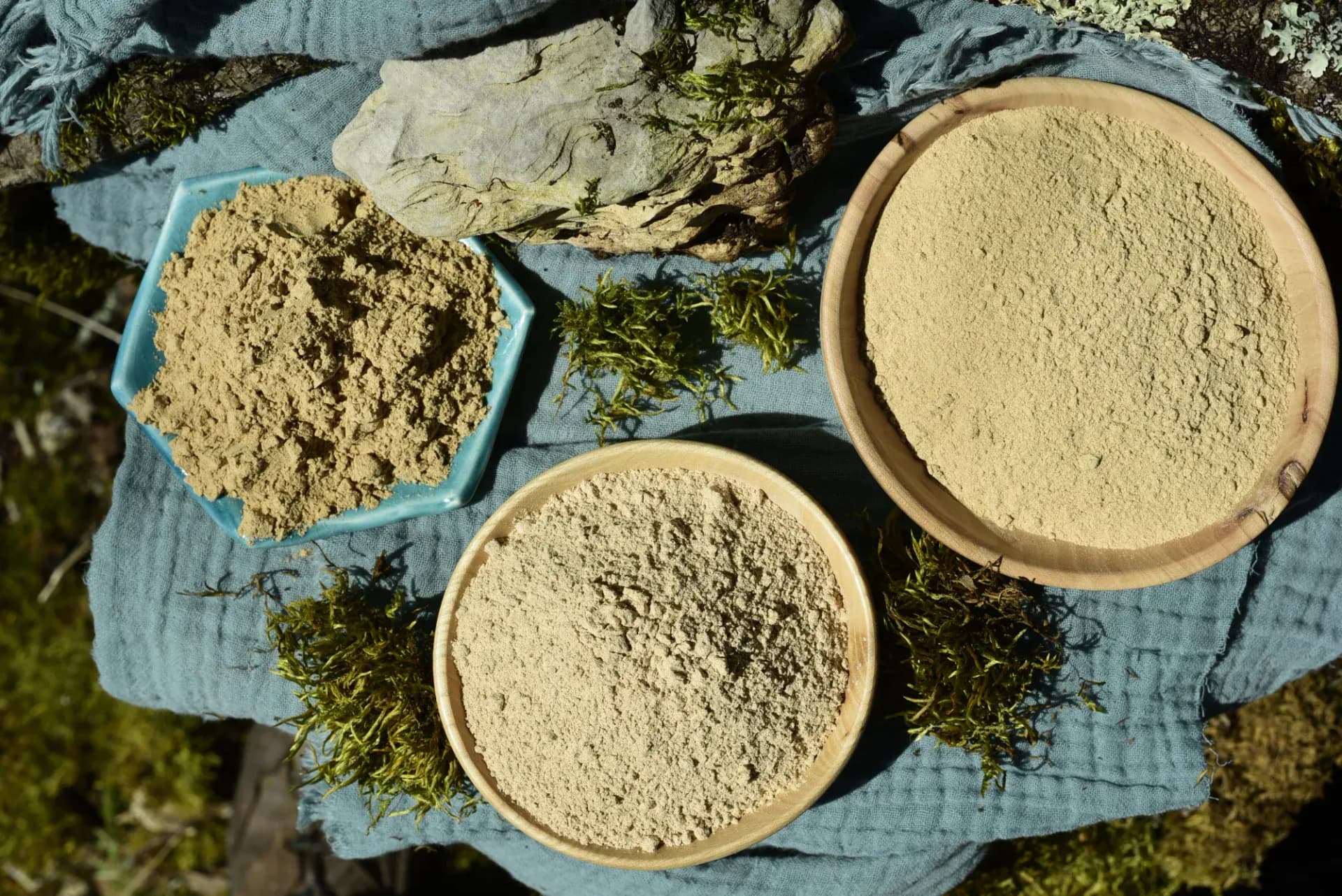
⊹ The path of the plant
⊹ Community voices
What the community murmurs.
Average · 12 reviews
including 12 left on our Etsy shop
Breakdown
I don't use it right now and not very often but I'm really really a fan of the sweet and delicious taste the effect in herbal tea is not noticeable after a day for me in any case. On the other hand in vaporization (with a vaporizer of plants) the effect comes direct and is stimulating, pleasant, aphrodisiac with a higher motivation.
Nébuleuse
Daily · left on our Etsy shop · 8 September 2022
Ask the Forest about Peruvian Maca – Yellow, Red & Black
408 books digested, 97,512 indexed passages. She answers on lineages, synergies, cautions, ritual variations.
⊹ FREQUENT QUESTIONS ⊹
We answer.
What is Peruvian maca?
Peruvian maca (Lepidium meyenii) is a small root of the brassica family that grows only on the Andean high plateaus of Junín-Pasco, above 4000 m altitude. In Andean grammar, she is first a staple food — like the potato and quinoa — consumed dried then cooked. She is ranked among the adaptogens.
What is the difference between yellow and red maca?
Yellow maca is the most abundant colour (60 to 70% of harvests) and the most versatile — it is the form of the daily, for everyone. Red maca is rarer; Andean tradition reserves her for transition phases and describes her as the richest in antioxidant pigments (anthocyanins). Maca seeds give all the colours at once — you don't choose the colour, you welcome her.
How do I consume maca powder?
Half a teaspoon to a teaspoon of powder (2 to 5 g) in a warm drink, a porridge or a smoothie, in the morning or mid-day. The traditional Andean recipe is maca con leche — warm plant milk, a pinch of cacao, a little cinnamon. Maca pairs with cacao, vanilla and milk. Better to cook her lightly or choose her gelatinised for digestibility.
How much maca per day?
Traditional references go from half a teaspoon to start (2 to 3 g) to a teaspoon at installation (about 5 g), up to two teaspoons (10 g) in food integration. Maca is for the long run. These are references, not a prescription — each adjusts to her sensation.
When to take maca during the day?
Morning or noon. Maca is a plant of daytime vigilance; taken late, she can disturb sleep onset in sensitive people. Andean tradition makes her the gesture of awakening — a warm latte facing morning light, in place of coffee.
Raw or gelatinised maca — which to choose?
Maca is not consumed raw over the long term. The raw root contains goitrogenic glucosinolates; tradition dries her long in the sun then cooks her. Gelatinisation is a gentle pressure cooking that removes raw starches and eases digestion. For daily use, the gelatinised form is the most comfortable.
Is maca contraindicated for certain people?
Caution in case of thyroid disorder (the glucosinolates of crucifers can theoretically interfere with the thyroid — prefer the gelatinised form), history of hormone-dependent cancer, and during pregnancy or breastfeeding for lack of sufficient clinical data. In these cases, ask a practitioner's advice before use.
Should I cycle maca or take her continuously?
Yellow maca lends herself to prolonged daily use — it is her nature as a food. Occasional pauses (a week every few weeks) are welcome without being obligatory. Effects build in regularity, over weeks, not in a peak.
⊹ Chapter · Questions ⊹
Ask, answer, share.
One question, one answer — sometimes several voices. The community answers first; INFUSE steps in when it should.
Nobody has opened a thread yet about this plant. You can be the one — a real question, a use, a doubt, a detail.
Anonymous if you prefer.
In depthbotany · phytochemistry · history
Botany
Maca is Lepidium meyenii Walpers — cultivated forms are sometimes assigned to Lepidium peruvianum Chacón, a botanical synonym still debated, and it is nicknamed "Peruvian ginseng." It is a small plant of the Brassicaceae family (crucifers — like cabbage, broccoli, mustard). It grows only on the high plateaus of the central Peruvian Andes, between 4000 and 4500 m of altitude, in the Junín-Pasco region: not lower, not elsewhere. At that altitude the conditions are among the most extreme of the inhabited world — temperature swings of 30 °C over twenty-four hours, constant wind, very high ultraviolet radiation, low atmospheric pressure, poor soils that volcanic activity has nonetheless mineralised. The part eaten is the fleshy root (the hypocotyl), which develops over seven to nine months before it matures.
Phytochemistry (descriptive)
Maca is studied above all for compounds particular to it: the macamides and macaenes (its signature compounds), the glucosinolates (the sulphur compounds characteristic of crucifers), sterols (beta-sitosterol, brassicasterol), polysaccharides, a complete profile of essential amino acids (especially rich in arginine and lysine), minerals (calcium, iron, zinc, selenium, iodine, potassium, magnesium — at notable concentrations thanks to the volcanic soils) and vitamins B1, B2, B12 (rare in the plant kingdom), C and E. Nutritionally, the dried root is roughly 60% carbohydrate, 10 to 14% protein, 8% fibre and 2% fat — which is what makes it a caloric, nourishing food rather than a mere supplement.
The phenotypes differ in their chemistry: black maca concentrates the most macamides and glucosinolates; red maca is the richest in anthocyanins (red pigments, with strong antioxidant capacity) and in phytosterols; yellow maca offers the broadest profile, but at more moderate individual concentrations — the signature of its versatility.
Three colours, three functions
A botanical quirk underlies the Andean wisdom: maca seeds produce every phenotype at once — you cannot, genetically, grow a single colour. Each harvest yields roughly 60 to 70% yellow, 15 to 25% red, 10 to 15% black. Traditional classification reads this distribution as a teaching: the yellow, abundant, is the everyday staple, for everyone; the red, rarer, accompanies transitions and is described as the most antioxidant; the black, rarest of all, is kept for targeted needs. These colours are not gendered in any strict sense — they are energetic qualities, called for by a body according to the moment.
What the studies report
Modern research has focused almost exclusively on cooked or gelatinised yellow maca, the most available form. Studies report a subjective improvement in energy, mood and resistance to fatigue in healthy subjects; a 2011 trial (Lee and colleagues) reports a reduction in symptoms associated with menopause, and the work of Gonzales and his team describes reported effects on libido — male and female — fertility and physical endurance.
One point recurs in the literature and deserves emphasis: maca does not change serum hormones (testosterone, oestradiol, FSH, LH and prolactin do not vary across the trials), even though subjective effects are reported. Its action would work through pathways other than the direct hormonal one — which sets it apart from phytoestrogenic plants and explains why it lends itself to prolonged use. Maca is neither a hormone substitute nor a medicine: these data describe observations.
Lineage and long history
Maca was domesticated around 3800 BCE in the Junín-Pasco plateau region — more than five thousand years before the Incas. Anonymous highland breeders spent centuries refining, from the wild variants of Lepidium meyenii, the cultivated root of today: without a microscope, without chemical analysis, they had identified a treasure. The pre-Inca civilisations (Chavín, Wari, Chanca) grew it; the Incas folded it into their tribute economy. Sixteenth-century Spanish chronicles document the use of maca to restore the fertility of men and of animals gone sterile at altitude.
The traditional preparations remain alive in Andean families: maca con leche (a hot milk drink), mazamorra (a thick porridge), chicha de maca (a lightly fermented drink, traditionally started by women chewing the roots, whose saliva launches the fermentation), flatbreads and soups.
Drying, cooking and goitrogens
The Andean protocol is precise. The roots are harvested at the end of the dry season, sun-dried for two to three weeks, sometimes as long as three months, then stored — maca improves with time, like a wine kept in a cellar. This drying also protects: the fresh root is goitrogenic and must be dehydrated and then cooked to be eaten safely over time. Gelatinisation (gentle pressure cooking) is the modern version of that transformation: it removes the raw starches and improves digestibility. Maca is not eaten raw; it is waited for, and cooked.
The market and authenticity
Between 2014 and 2016, foreign buyers paid very high prices to Junín farmers for fresh roots, took living seeds and plants out of Peru, and started cultivation at lower altitude elsewhere in the world. Reported consequences: a collapse of Peruvian prices, Andean communities left fragile, and a maca of lower phytochemical density — because it was grown away from the altitude that makes its strength. Maca's density comes from the extreme terroir of Junín-Pasco; a maca grown lower down is no longer quite the same plant.
Safety
Maca is very well tolerated — over two thousand years of daily consumption attest to it. The main precautions concern thyroid disorders (the glucosinolates of crucifers — prefer the gelatinised form), a history of hormone-dependent cancer (medical advice, even though the action is described as non-hormonal), and pregnancy and breastfeeding (modern clinical data insufficient). A transient digestive discomfort is possible at the start of use with the raw form. Taken late, it can disturb sleep onset in sensitive people.