Cordyceps — the Mushroom of the Breath, from the Tibetan Monk to the Athlete
Ophiocordyceps sinensis — a high-altitude parasitic fungus that turns the caterpillar into a fruiting body. Used in Tibet for more than 1,000 years for altitude, endurance, vitality. Militaris as a verified alternative. Cordycepin and adenosine: the dual energy system.
 A planta deste artigoCordyceps · Cordyceps militarisdesde 30,00 €Ver →
Le règne tranquille — racines, polypores, mycélium. La résilience du vivant prête au quotidien.
tagline · path
Tradução portuguesa a caminho — este artigo é apresentado noutra língua.
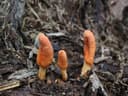
A fungus that parasitises a caterpillar, consumes its chrysalis from within through the winter, then sends its fruiting body up in spring from the head of the dead host. Ophiocordyceps sinensis — Yartsa Gunbu in Tibetan, "winter-grass summer-mushroom." Gathered by hand on the high Himalayan plateaus above 3,500 metres.
1,000 Years of Tibetan Use — Yartsa Gunbu
A fungus that parasitises a caterpillar, consumes its chrysalis from within through the winter, then sends its fruiting body up in spring from the head of the dead host. Ophiocordyceps sinensis — Yartsa Gunbu in Tibetan, "winter-grass summer-mushroom." Gathered by hand on the high Himalayan plateaus above 3,500 metres.
Human use takes hold: Yartsa Gunbu, long turned to for altitude, for lasting fatigue, for masculine vitality, for the cough tied to the dry cold of the high plateaus. In TCM (traditional Chinese medicine): it tonifies the Qi of the Lung and the Kidney, the two energetic organs the tradition holds fundamental to endurance.
In the twentieth century: in 1993, the Chinese women's athletics team broke three world records. The coach credited the performances to a preparation based on Cordyceps and turtle blood. The Western world discovered the mushroom.
Cordyceps sinensis vs Cordyceps militaris — the Sourcing Problem
A fungus that parasitises a caterpillar, consumes its chrysalis from within through the winter, then sends its fruiting body up in spring from the head of the dead host. Ophiocordyceps sinensis — Yartsa Gunbu in Tibetan, "winter-grass summer-mushroom." Gathered by hand on the high Himalayan plateaus above 3,500 metres.
C. militaris can be cultivated and contains cordycepin in greater quantity than cultivated sinensis. INFUSE works with C. militaris grown on an organic brown-rice substrate — whole fruiting bodies, not mycelium — with a double extraction (water + alcohol).
Pharmacology — Cordycepin and Adenosine
A fungus that parasitises a caterpillar, consumes its chrysalis from within through the winter, then sends its fruiting body up in spring from the head of the dead host. Ophiocordyceps sinensis — Yartsa Gunbu in Tibetan, "winter-grass summer-mushroom." Gathered by hand on the high Himalayan plateaus above 3,500 metres.
Adenosine: a universal cell-signalling molecule. A precursor of ATP. A support to cellular energy production.
Beta-glucans (1-3 and 1-6): immunomodulators, shared with the other medicinal mushrooms.
Specific polysaccharides: CPS-1, CPS-2 — a documented immunomodulating profile.
Mechanisms: an improvement in VO2max documented in studies on athletes, an improvement in cellular oxygen use, a modulation of the HPA axis.
Preparation and Double Extraction
A fungus that parasitises a caterpillar, consumes its chrysalis from within through the winter, then sends its fruiting body up in spring from the head of the dead host. Ophiocordyceps sinensis — Yartsa Gunbu in Tibetan, "winter-grass summer-mushroom." Gathered by hand on the high Himalayan plateaus above 3,500 metres.
INFUSE protocol: water decoction at 70–80 degrees, 3 hours + 40% alcohol maceration, 3 weeks. Cohobation. A dry product is possible (ground fruiting-body powder) for a long cure.
Red Lines
A fungus that parasitises a caterpillar, consumes its chrysalis from within through the winter, then sends its fruiting body up in spring from the head of the dead host. Ophiocordyceps sinensis — Yartsa Gunbu in Tibetan, "winter-grass summer-mushroom." Gathered by hand on the high Himalayan plateaus above 3,500 metres.
 desde 30,00 €Ver →
Também tens um relato para deixar na Floresta?
Partilhar um relato →Ophiocordyceps sinensis -- champignon-parasite de haute altitude qui transforme la chenille en fructification. Usage tibetain depuis plus de 1000 ans pour l'altitude, l'endurance, la vitalite. Militaris comme alternative verifiee. Cordycepine et adenosine : le double systeme energetique.
98 min déjà parcourues · 105 min jusqu'au seuil de retour
O que esta leitura abriu
Sê a primeira voz. Cada palavra é relida antes de se juntar à leitura.
Inicia sessão para partilhar o que esta leitura abriu em ti.
Iniciar sessão →