⊹ To weave around
To accompany Mulungu
Click a card to see why it pairs — and choose your form.
✦ Mulungu · in one breath ✦
The coral-flowered tree that speaks the language of the nervous system — deep rest and inner calm.
⊹ The path of the plant
⊹ Community voices
What the community murmurs.
Average · 1 reviews
including 1 left on our Etsy shop
Breakdown
Ask the Forest about Mulungu
408 books digested, 97,512 indexed passages. She answers on lineages, synergies, cautions, ritual variations.
⊹ FREQUENT QUESTIONS ⊹
We answer.
What is mulungu?
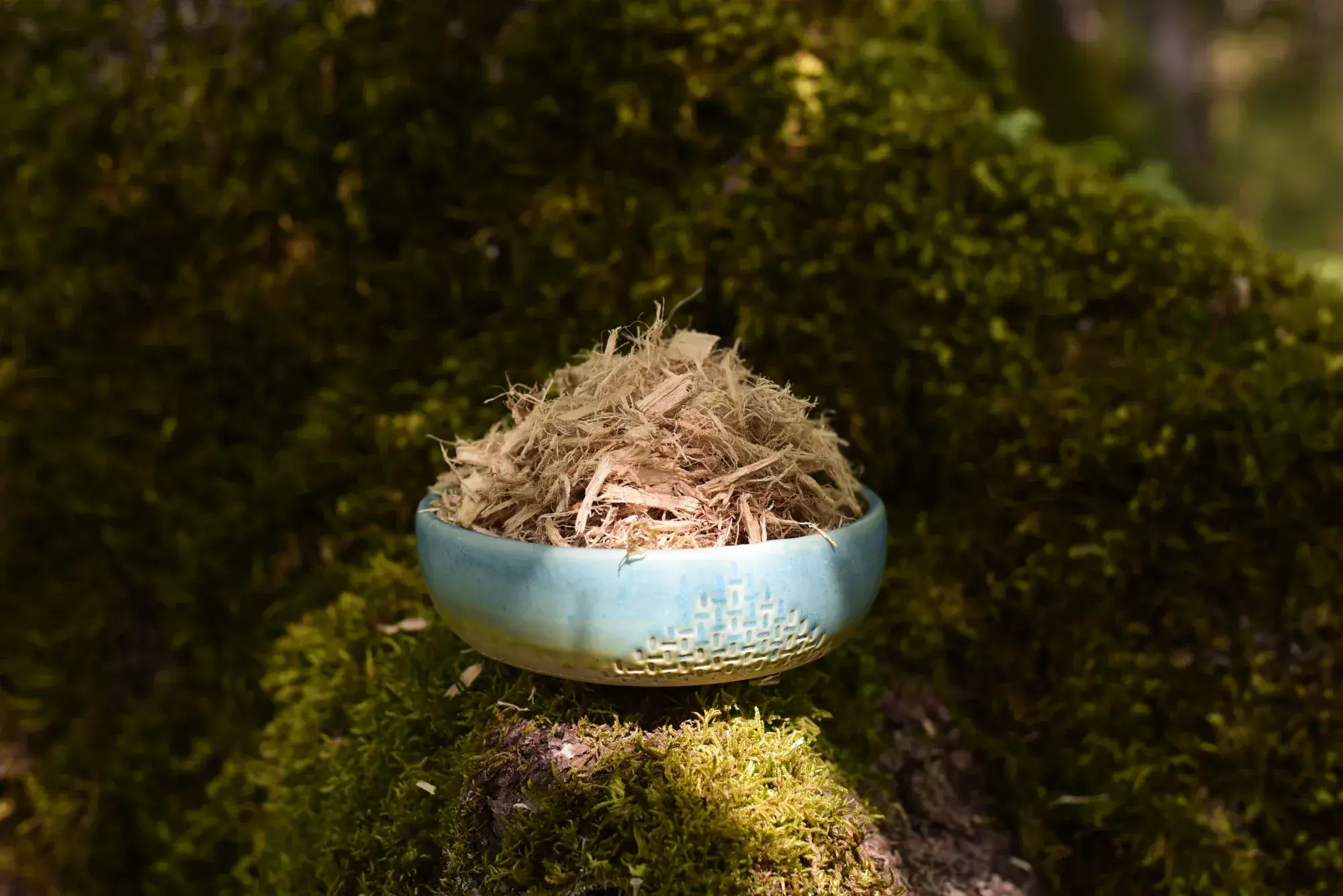
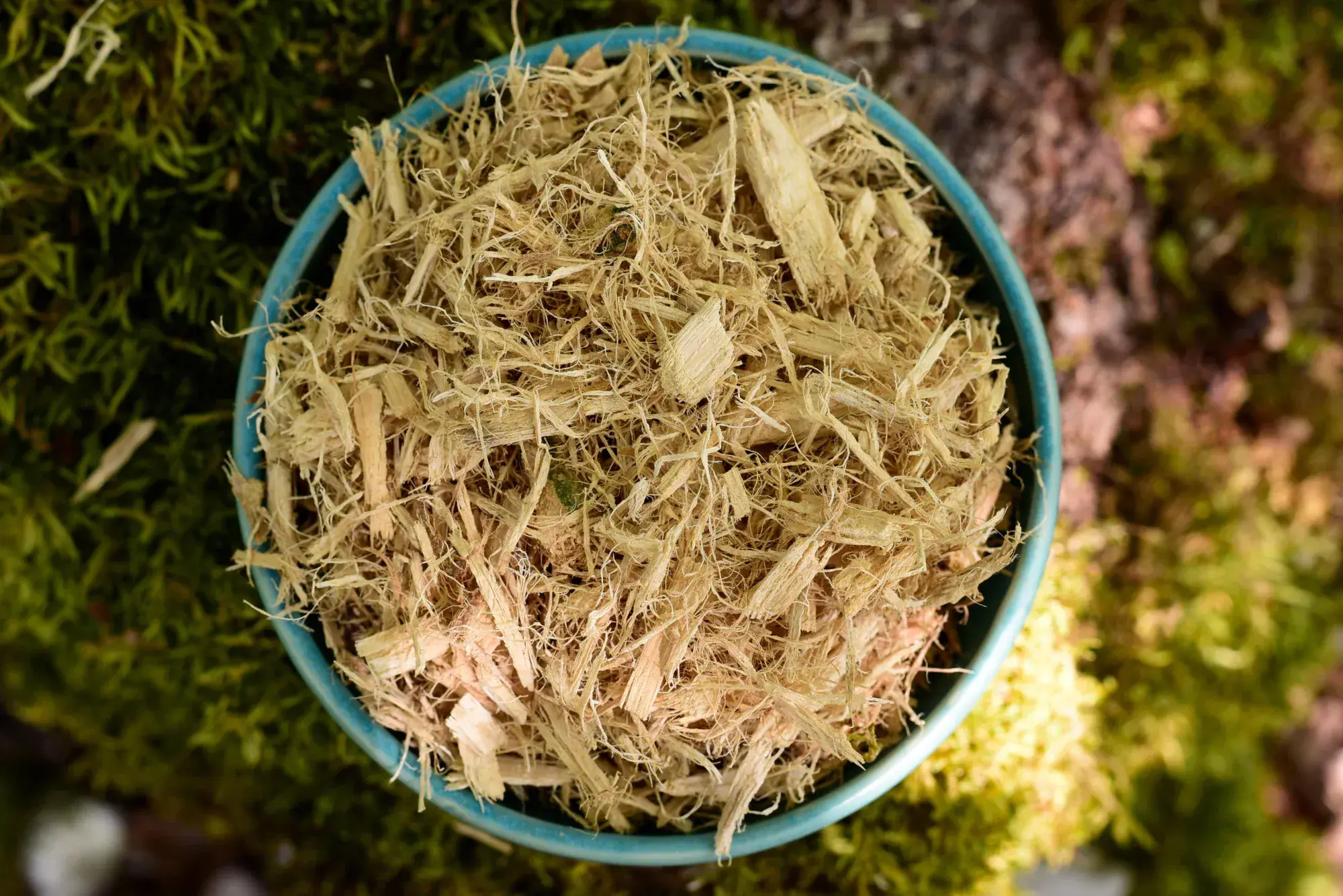
Mulungu is the bark of Erythrina mulungu, a coral tree of the Fabaceae family native to Brazil and Bolivia. In Brazilian folk medicine, he has been revered for several centuries as guardian of deep rest and inner calm. INFUSE offers him as crushed bark for the evening decoction.
What is mulungu traditionally used for?
In Brazilian folk herbalism, the raizeiros and benzedeiras use him in evening decoction to soften the intensity of agitated nights. He is also held as an ally of dream time.
How do I prepare mulungu?
Mulungu is prepared as a decoction, never as a simple infusion — his bark is hard and requires simmering. Count one tablespoon of crushed bark for 250 ml of water, bring to simmer and let cook 15 to 20 minutes, then strain. To savour warm, in the evening.
Does mulungu favour sleep?
It is precisely his oldest use. Brazilian tradition holds mulungu as an evening ally, drunk about thirty minutes before bedtime to soften frayed nerves. INFUSE formulates no medical promise — the plant invites rest, he does not decree it.
Does mulungu provoke dreams?
Some traditions consider him a protector of the dream realms. At high dose, vivid dreams, sometimes heavy, are reported — this is one of the reasons use is held in short cures rather than continuously.
What are the precautions with mulungu?
Mulungu is contraindicated during pregnancy and breastfeeding. His soothing effect invites not driving or operating machinery after intake. Caution in case of hypotension or use of antihypertensives, sedatives, antidepressants or alcohol — ask for advice before combining. INFUSE uses only the bark, never the seeds (reputed toxic).
How long can mulungu be taken?
Tradition and modern use converge on short cures — 4 to 6 weeks at maximum, followed by a pause of several weeks. This cyclic rhythm respects his nature.
Where does INFUSE's mulungu come from?
Our mulungu is a crushed bark of Amazonian origin (Brazil), dried and ready for decoction.
Does mulungu help soothe anxiety?
In Brazilian folk medicine, mulungu is reputed to loosen tense nerves and soften inner agitation; the raizeiros use him in the evening in this spirit. Research takes an interest in him as a lead toward new non-benzodiazepine calmatives, without anything being established in humans.
Where can I buy quality mulungu bark?
INFUSE offers mulungu as crushed bark of Amazonian origin (Brazil), ready for the evening decoction, with shipping to France/EU and worldwide. We use only the bark, never the seeds of the genus Erythrina, reputed toxic.
⊹ Chapter · Questions ⊹
Ask, answer, share.
One question, one answer — sometimes several voices. The community answers first; INFUSE steps in when it should.
- NiniAug 23
Combien de grammes d'écorce broyée doit-on laisser mijoter pour 250 ml d'eau ? Une cuillère à soupe est très variable et peu claire. Merci
- flordelparaisoestelarINFUSE teamAug 23
Bonjour Nini, Une cuillère à soupe correspond environ à 8 à 10g d’écorces de Mulungu. Vous pouvez ajuster cette dose en fonction de votre sensibilité personnelle et des effets recherchés. La dose « idéale » est quelque chose qui s’affine dans le temps et peut également évoluer:) Belle expérimentation à vous 🙏
- flordelparaisoestelarINFUSE teamAug 23
Bonjour Nini, Une cuillère à soupe correspond environ à 8 à 10g d’écorces de Mulungu. Vous pouvez ajuster cette dose en fonction de votre sensibilité personnelle et des effets recherchés. La dose « idéale » est quelque chose qui s’affine dans le temps et peut également évoluer:)
In depthbotany · phytochemistry · history
Botany — the coral tree of the dry season
Erythrina mulungu is a majestic tree that can reach some fifteen metres, native to the cerrado and caatinga ecoregions of Brazil and Bolivia. It belongs to the Fabaceae family (legumes), to the genus Erythrina — the coral trees, so named for the coral-red colour of their flowers (Schultes, Hofmann & Rätsch, Plants of the Gods, pp. 42-43). The genus name comes from the Greek erythros, "red."
Its signature is seasonal: at the end of the dry season, the tree sheds its leaves and covers itself in masses of coral-orange flowers shaped like a claw or a beak, pollinated by hummingbirds. When mulungu blooms in the sertão, it is said that rain is on its way — hence its reputation as a calendar-plant, almost a prophet-plant, in the Brazilian Nordeste.
Descriptive phytochemistry
The bark contains a family of erythrinian alkaloids specific to the genus Erythrina, which make up its pharmacological signature. Among the compounds identified are erysothrine, erysovine and erysodine, along with (+)-erythravine — isolated in 2006 and described as the principal anxiolytic agent — and (+)-11-α-hydroxy-erythravine. A minor indole alkaloid, hypaphorine, is also found. Naming these compounds is a matter of botanical description, not a promise of effect.
It should be noted that the seeds of Erythrina trees are reputed toxic, with a hypnotic or hallucinogenic effect reported for certain species (Rätsch & Müller-Ebeling, The Encyclopedia of Aphrodisiacs, pp. 457-458). INFUSE uses only the bark, never the seeds.
Mechanisms — what the studies report
The scientific literature describes a mode of action distinct from the classic GABAergic anxiolytics (benzodiazepines, kava): studies report that mulungu's alkaloids would act chiefly by inhibiting the nicotinic acetylcholine receptors, in particular the alpha4-beta2 subtype. Work in animals (the so-called elevated plus-maze and forced-swim tests) reports an anxiolytic-like effect without marked alteration of motor coordination at the doses studied, as well as an anticonvulsant effect for certain alkaloids in experimental models.
These results explain the research interest in mulungu as a lead toward a possible new class of non-benzodiazepine anxiolytics. These are leads described by research, not clinical effects established in humans — and nothing here constitutes medical advice.
History & long lineage
Mulungu bark has been referenced in Brazilian folk medicine since colonial times, that is more than four centuries. It belongs to the Brazilian sleep trinity (mulungu, passionflower, chamomile) that the raizeiros and benzedeiras prepare as an evening tisane, the maracujá da boa noite. Among the Tupi and the Guarani, the same bark served as both medicine and fishing poison (the saponins stunned the fish) — a continuum between nourishing and healing typical of indigenous knowledge.
Notes on safety & use
Mulungu is traditionally held to be hypotensive: caution in case of low blood pressure or antihypertensive treatment. Its sedative effect makes driving inadvisable after intake and calls for caution with sedatives, anxiolytics, antidepressants (notably MAOIs) and alcohol. It is to be avoided during pregnancy and breastfeeding, and stopped about two weeks before surgery. A tolerance can set in with prolonged use, and a slight flattening of mood is sometimes reported after several weeks — hence the rule of cures of 4 to 6 weeks maximum followed by a pause. As the bark is hard, only a long decoction (15-20 minutes) releases its principles; a simple infusion is not enough.