Shilajit, rock juice — conqueror of the Altai mountains
The Conqueror of Mountains, the black gold of the mountains: the resin born of rock over the centuries, from Shiva to the herders of the Altai, and the pure paste we offer.
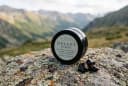 Växten i den här artikelnShilajit (mumijo) · Asphaltum (mineraloid resin)5.0(2)från 32,00 €Se →
The quiet kingdom — roots, polypores, mycelium. The resilience of the living, ready for every day.
Svensk översättning kommer snart – artikeln visas på ett annat språk.
The Conqueror of Mountains. The black gold of the mountains. Shilajit comes from the rock. It is a black, glossy, dense resin that seeps, in the warm months, from the cracks of Asia's high mountains: the Himalayas, the Karakoram, the Altai, the Tian Shan, the Caucasus. It forms over centuries, sometimes millennia, from mosses, lichens and alpine plants caught between layers of stone, pressed by glaciers, worked by frost and heat. What is scraped from the rock face is the essence of a thousand plants, reshaped by time.
The name as a signature
Every people that met it named it for what they saw.
Shilajit, in Sanskrit: shila, the rock, jit, the conqueror. The conqueror of mountains. The classical texts also say shilajatu, "born of the rock".
Brag-zhun, in Tibetan: brag, the rock, zhun, the juice. Rock juice. A dry, exact name: the mountain seeps, and the word says so.
Mumijo, in the Altai and in Russia, comes from the Persian mum, wax. The Greeks said asphaltum, for its tar-like texture. None of these names dresses it up; they all speak of the substance.
What the mountains tell
A legend from India tells that a king of the North, King Chandra Varma, withdrew to the Himalayas in the evening of his life. There he met Shiva, who thanked him for serving his kingdom well by handing him a substance drawn from the rock: shilajit. Since then, Shiva's devotees have honoured the resin as a gift from the god.
A more intimate variant: Shiva was meditating on the heights when Parvati came to surprise him. He wept. His tears touched the stone, sank into it, and the centuries turned them into resin. In some tellings it is still called the tears of Shiva.
A last story comes from the mountain villages. One summer, villagers saw great white monkeys licking the resin that ran down the rocks. They began to gather it in turn. The story keeps an idea as old as the pharmacopoeias: people learned plants by watching animals.
Three lineages
Ayurveda. The Charaka Samhita, the founding treatise of Ayurveda, devotes a long passage to shilajatu and places it among the rasayana, literally "the path of essence". The vaidyas told four varieties apart by colour, each bearing the name of a metal: Sauvarna gold, Rajat silver, Tamra copper, Lauh iron. Almost all shilajit on the market today is of the Lauh type, iron-black. The names of the metals gave rise to a stubborn legend, which our product notes correct in one line: Integrity note: no gold or silver in it, whatever the legend says — we name the real ones. The real ones are fulvic acid and a whole range of minerals: iron, magnesium, zinc, copper, selenium.
Tibet. Tibetan monks have for centuries been the specialists in purifying brag-zhun: dissolving it in spring water, filtering, distilling again and again, drying it in the sun on trays of wood or ceramic. Tradition has it that they pray over the resin for the weeks the work lasts.
The Altai. In the mountains of Siberia, on the border with Mongolia, mumijo has been gathered since ancient times. As the tradition is told, the high-pasture herders set out at the end of summer, when the heat makes the resin run. Before climbing, an offering to the spirits of the mountains. The rock face is scraped with a blade of wood or bone, never metal. And a share is always left in the crack.
Shilajit at the House
Our shilajit comes from wild harvest. Harvested from the sacred Altai mountains in Siberia, at the border of Mongolia, where the air and soil are still pure and untouched.
- A pure paste, undiluted, unstandardised, with no additives.
- Laboratory-tested in Russia for heavy metals.
- In a 30 g glass jar: the resin dislikes direct light and heat. The jar lasts more than two months of daily use.
In the cup
The first sip is mineral, earthy, slightly bitter, almost salty. In hot water the bit of resin melts slowly and darkens the cup to a deep brown, nearly black.
At the House: a grain (≈ 400 mg) in hot water, in the morning on an empty stomach. A pea-sized piece, taken with a wooden or ceramic spatula: fulvic acid reacts with metals. Dissolve it in hot water, never boiling, or in tea, milk or plant milk; it also melts in cold water. Tradition adds a little honey or ghee. For the first few days, half a piece is enough while you get acquainted.
Ayurveda takes it in courses of one to three months, with breaks between them. These are guidelines for use.
Extremely easy to use, simply dissolve a small piece in warm water or tea and let the wisdom of the ancient mountains infuse in your being.
Recognising a pure resin
Three traditional checks, to do at home. In cold water, the resin dissolves completely into a translucent amber-brown, with no sediment. Under gentle heat, it softens instead of hardening or burning. In the mouth, it is earthy, bitter, mineral. These tests give a first idea; the real guarantee remains laboratory testing for heavy metals, batch by batch.
Precautions
- Quality: only use shilajit that has been purified and tested. Raw resin can contain heavy metals, mycotoxins and soil debris.
- Haemochromatosis or iron overload: avoid, shilajit contains iron. The same caution with iron supplements.
- Gout, hyperuricaemia: caution, it may raise uric acid.
- Pregnancy, breastfeeding, children: avoid, there is not enough data.
- Anticoagulants, diabetes or thyroid medication: ask for medical advice before use.
- History of heavy-metal poisoning: ask for medical advice, even with a purified resin.
- Beyond the usual amounts, digestive discomfort, restlessness or dizziness have been reported. Keep to a small piece.
Store in its glass jar, away from moisture and heat.
Pure shilajit paste, wild-harvested in the Altai mountains of Siberia. Undiluted, unstandardised, laboratory-tested in Russia for heavy metals. A 30 g glass jar, more than two months of daily use.
Discover INFUSE shilajit →Sources
- Charaka Samhita, Chikitsa Sthana: shilajatu among the rasayana.
- David Winston and Steven Maimes, Adaptogens, 2007.
- E. Wilson et al., "Review on shilajit used in traditional Indian medicine", Journal of Ethnopharmacology, 2011.
- Our supplier's sheet: Altai origin, heavy-metal testing in a laboratory in Russia.
 5.0(2)från 32,00 €Se →
Få vårt veckobrev.
Har du också en berättelse att lämna i Skogen?
Dela en berättelse →Det som den här läsningen öppnade
Bli den första rösten. Varje ord läses igenom innan det ansluter till läsningen.
Logga in för att dela det som den här läsningen öppnade i dig.
Logga in →