Cat's Claw — the vine between worlds: 2000 Asháninka years and modern pharmacology
The vine has claws — not to attack, but to climb. Uncaria tomentosa's curved hooks are the exact image of its teaching: one does not rise alone. 2000 years of Asháninka use, 80 generations of transmission. Modern pharmacology is only confirming what the rainforest already knew.
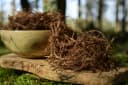 이 글에 나오는 식물캣츠클로 (Uncaria tomentosa) · Uncaria tomentosa4.9(9)€6.86부터보기 →
The master plants, approached with devotion — what they teach when we let them be what they are.
한국어 번역을 준비하고 있어요. 이 글은 지금 다른 언어로 보여 드려요.
The vine has claws — not to attack. To climb. These curved hooks at the base of each leaf, which cling to the trunks of support trees to allow Uncaria tomentosa to reach the canopy — this is the exact image of what this plant teaches: one does not rise alone, one rises by leaning on what is greater. The Asháninka have read this in the very biology of the plant, and have made it the central metaphor of their cosmology around it.
2000 years of continuous use. It is one of the longest documented durations in global ethnobotany. 80 generations of observation, transmission, refinement. For the Asháninka, Cat's Claw is one of their most sacred plants — not despite its pharmacological power, but because of it. The two inseparable.
The Asháninka: plant of the entire life
The Asháninka tradition is remarkable for its comprehensiveness: Cat's Claw is used at all ages and stages of life. At birth: postpartum recovery for the mother, immune support for the newborn. In childhood: general tonic. In adulthood: strength at work, fertility, healing of deep wounds. In old age: joint pain, vitality, accompaniment of cancer, dignity in death. This spectrum of use — from cradle to last breath — is the signature of a fundamental, not specialized, plant.
The Asháninka harvesting protocol is a model of ecological ethics: only mature vines are harvested, never killing the plant — only the inner bark is carefully taken. The harvest is accompanied by prayer and tobacco offering. Only certain elders are authorized to harvest the most powerful vines. This ethic now faces international commercial pressure.
Selective Immunomodulation: The Difference That Changes Everything
The systematic review PMC 2024 on the immunomodulatory and anti-inflammatory activity of Cat's Claw (meta-analysis) confirms a remarkable specificity: decrease in IL-6 and NF-κB (key markers of chronic inflammation) without modification of IL-1, IL-10, or TNF-α. Increase in phagocytic activity and lymphocyte proliferation. No immunosuppression.
This selectivity is pharmacologically rare. Most immune-stimulating plants act globally — which can be problematic for individuals already in a state of immune hyperactivity. Cat's Claw regulates with precision. Other documented effects: stimulation of DNA repair, antiviral activity (HSV, RSV, chickenpox in vitro), accelerated healing, anti-inflammatory (comparable to NSAIDs in certain preclinical models). Clinically: reduction of joint pain in knee osteoarthritis in 1 week, improvement in quality of life in cancer palliative care.
POA vs TOA: why chemotype matters
The discovery by Klaus Keplinger in the 1980s-90s revealed two botanically distinct chemotypes: POA (pentacyclic oxindole alkaloids) and TOA (tetracyclic oxindole alkaloids). The POA chemotype is the one the Asháninka tradition has used for 2000 years — it carries selective immunomodulation. The TOA chemotype could antagonize the beneficial effects of the POA. The problem: modern commercial sources do not always distinguish between chemotypes, which may explain significant variability in effect from one product to another.
INFUSE uses certified organic Cat's Claw from Peru, harvested by rural communities following ethical protocols.
Preparing Cat's Claw: the long decoction that extracts the alkaloids
The classic method takes time — it is in the long extraction that the medicine resides. 5-10 g of inner bark in 500 ml of water, simmer for 1 to 3 hours (alkaloids require a prolonged extraction that standard infusion does not allow). Strain. Drink 2-3 cups per day in a 21-day regimen for full effect. Earthy taste, slightly bitter, not unpleasant.
The Asháninka spiritual tradition also includes cold infusion (soaking for 24 hours, drunk on an empty stomach) for ritual 'cleansing'. INFUSE recommended regimen: 21 consecutive days — then a break of several weeks. The Cat's Claw + Reishi combination (Cat's Claw decoction in the morning, Reishi double extraction at any time) is the reference immunomodulatory protocol of the INFUSE form.
4.9(9)€6.86부터보기 →
매주 보내는 레터를 받아 보세요.
숲에 함께 남기고 싶은 이야기가 있나요?
이야기 나누기 →Cat's Claw — the vine between worlds: 2000 Asháninka years and modern pharmacology. ... INFUSE honours this plant within its living lineage — the body of knowledge that surrounds it, not just the active compounds. We share what tradition and contemporary research have observed, without medical claims or surclaim.