Reishi, the mushroom of immortality
The lingzhi of the Taoists, the mannentake of Japan: the tradition of reishi, from Magu to the edict of 1004, and what we offer, as wild Siberian slices or a 15:1 extract.
 Tämän artikkelin kasviReishi · Ganoderma lucidum4.4(20)alk. 9,00 €Katso →
The quiet kingdom — roots, polypores, mycelium. The resilience of the living, ready for every day.
Suomenkielinen käännös on tulossa – tämä artikkeli näytetään toisella kielellä.
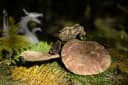
Reishi is a polypore, Ganoderma lucidum, that grows on hardwoods: oak, maple, alder, beech. Its red-brown cap shines like lacquer and opens like a fan. It is so hard, almost woody, that nobody eats it as it is: it is simmered for a long time, or extracted.
The name as a signature
Lingzhi (靈芝), in Chinese. Ling is the subtle spirit, the invisible at work; it is also the character used for mediums. Zhi is the mushroom. Japanese keeps the same characters, read reishi, and also calls it mannentake (万年茸), "the ten-thousand-year mushroom". In Korean it is yeongji.
The Chinese classics describe six lingzhi of different colours, each tied to an element: red for Fire, blue-green for Wood, white for Metal, yellow for Earth, black for Water, and a sixth one, purple. Almost all reishi on the market today is red reishi.
The plant of the immortals
The Shennong Ben Cao Jing, a materia medica of the Han era attributed to the mythical emperor Shennong, the "Divine Farmer", places lingzhi in its highest class, shang pin: the substances held safe for long use. The Taoists made it the plant of the xian immortals and tied it to the Three Treasures: jing, essence, qi, breath, shen, spirit.
Legend says the goddess Magu, the "Hemp Maiden", became immortal by drinking a reishi wine under Emperor Huan (146-167). She is painted young, a basket of peaches in her hand and a deer at her side, and she is invoked on grandmothers' birthdays. In Taoist imagery, Shou Lao, the god of long life, and the Eight Immortals hold reishi in their hands. Taoist temples were called "houses of mushrooms".
Worth more than gold
In imperial China, wild reishi was worth more than its weight in gold, and the court kept it for itself. Tradition says that in the year 1004 an imperial edict ordered every wild reishi found in the Empire to be brought to the palace, like a strategic metal.
In Japan, the Nihon Shoki (720) already mentions it, and Buddhist monasteries grew it to keep company with the calm of meditation. Reishi stayed rare for two thousand years. Japanese and Chinese researchers worked out how to cultivate it in the early 1970s: since then anyone can drink it, and the wild one remains rare.
Reishi at the House
We offer two forms, and they do not share the same origin.
- The dried slices (20 g, 50 g): reishi wild-harvested in Siberia, in the depth of winter, in forests far from human activity. Whole fruiting body, no organic label.
- The 15:1 powdered extract (30 g): reishi cultivated in China, fruiting body only, no mycelium or filler, dual-extracted with water and alcohol, from a certified organic supply chain. Declared contents: at least 20% beta-glucans and 4% triterpenes.
Why two extractions: beta-glucans dissolve in hot water, triterpenes only in alcohol. A plain tea leaves the latter in the mushroom.
Taste and gesture
Reishi is earthy and deeply bitter; in the Chinese reading, the more bitter, the more esteemed. Tradition softens it with honey, or pairs it with liquorice, jujube and goji berries.
- The slice decoction: 5 to 10 g in a litre of water, at a gentle simmer, never boiling, for two to three hours, until reduced by half. Strain and drink warm. The slices are so woody that they can be simmered again several times.
- The extract: about 0.5 g in a warm drink, once or twice a day.
Tradition likes the decoction in the morning; others prefer it in the evening. It is taken for one to three weeks, then paused. These are markers of use.
The grandmother of mushrooms
Herbalists today call it "the grandmother of mushrooms": old, slow, bitter, built over years before it fruits. Robin Rose Bennett speaks of it as the plant for people who carry too much. It is said to keep company at thresholds, endings, breaks, changes of season in a life: it hurries nothing. We attribute no effect to it; we keep the image, which says the slowness of the gesture well.
Precautions
- Known mushroom allergy: a small amount the first time.
- Anticoagulants (warfarin, heparin, aspirin): medical advice first. Stop about two weeks before surgery.
- Blood pressure medication: talk to your doctor.
- Organ transplant, autoimmune disease, immunosuppressants: avoid without medical advice.
- Pregnancy and breastfeeding: avoid, there is not enough data.
When in doubt, your doctor before the mushroom.
As thin slices, wild-harvested in Siberia in the depth of winter. As a 15:1 fruiting-body extract, dual water and alcohol extraction, certified organic supply chain, at least 20% beta-glucans and 4% triterpenes declared.
Discover INFUSE reishi →Sources
- Shennong Ben Cao Jing (Han era): lingzhi among the shang pin.
- Nihon Shoki (720).
- Robin Rose Bennett, The Gift of Healing Herbs.
- Our suppliers' technical sheets: 15:1 reishi extract, extraction method and declared contents.
 4.4(20)alk. 9,00 €Katso →
Tilaa viikon kirjeemme.
Onko sinullakin kertomus jätettäväksi Metsään?
Jaa kertomus →Mitä tämä lukeminen avasi
Ole ensimmäinen ääni. Jokainen sana luetaan ennen kuin se liittyy tähän tekstiin.
Kirjaudu sisään jakaaksesi, mitä tämä lukeminen avasi sinussa.
Kirjaudu sisään →