Rhodiola rosea: history, northern traditions and botany of roseroot
The golden root, a plant of all extremes: from Dioscorides to the Vikings, from the Golden Mountains of the Altai to our morning decoction, the story of Rhodiola rosea and the way we drink it at the House.
 Växten i den här artikelnRosenrot (Rhodiola rosea) · Rhodiola rosea5.0(33)från 12,00 €Se →
The quiet kingdom — roots, polypores, mycelium. The resilience of the living, ready for every day.
Svensk översättning kommer snart – artikeln visas på ett annat språk.
Rhodiola, the golden root, is a plant of all extremes. It loves the harshest climates. From the heights of the Altai to the plains of northern Alaska and Siberia, it grows in the heart of the coldest places on Earth, exposed all the while to intense sunlight. It is the source of incredible legends.
Roseroot
Rhodiola rosea is a succulent of the Crassulaceae, the family of stonecrops and houseleeks. Its stems carry fleshy, blue-green leaves and, in summer, a head of small yellow flowers; male and female plants are separate. Underground lies a thick, knotted rootstock. Cut fresh, it smells of roses.
Hence its names: roseroot in English, rosenrot in Swedish and Norwegian, and the scientific name Linnaeus gave it in 1753, from the Greek rhodon, the rose. It is also found under the old name Sedum rosea, rose stonecrop.
It holds on where few plants do: sea-beaten cliffs in Norway, Iceland and Scotland, scree in the Alps, the Pyrenees and the Carpathians, the slopes of the Altai, the tundra of Siberia, Alaska and Canada. In the Far North it comes right down to the water's edge; further south, it climbs high into the mountains.
A golden root, and names by the dozen
In Russia it is called zolotoy koren, the golden root, for the colour of its dried rootstock and the price once paid for it. In China, hóng jǐng tiān (红景天); in Tibetan medicine, solo marpo. In English it is also arctic root.
Its heartland bears the same metal. Altai comes from the Turkic-Mongolian word for gold: the Altai Republic is the Golden Mountains, and there the golden root has been revered since time immemorial.
What the peoples tell
Greece. The golden root is mentioned by the Greek physician Dioscorides as early as the first century AD, under the name rhodia riza, the rose root. An older legend has it born of the blood of Prometheus. In the Argonautica of Apollonius of Rhodes, Medea gathers in the Caucasus a plant sprung from the drops that fell from the chained Titan; its cut root looks like fresh flesh. From it she makes the charm Jason rubs on himself before facing the fire-breathing bulls. Some herbalists recognise rhodiola in it.
The Vikings. The Vikings regarded rhodiola as a legendary plant, sacred to the Gods. In Sweden, it is said they took it with them on their long sea crossings.
Imperial China. Tradition reports that emperors of China sent expeditions to Siberia to bring back the golden root.
The Altai and Siberia. In the Golden Mountains, a saying goes that whoever sets out in search of the golden root will live two centuries, with a great deal of luck and iron health. In Siberia, a bouquet of roots is still given to couples before their wedding. For centuries, it is also said, Siberians carried the root down old trails to the Caucasus, to trade it for Georgian wines, fruit, garlic and honey.
The botanists of Tomsk
In the twentieth century, the golden root entered Soviet laboratories. In 1961 the botanist G. V. Krylov led an expedition into the Altai and mapped the places where it grows. In Tomsk, the pharmacologist A. S. Saratikov devoted a large part of his career to it; in 1987, with E. A. Krasnov, he drew a whole book from it, Rhodiola rosea, a valuable medicinal plant (golden root). This work is often said to have been secret. A good part of it was in fact published, in Russian, and simply went little read outside the Soviet Union. We tell this story in our page on adaptogenesis.
Rhodiola at the House
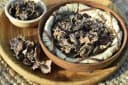
We are happy to have found this Rhodiola of excellent quality. A new treasure, with delicate & delicious aromas. INFUSE rhodiola is Rhodiola rosea root in dried pieces, from Eastern Europe. Its taste is earthy, lightly floral; the decoction turns amber and keeps, on the nose, a trace of roses.
The gesture: the morning decoction
- One tablespoon of root pieces, about 5 g, in a litre of water.
- Simmer gently for about twenty minutes, until the decoction is coloured and fragrant.
- Strain, and drink one to two cups over the day, preferably in the morning. A little honey, if you feel like it.
- The same pieces can be used up to four times, simmering a little longer each time.
The Altai tradition drinks it this way over a course of seven to twenty-one consecutive days, at a set hour, then takes a break. These are markers of use, which everyone tunes to their own season.
Precautions
- Pregnancy and breastfeeding: not enough data; avoid without medical advice.
- Blood pressure or diabetes medication: talk to your doctor first.
- Autoimmune disease: medical advice first.
- Bipolar disorder, antidepressants: avoid without medical advice.
- Coffee, strong tea and other stimulants: take care when combining.
- Best drunk in the morning or at midday.
When in doubt, your doctor before the root.
Rhodiola rosea root in dried pieces, to simmer in the morning, over a course of seven to twenty-one days.
Discover INFUSE rhodiola →Sources
- Dioscorides, De materia medica (first century): the rhodia riza.
- Apollonius of Rhodes, Argonautica, Book III: the plant born of the blood of Prometheus.
- Carl Linnaeus, Species Plantarum (1753).
- R. P. Brown, P. L. Gerbarg, Z. Ramazanov, "Rhodiola rosea: a phytomedicinal overview", HerbalGram 56 (2002): northern traditions, Chinese expeditions, the 1961 Krylov expedition.
- A. S. Saratikov, E. A. Krasnov, Rhodiola rosea (golden root), Tomsk University (1987).
- INFUSE product sheet: form, origin, preparation and precautions.
 5.0(33)från 12,00 €Se →
Få vårt veckobrev.
Har du också en berättelse att lämna i Skogen?
Dela en berättelse →Det som den här läsningen öppnade
Bli den första rösten. Varje ord läses igenom innan det ansluter till läsningen.
Logga in för att dela det som den här läsningen öppnade i dig.
Logga in →